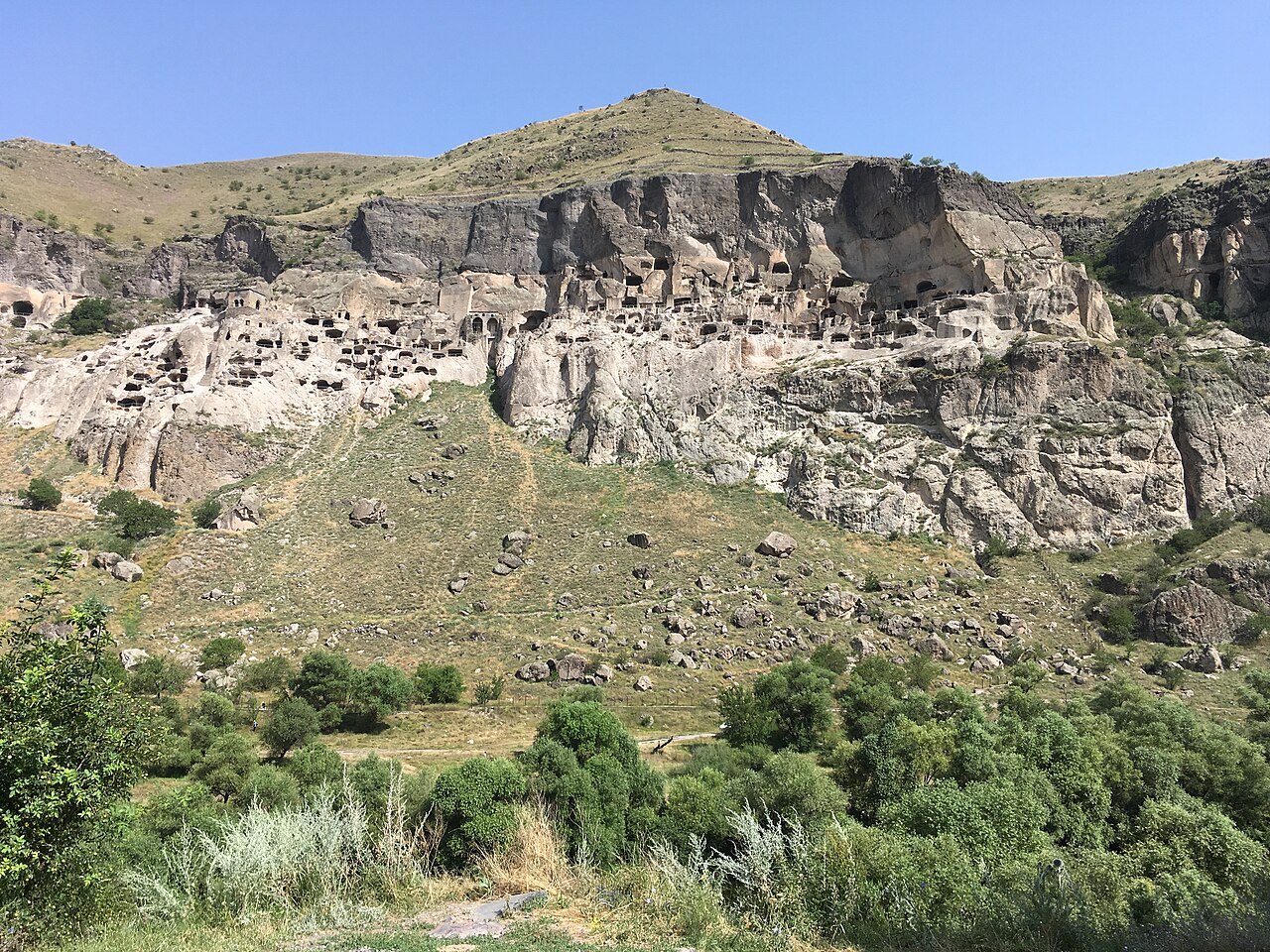
Carved straight into a cliff above the Mtkvari River in southern Georgia, Vardzia is one of the country’s most extraordinary sights — a 12th-century cave monastery city with hundreds of rooms hollowed out over roughly a dozen tiers of rock. It was commissioned under King Giorgi III and completed during the reign of his daughter, the legendary Queen Tamar, whose lifetime portrait still survives in frescoes deep inside the complex. The catch is distance: Vardzia sits about four to five hours from the capital, so a visit takes real planning. This guide covers everything you need to know before you go.
Vardzia at a glance
- What it is: A cave monastery city carved into a cliff face in the 12th century
- Where: Near Aspindza, Samtskhe-Javakheti region, southern Georgia
- Distance from Tbilisi: Around 270 km by road, a 4–5 hour drive each way
- Entry fee: 15–17 GEL for adults, plus 15 GEL for an optional audio guide
- Opening hours: Roughly 10am–7pm, varying by season
- Time needed on site: 2–3 hours to explore properly
- Best done as: A long day tour or, better, an overnight trip
What is Vardzia?
Vardzia began under King Giorgi III in the mid-12th century as a fortified refuge — a hidden network of caves where the local population could shelter from invaders. His daughter Queen Tamar, one of the most celebrated rulers in Georgian history, transformed it into something far grander: a self-sufficient monastic city with chapels, wine cellars, bakeries, stables and living quarters, all cut from the living rock.
At its peak the complex is thought to have stretched across as many as 19 levels with thousands of rooms. Today around 640 chambers survive across roughly 13 tiers, running some 500 metres along the cliff. The reason so much is now exposed is a catastrophe: a powerful earthquake in 1283 sheared away the outer face of the cliff, opening rooms that had once been safely hidden inside the mountain. According to the Wander-Lush visitor’s guide, the monastery was largely abandoned by the 16th century, and monks only returned in 1988.
The spiritual heart of the site is the Church of the Dormition, whose 12th-century frescoes include a life-size portrait of Queen Tamar painted during her lifetime — one of only a handful of authentic images of her that exist. The name “Vardzia” itself comes from a legend: as a girl, Tamar became lost in the caves while hunting, and when her uncle called out she answered “Aq var, dzia” — “I am here, uncle.”
How to get to Vardzia from Tbilisi
There is no getting around it: Vardzia is remote. Whichever way you travel, you route through the regional hub of Akhaltsikhe first, then continue south along the Mtkvari valley.
By organised tour
The easiest option is a day tour from Tbilisi, and dozens of operators run them — usually combining Vardzia with Rabati Castle and Borjomi. Expect a long day: these tours typically cover around 495 km round trip and can run close to 15 hours door to door. A tour removes the logistics but leaves little slack in the schedule.
By private driver
Hiring a driver for the day gives you flexibility to linger at Vardzia and set your own pace. It costs more than a group tour but is worth it if you want the frescoes and the tunnel without being rushed back to the minibus.
By marshrutka (shared minibus)
Budget travellers can do it in stages. Marshrutkas to Akhaltsikhe leave Tbilisi’s Didube station every 40–60 minutes from around 8am, take about three hours and cost roughly 10 GEL. From Akhaltsikhe, a handful of daily minibuses continue to Vardzia (about an hour, around 5 GEL). This works but demands careful attention to return times — miss the last one back and you are stuck.
By self-drive
Driving yourself is a fine option in this part of Georgia, where roads are generally decent and traffic light once you leave Tbilisi. If you are weighing it up, see our guide to renting a car in Georgia for what to expect on the road.
Entry fee, hours and what to see
Admission is 15–17 GEL for adults, with an optional audio guide for another 15 GEL that is well worth it given how little on-site signage there is. Opening hours run roughly from 10am to 7pm, though they shorten in the colder months, so aim to arrive by early afternoon at the latest. Full details are listed on the official Visit Samtskhe-Javakheti tourism site.
Give yourself two to three hours to explore. A network of stepped paths and passages links the tiers, and the highlight for many visitors is a dark, sloping tunnel cut through the rock that once served as a secret escape route and water supply — bring a phone torch, as it is genuinely dim inside. Don’t miss the bell tower, the wine-making chambers and, above all, the frescoed Church of the Dormition.
Combining Vardzia with Rabati Castle and Borjomi
Because the drive is so long, most people fold two other stops into the trip, and they pair naturally along the route.
- Rabati Castle (Akhaltsikhe): A heavily restored 13th-century fortress complex covering seven hectares, with a church, mosque, minaret and synagogue reflecting the region’s layered history. It sits right on the way to Vardzia.
- Borjomi: A leafy spa town famous for its mineral water. The spring in the central park pours out water far stronger than the bottled version sold across Georgia.
This three-in-one loop is the standard packaged day trip, and it is a good use of the long drive — just know it makes for a very full day. For more ideas on structuring excursions, browse our roundup of day trips from Tbilisi.
Is a day trip too much?
Honestly? For many people, yes. A Vardzia day trip from Tbilisi means eight to ten hours of driving to spend two or three hours at the caves. It is doable, and thousands of visitors do exactly that, but you will spend most of your day in a vehicle and arrive back late and tired.
If your schedule allows, an overnight is the far better choice. Staying near Vardzia or in Akhaltsikhe lets you see the caves in softer morning light before the tour buses arrive, and turns a gruelling marathon into a relaxed two days. Travellers who have made the trip, including The Sandy Feet, consistently recommend giving Vardzia more than a rushed afternoon.
Best time to visit and what to bring
Late spring (May) and early autumn (September–October) are the sweet spots — mild temperatures, clear light and thinner crowds. Summer can be hot and exposed on the sun-baked cliff, while winter shortens the opening hours and can make the paths slippery.
Pack for a site that is essentially an open rock face:
- Sturdy, grippy footwear — the stone steps and passages are uneven
- Water and sun protection — there is little shade on the cliff
- A phone torch or small flashlight for the tunnel
- Modest clothing; women should carry a scarf to cover their hair for the church
- Cash in GEL for the entry fee and audio guide
Accommodation nearby
You have two main bases. A cluster of guesthouses and small hotels sits directly across the valley from the caves, offering the memorable experience of waking up with the monastery in view. Alternatively, the town of Akhaltsikhe — about an hour away — has a wider range of hotels and restaurants and works well if you are also visiting Rabati Castle. Either makes the trip vastly more comfortable than a same-day return to Tbilisi.
Once you have Vardzia under your belt, it pairs well with other multi-day escapes from the capital, such as a Kakheti wine tour in Georgia’s eastern vineyards.
Frequently asked questions
How far is Vardzia from Tbilisi?
Expect roughly 270 km each way — four to five hours behind the wheel. Every option funnels through the town of Akhaltsikhe before the final stretch south to the caves.
How much does it cost to enter Vardzia?
Adult tickets run 15 to 17 lari, and another 15 adds the audio guide — a smart buy given how little signage the site has. Pay in cash, since cards are not reliably accepted there.
Can you visit Vardzia as a day trip from Tbilisi?
It is possible, though punishing: the driving alone swallows most of the day and leaves only a short window at the caves. Tours soften the marathon by bundling in Rabati Castle and Borjomi, but sleeping over in Akhaltsikhe or opposite the cliff is the kinder plan.
Who built Vardzia?
Work started in the 1100s under King Giorgi III, and his daughter Queen Tamar later turned the fortified refuge into a full monastic city. A rare portrait of Tamar, painted while she was alive, still adorns the Church of the Dormition.
Last checked: July 2026. Fees, hours and transport schedules can change, so confirm current details before you travel.
Featured image: Shomroni (CC BY-SA 4.0) via Wikimedia Commons.

Leave a Reply