If you have one whole free day, spend it on Kazbegi. Half a day, spend it on Mtskheta. That is the short answer, and the rest of this page exists for everyone whose situation is messier: two days to fill, a tight budget, a dislike of early alarms, or a fixed idea about wine.
Ranking fifteen places against each other never made much sense anyway. One of them is a 25-minute ride, another is four hours of driving each way; they are not competing for the same day. So the list below is sorted by the only constraint that actually decides anything: how much time you can spare. Half a day. One full, comfortable day. And the long hauls that only work with a tour or an overnight.
First, the transport maths
Marshrutkas (shared minibuses) are absurdly cheap. From Didube station on the metro’s red line you can reach Mtskheta for about 2₾, Gori for 4–7₾, Borjomi for 10–15₾ and Stepantsminda (Kazbegi) for 15–20₾ — the Kazbegi ticket window was charging 20₾ in summer 2026, checked August 2026 against Wander-Lush’s Tbilisi to Kazbegi transport guide. The catch isn’t the price. Vans leave when full, drop you on the main road rather than at the sight, and won’t stop at a single viewpoint along the way.
One trap worth naming before anything else: Kakheti doesn’t run from Didube. Sighnaghi and Telavi vans leave from the Navtlughi lot beside Samgori metro, on the opposite side of the city, and every week someone burns an hour learning this at the wrong station. Our Didube marshrutka guide maps which station serves what, and how to find your van when not one sign is in English.
Group tours cost 40–80₾ per person for Kazbegi and 90–160₾ for Kakheti with tastings folded in. Good value, zero effort; the real price is 45 minutes per stop and a detour to a honey shop nobody asked for. A private driver runs 150–300₾ for the whole car, which beats everything for three or four people sharing — agree the route, the total, and every stop before you set off, because renegotiating at a viewpoint never goes your way.
Renting a car (80–120₾ a day for something small) buys total freedom and works well for Gori, Kakheti or Borjomi. It works badly for anywhere in this article’s final section, where the last stretch wants a 4×4, and Georgian highway driving takes a day to acclimatise to. If you’re hesitating, that’s your answer: take a driver.
Half a day spare
Two of the fifteen fit a spare morning, and neither needs planning beyond a metro ride or a Bolt. They also happen to bracket Georgian history rather neatly: the country’s oldest capital, and one of its strangest Soviet monuments.
Mtskheta and Jvari Monastery
Georgia’s ancient capital sits 20 km up the road: 25–35 minutes and about 2₾ by marshrutka from Didube, or 25–35₾ by Bolt straight to the cathedral door. Svetitskhoveli Cathedral, where Georgians believe Christ’s robe lies buried, anchors a compact UNESCO-listed old town you can cover in two unhurried hours, souvenir stalls, churchkhela strings and all. The town was Georgia’s capital for close to a thousand years, and it still functions as the country’s spiritual centre — expect weddings on weekends, incense on weekdays, and a scarf for shoulders in every season.
The complication is Jvari, the 6th-century church on the bluff above with the celebrated view over the meeting of two rivers. Nothing public goes up. Count on 15–25₾ for a taxi from town with waiting time, or fold both into a driver day. Timing matters more than transport here: tour buses own the cathedral square from late morning, so go for 9am or after 4pm. The full plan, including where to eat, is in our Mtskheta day trip guide.
Chronicle of Georgia and the Tbilisi Sea
Technically still inside the city, which is the point. Zurab Tsereteli’s colossal carved columns — kings below, Bible scenes above, the whole thing a sort of concrete Stonehenge — stand on a hill over the Tbilisi Sea reservoir, and most visitors never hear of it. There’s no direct public transport; a Bolt costs 12–18₾ each way and is genuinely the only sane approach.
Go the last hour before sunset, when the columns turn amber and the city starts switching its lights on below. In July and August locals swim at the reservoir’s beach clubs, so bring a towel and stretch the outing into an afternoon.
One full, comfortable day
This is the tier where most people should be shopping. Five very different days follow — high mountains, wine, ancient rock, spa forest, a glass bridge — and every one of them gets you back to your Tbilisi bed at a civilised hour without a 6am alarm.
Kazbegi, with Ananuri on the way
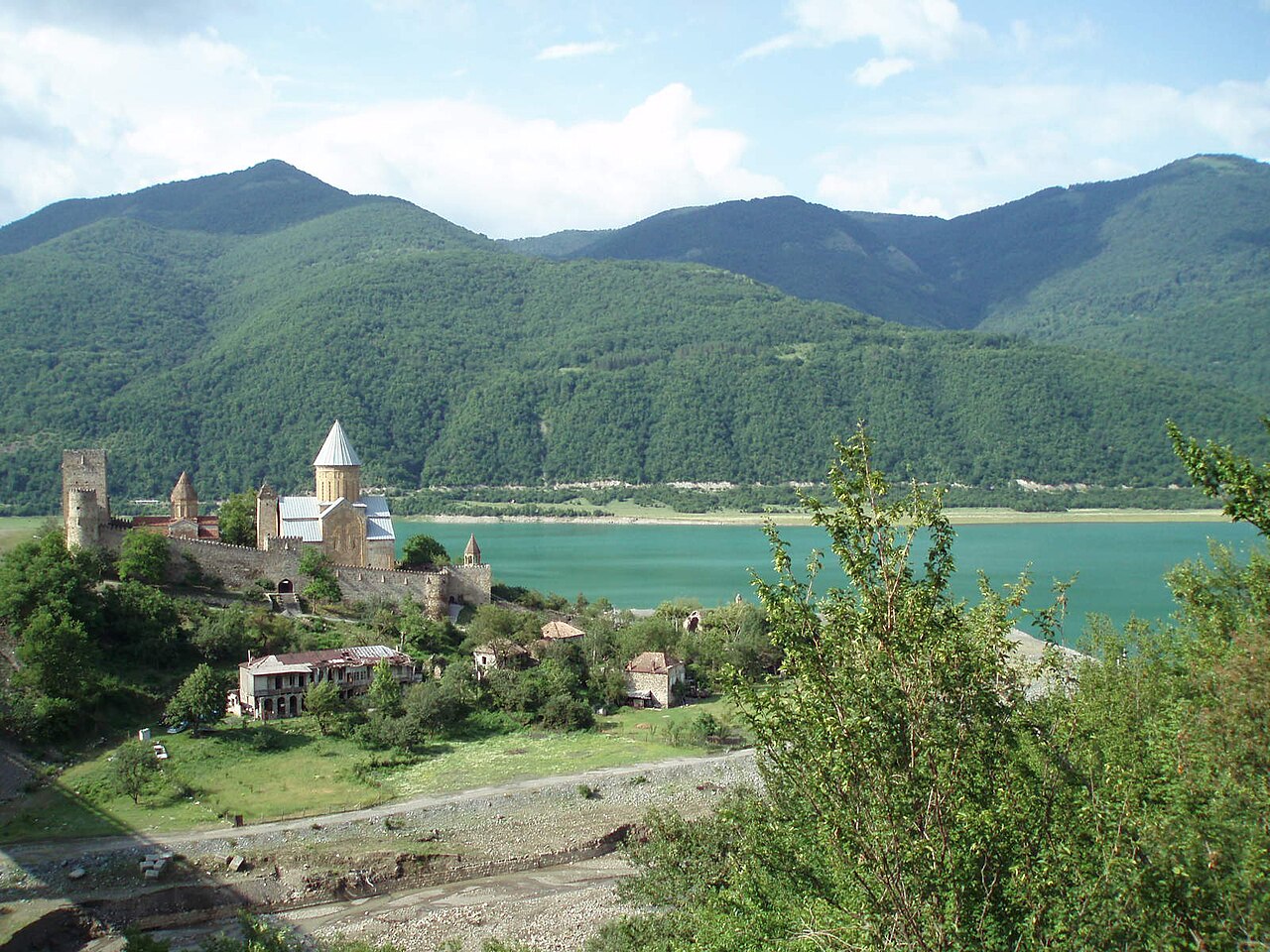
155 km north along the Georgian Military Highway, three hours plus each way, and worth every one of them. The road itself is half the trip: past the Ananuri fortress towers on the Zhinvali reservoir (a 45-minute stop, prettiest in spring while the water is high — nobody sensible builds a separate day around it), up through the Gudauri ski bowl, over the Jvari Pass, then down into Stepantsminda. Above the town, the 14th-century Gergeti Trinity Church holds its ridge at 2,170 m with the 5,047 m glaciated cone of Mount Kazbek filling the sky behind it.
Getting up to the church is its own decision. Local 4x4s charge about 25₾ per person return for the rutted track; the alternative is a 90-minute hike that starts steep and stays steep. The marshrutka (15–20₾ from Didube) is the cheapest way north but sails past every viewpoint, so a tour at 50–80₾ is the better spend on a first visit. One seasonal warning: from November to April the Jvari Pass closes without notice in heavy snow, sometimes for days, and clouds can swallow Kazbek entirely. Check the forecast for Stepantsminda, not Tbilisi — the two are 1,300 vertical metres apart and behave like different countries.
Our advice: if this is your only free day in Georgia, this is the trip. Not Kakheti, not Mtskheta. Wine cellars exist in other countries; the view from Gergeti doesn’t. Weather caveats, winter warnings and where to eat are in our Kazbegi day trip guide.
Kakheti wine country: Sighnaghi and Bodbe
Two hours east, Kakheti is where qvevri winemaking — fermentation in clay vessels buried to the neck — has carried on more or less unbroken for millennia, and the amber wines that come out of those vessels taste like nothing in a European supermarket. A day here means tastings at family cellars (15–40₾ a head), a lunch that overruns, and a slow loop of Sighnaghi’s walled hilltop lanes with the Alazani valley spread out below. Bodbe convent, burial place of St Nino, sits a couple of kilometres under the town and earns the detour; dress code is enforced, with wrap skirts and headscarves lent at the gate, and a steep path drops to her holy spring if you fancy a cold plunge among pilgrims. Telavi, deeper into the region, swaps Sighnaghi’s prettiness for working wineries and a giant 900-year-old plane tree; with one day you pick a side of the valley, not both.
Don’t drive yourself if you plan to taste. A group tour at 90–160₾ solves that; so does a driver at 200–320₾ for the car. And remember the station: Sighnaghi vans leave from Navtlughi by Samgori metro for 10–15₾, not from Didube. Which cellars deserve your lari is covered in our Kakheti wine tour guide.
Gori and Uplistsikhe together
These two only make sense as a pair. They sit 10 km apart, and each fills half a day on its own. Uplistsikhe is a town carved into a sandstone ridge above the Mtkvari, lived in from around the 1st millennium BC — halls, wine cellars, even a theatre, all cut from bare rock. Entry is 15₾ in season, about 7₾ in winter, and the stone has been polished glassy by three thousand years of footsteps, so wear shoes with grip.
Gori is Stalin’s birthplace. Its museum (around 15₾) presents his life with almost no critical distance: the death mask, the armoured railway carriage, barely a whisper of the Terror. Uncomfortable and fascinating in equal measure, and better with a guide since English signage is thin. Marshrutkas to Gori leave Didube every 20–30 minutes for 4–7₾; a Gori taxi to Uplistsikhe and back, waiting time included, is 30–40₾ if you fix the price first.
Borjomi
The spa town behind the green bottles on every supermarket shelf between Warsaw and Tashkent. The central park costs 5₾, the warm mineral water inside is free straight from the tap — it tastes aggressively of salt and sulphur, so sip before you fill a bottle — and the wooded gorge setting makes this the greenest, least strenuous full day on the list. Marshrutkas from Didube run 10–15₾ and take about two and a half hours; there’s also a slow, lovely 2₾ train, card payment only on board, for anyone who values the journey over the destination.
Inside the park, the Soviet-era cable car (15₾ each way) lifts you to a plateau with a small Ferris wheel and a long view down the gorge, and a 3 km walk past the promenade ends at open-air sulphur pools (5–10₾) in the forest. And no, Borjomi does not pair with Vardzia in a single day; the arithmetic on that is below.
Dashbashi Canyon
The engineered one. A diamond-shaped glass bridge hangs over a green gorge near Tsalka, two hours out, with a café pod dangling beneath the walkway and waterfall trails threading the canyon floor. Families love it, and it photographs superbly. Getting down to the waterfalls and back up again is a proper 40-minute stair workout, so allow more time than the bridge photos suggest.
Know the price before you commit: entry that used to sit near 30₾ has climbed to about 50₾ per adult, checked August 2026 against Vitis Travel’s 2026 visitor guide. Our take: at that money it’s a decent weekday outing and a poor swap for Kazbegi — summer weekend queues are real, and once you’ve crossed the bridge and seen the falls, you’ve seen it.
The long hauls: tour or overnight only
Everything from here on involves seven-plus hours in a vehicle if you insist on a same-day return. All three are worth seeing. None of them is worth seeing at that price if you have the flexibility to stay out overnight instead — and one of them can’t be day-tripped by public transport at all.
Vardzia, with Rabati Castle
A 12th-century cave city of hundreds of chambers cut into a cliff on Queen Tamar’s orders, then sliced open by an earthquake a century later so the whole honeycomb of tunnels, chapels and wine cellars now faces the valley open-sided, thirteen levels of it. A working church with 12th-century frescoes of Tamar herself survives at the centre, monks still live on site, and clambering through the passages is half the fun. It’s the most impressive historical site in this article and, at 210 km and 3.5–4 hours each way, the hardest to do honestly in a day. Entry is 15–17₾ plus 15₾ for the audio guide, which you’ll want because on-site signage explains almost nothing.
By marshrutka a same-day return is off the table: Didube to Akhaltsikhe takes about three hours (10₾), the scarce onward van to Vardzia another hour (5₾), and the return legs don’t line up. The plan that works is a night in Akhaltsikhe — see Rabati Castle in the evening, a heavily restored fortress with a mosque, a church and an Ottoman quarter inside one set of walls, polished to the edge of theme park but photogenic — then Vardzia at opening. Or book a long single-day tour and accept the 7am start. Staged logistics are in our Vardzia guide.
David Gareja
A 6th-century monastery colony dug into striped desert hills on the Azerbaijani border, and the strangest landscape within reach of Tbilisi. No marshrutka goes there. The seasonal Gareji Line shuttle (roughly late spring to the end of October) does the return run for 30–40₾, and organised tours start around 175₾ per person. As of summer 2026 the lower Lavra monastery is fully open, while the frescoed Udabno caves on the ridge above sit on disputed ground and close whenever the border guards decide they do — ask at the Lavra reception before hiking up, and check the current status in Wander-Lush’s David Gareja guide. There is no shade out there and no shop. Two litres of water minimum, and a hat you mean it with.
Martvili and Okatse canyons
Beautiful, subtropical, and 250 km away in Samegrelo. The boat glide through Martvili’s emerald slot and the cliffside walkway hanging over Okatse are worth seeing — from Kutaisi. From Tbilisi they cost eight hours in a vehicle for perhaps three hours of canyon, which is a bad trade however you slice it. If western Georgia is calling, give Kutaisi a night or two and do the canyons plus Prometheus Cave without the death march. The Martvili boat, incidentally, is a 20-minute glide and costs extra on top of entry; at Okatse the walkway sits a 2 km walk from the ticket office, another detail the eight-hour-drive crowd discovers too late.
Pairings that work, and the ones that don’t
Can you stack Mtskheta onto a Kazbegi day? Yes, and it’s the best combination going: Mtskheta sits just off the highway north, and most drivers will add an hour’s stop for little or nothing extra. Gori plus Uplistsikhe is the other natural pair. Sighnaghi plus Bodbe barely counts as a pairing at all, since they’re five minutes apart. Borjomi also pairs honestly with one thing: nothing. Treat it as a slow day, which is the whole point of a spa town.
Now the mistakes. Borjomi plus Vardzia plus Rabati in one marshrutka day is impossible — not hard, impossible; the driving legs alone outrun the daylight. Tour vans do sell that triple as a single day, and it delivers ten-plus hours in a seat with a walk-through of each stop. David Gareja plus a Kakheti tasting afternoon is another brochure special that leaves you 40 rushed minutes at each. And Kazbegi plus anything beyond Mtskheta or Ananuri simply doesn’t fit inside daylight.
Frequently asked questions
Which day trip from Tbilisi is best if I only have one day?
Kazbegi. The Georgian Military Highway plus Gergeti Trinity Church under Mount Kazbek is the strongest single day in the country, and a group tour at 50–80₾ makes it effortless. Pick Kakheti instead only if mountains leave you cold and wine doesn’t.
How much is the marshrutka from Tbilisi to Kazbegi in 2026?
Around 20₾ one way from the ticket window at Didube station, plus about 5₾ for an oversized bag. Vans follow a published schedule from about 8am, leave when full, and take 3 to 3.5 hours. Cash only, small notes.
Can I visit Vardzia in one day from Tbilisi?
Only with an organised tour or a private driver, a 7am start and a late return — public transport cannot get you there and back the same day. The better plan is a night in Akhaltsikhe, which adds Rabati Castle and halves the pain.
Do I need a tour for day trips from Tbilisi, or can I go independently?
Independently works fine for Mtskheta, Gori, Borjomi and Sighnaghi, which all have cheap direct marshrutkas. Book a tour or driver for David Gareja, Vardzia and the western canyons, where public transport is either missing or won’t bring you home before dark.
One last thing, because it undoes more day trips than any timetable: cash. Rural ticket desks, marshrutka drivers, the jeep men below Gergeti and half the roadside lunches on these routes take lari notes only, and small ones at that. Break your 100₾ notes at a Tbilisi supermarket the night before, and every trip on this page gets easier. Still choosing? Start with Kazbegi and work outward from there.
Featured image: DAVID HOLT from London, England (CC BY-SA 2.0) via Wikimedia Commons.

Leave a Reply