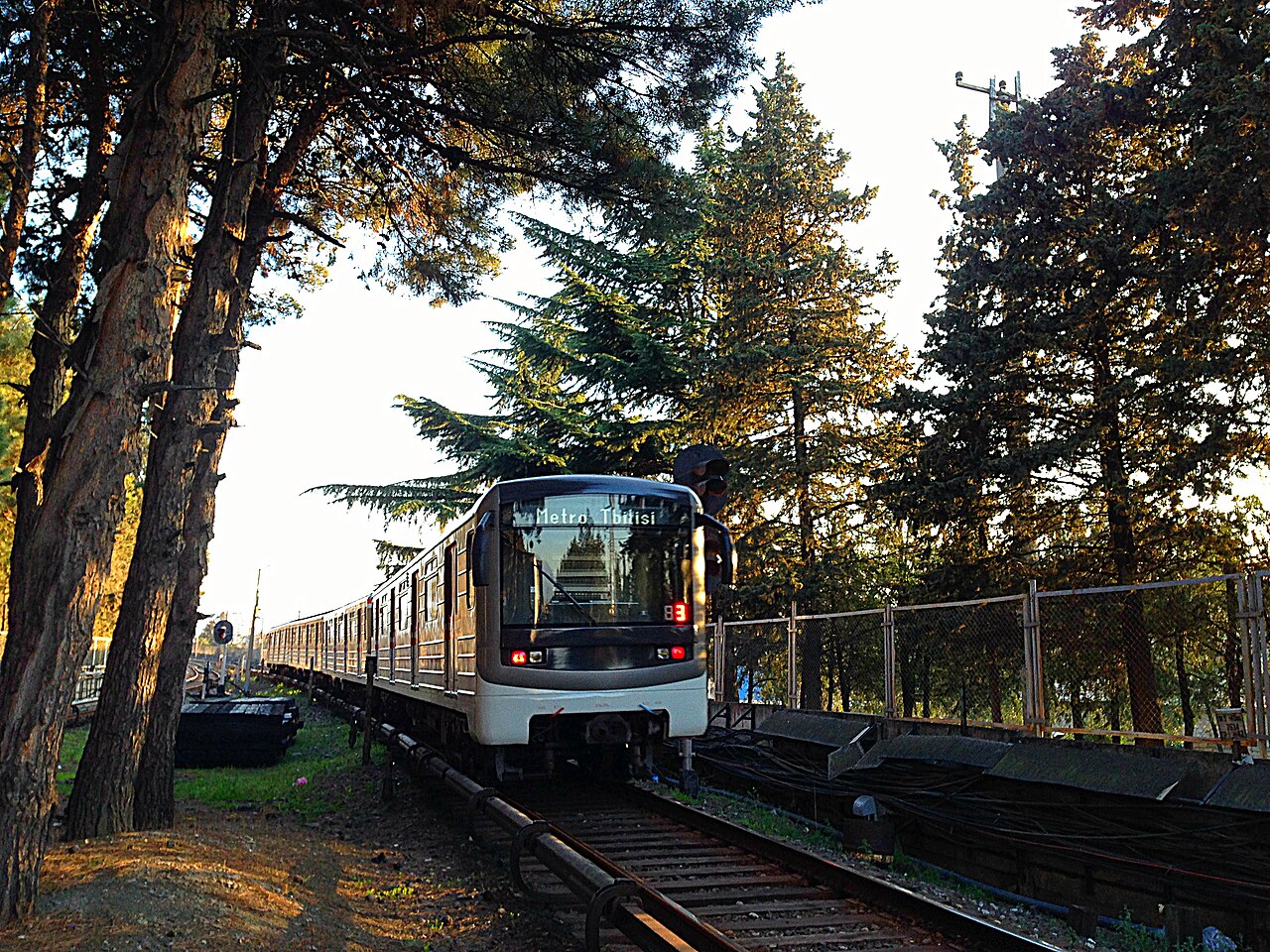
One decision shapes every journey you make here, and you make it in the arrivals hall: buy a 2₾ Metromoney card, or just tap the contactless bank card already in your wallet. Tap the bank card if you’re travelling alone for three or four days; buy the Metromoney if there are two or more of you, because one green card can be tapped once per passenger and a bank card only ever counts as one.
Either way the fare is the same 1₾, and that 1₾ buys 90 minutes of unlimited changes between metro, bus and marshrutka rather than a single ride. The 2₾ on the card is a deposit, not a fee: bring the receipt and your passport back to a station cashier within a month of first use and you get it back, plus any unspent balance (fares checked August 2026 against Tbilisi Transport Company).
One more reason to hold a Metromoney: the Narikala cable car takes that card and nothing else.
Your first hour, from the arrivals hall
The vending machine selling Metromoney cards sits near the exit of the arrivals terminal, and it’s the last easy place to get one. Watch the decoy: the Bank of Georgia Express desk inside arrivals sells a Transport Card, a different product. If the machine is empty, tap your bank card for now and buy the Metromoney at a metro station cashier later.
- The machine takes lari notes and gives change — there’s an ATM in the same hall.
- Load 15₾. That’s a fortnight of city travel for one person and it spends down to zero.
- Bus 337 leaves from directly in front of the arrivals hall — 1₾, every 15–20 minutes across the scheduled day, roughly 07:00 to 23:00. Departures do continue after that but at far wider gaps, so a very late landing is a Bolt job.
- Don’t pay the driver in cash. Cash and in-app payments on the bus forfeit the 90-minute transfer window, per the airport’s own bus page.
- Landing after midnight? Take a Bolt: 15–25₾ in normal hours, 30–40₾ once surge bites. Take a Bolt, 20–30₾. The night 337 exists, but the airport publishes a 06:59–22:59 timetable, and arguing about that at 03:00 with a rucksack is nobody’s idea of a start.
One dated warning changes the shape of that ride. Rustaveli Avenue is closed to vehicles from 23 July 2026 until the end of November 2026 — two kilometres, from Tamar Chovelidze Street down to Freedom Square, while the avenue is rebuilt. Routes that normally run its length, the 337 included, are on diversions, so assume you land a few blocks adrift of where the map promised. Nightly pro-EU protests outside Parliament, a fixture since November 2024, can close it at short notice too. More in our Rustaveli Avenue guide.
The metro: the trains are fine, the 60 metres above them are the problem
Rustaveli station sits about 60 metres below the pavement on an escalator run of roughly 120 metres, and the descent takes longer than some of the journeys people use it for (depth per Wikipedia’s station record). Most stations have no lift. Move a suitcase, a pushchair, or a knee with opinions about stairs, and the metro is the wrong tool that day whatever the fare says.
Second trap, and it catches more people than the escalators: platform names are transliterated from Georgian, not translated. You want Freedom Square; the wall says Tavisuplebis Moedani. You want Station Square for the railway and the marshrutka yards; the wall says Sadguris Moedani. Screenshot your stop before you go down — there’s no phone signal on the platform.
What works: two lines, red and green, crossing at Sadguris Moedani. Trains run from around 06:00 to midnight, every 2–3 minutes at peak and stretching towards 8 late at night. You tap in and there are no exit gates. Station by station, our Tbilisi metro guide covers which exit puts you where.
Buses: the app is confident, the bus is not
Install Tbilisi Transport (the TTC app), then learn not to believe half of it. The countdown timers drift, badly in traffic and worst on minibus-numbered routes; a bus advertised as four minutes away arrives in one, or eleven. What’s reliable is the live vehicle map — the moving dot is a real bus reporting a real position. Watch the dot, ignore the number.
Otherwise buses are the easy mode here. The blue ones are low-floor and air-conditioned, you board through any door and tap as you go, and Google Maps is competent at which number to catch. Planning four or more rides in a day? Load the 3₾ day pass instead of paying per trip — it needs a physical card, so bank-card tappers can’t buy it.
After midnight the network thins to a handful of corridors and the metro has already stopped. That’s the hour Bolt earns its keep.
Marshrutkas: nobody is going to announce your stop
No screens, no recorded announcements, no driver calling out streets. The yellow minibuses stop when a passenger asks, and if you say nothing you sail past your turning and find out four hundred metres later. Say gaacheret (გააჩერეთ), which is simply stop, or aq gaacheret for stop here, loud enough to reach the front. Newer vehicles have a button by the door. Ask a block early: the driver needs somewhere legal to pull in.
Fares match everything else: 1₾ tapped on the reader by the door, transfers included. The route number sits on a card in the windscreen, sometimes handwritten. Inside the city you rarely need them now the buses cover the same streets more comfortably. Out of town they’re unbeatable — Didube is where you catch one to Mtskheta or Kazbegi, and our day trips from Tbilisi covers those departures.
Bolt: the pin drifts, and it drifts hardest in the Old Town
Set a pickup in the lanes below Narikala and the pin often lands on a street your driver can’t legally enter, or across a one-way that costs him six minutes to loop. Then the phone rings, in Georgian, and neither of you can explain a location. Fix it before booking: drag the pin onto something you can stand beside and name — the Peace Bridge steps, Gorgasali Square, the Meidan Bazaar entrance, the Rike Park cable-car station.
Prices are fixed before you accept, so nothing is negotiable and nothing can be inflated: 4–6₾ across the centre, 8–12₾ cross-town, 20–30₾ to or from the airport. Pay by card in the app or cash to the driver, but carry small notes — a 50₾ note for a 5₾ fare buys a long, apologetic search of the glovebox. Keep Yandex Go as the backup for rain and the 18:00 crush.
Our advice: take the taxi over the metro whenever you have luggage, whenever it’s past 23:00, and whenever the trip needs a line change plus a bus at the far end. A 6₾ Bolt that saves twenty-five minutes and a 60-metre escalator is the best value purchase in this city; defaulting to the metro because it is cheaper is a false economy at these prices. The exception is absolute, though — between 08:30 and 10:00 and again from 17:00 to 19:00 the roads seize, and the metro wins by a margin no fare can close.
Walking: the Old Town is unwalkable in the wrong shoes
The distances are short: Freedom Square to the sulphur baths at Abanotubani is a fifteen-minute stroll on the map. The surface is the issue. Kerbs run 20 centimetres and higher with no dropped crossings, cars park across the pavement so you step into the road to pass, paving slabs are missing often enough that you walk looking down, and whole streets in Betlemi and Sololaki turn out to be staircases. After rain the polished cobbles below Narikala are genuinely slippery.
Two shoe mistakes cause most of the misery: smooth soles, and completely flat ones. Grip and a little cushioning turn the same day around. Our Old Town walking guide sequences the climbs so you’re not doing the hills twice.
If step-free travel matters, plan around taxis rather than the metro and say so in the app message; drivers will come to the door. The newer blue buses are workable. The marshrutkas are not.
The cable car and the funicular break every rule above
Different cards, different money, and the mistake costs you a queue. The Rike–Narikala cable car is 2.5₾ each way, Metromoney only — the one ride where a bank card leaves you stuck at the barrier. The Mtatsminda funicular is a separate operation again: 12₾ each way plus a 2₾ park card bought at the base station, and Metromoney is no use on it at all. Times and details in our Mtatsminda Park and funicular guide.
Frequently asked questions
Do I need a Metromoney card in Tbilisi or can I just tap my bank card?
A contactless bank card or phone is enough for a solo short stay — same 1₾ fare, same 90-minute transfers. Buy the 2₾ Metromoney if you’re two or more people sharing one tap, if you want the 3₾ day pass, or if the Narikala cable car is on your list, since that ride refuses everything except Metromoney.
How much is a bus or metro ride in Tbilisi in 2026?
1₾ per journey, and the journey lasts 90 minutes rather than one vehicle — change metro to bus to minibus inside that window and you pay nothing extra. A full day of criss-crossing the city on public transport lands under 5₾, and there is a 3₾ all-day pass for heavy users.
Is Bolt cheaper than a street taxi in Tbilisi?
Almost always, and it removes the argument. Cars waiting outside stations and tourist sights quote a flat price aimed at visitors, while Bolt fixes the fare before you accept: 4–6₾ across the centre, 20–30₾ from the airport. Yandex Go covers you when Bolt surges.
Is the Tbilisi metro accessible with luggage or a wheelchair?
Not reliably. Most stations have no lift, escalators run to 60 metres at Rustaveli, and platform access is stairs at the bottom of several. Use taxis for step-free door-to-door travel, or the low-floor blue buses; the yellow minibuses have no wheelchair provision.
The one thing worth carrying out of all this: your 1₾ is 90 minutes, not one ride. Tap on for the connecting bus even when it feels like paying twice — it isn’t, and half the visitors giving up at a bus stop here are hailing a taxi they had already paid to avoid. Landing soon? Start with getting from Tbilisi airport to the city centre.
Featured image: Max Benidze (CC BY-SA 2.0) via Wikimedia Commons.

Leave a Reply