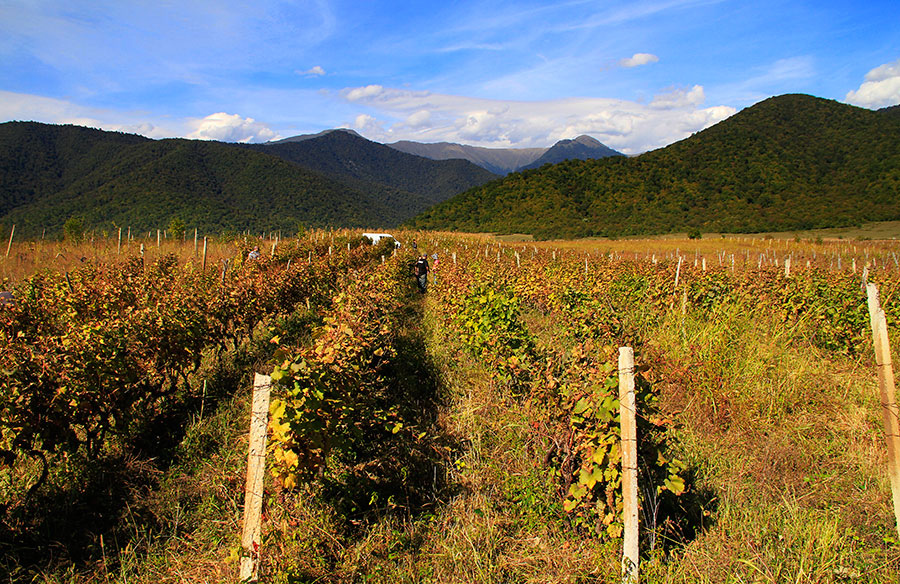
Three different day trips are sold under the same name here, and choosing between them matters more than choosing a winery. You can spend your day at polished estates with English-speaking guides, in a family courtyard where the wine comes out of clay pots buried in the floor, or walking a walled hilltop town with a glass at the end of it. The transport, the cost and the whole feel of the day follow from that one decision.
Kakheti begins about 110–120 km east of Tbilisi. Sighnaghi and Telavi are both two to two and a half hours by road: close enough that all three versions fit in one day, far enough that whoever drives isn’t drinking. Everything else bends around that.
Version A: the big estates
Start with what this version is genuinely good at. Tsinandali and Khareba are built for people who have never had a Georgian wine explained to them: signposted, priced in advance, staffed in English, with a guide who’ll tell you Rkatsiteli is a white grape before you have to ask.
Tsinandali, near Telavi, was the estate of the 19th-century poet and aristocrat Alexander Chavchavadze, who put Georgia’s first European-style bottling cellar in the grounds. Museum and garden entry is ₾10. Add a glass at the Old Winery and it’s ₾12. The full degustation tour is ₾35 and pours the estate Tsinandali, a Rkatsiteli aged in clay, dry and semi-dry Saperavi, and a chacha to finish. Prices checked in August 2026 against the estate’s own visitor page.
Khareba at Kvareli is the other kind of large: a Soviet-era tunnel complex bored into the foothills, cold and damp year round. Walking it costs about ₾3, or ₾6 with a glass at the end. Tastings there are quoted in euros, from €7 for two classic wines to €35 for seven plus bread-baking and a barbecue, so call it ₾20 to ₾100.
So who is this day for? Anyone travelling with people who don’t drink much, anyone nervous about the language barrier, and anyone who wants the categories explained before forming opinions. It’s also the version that survives bad weather, since the good parts are indoors.
- Realistic cost: a group minivan day out of Tbilisi runs about ₾70 per person for roughly ten hours; entries and tastings on top land a full Version A day at ₾120–170 each.
- Time on the road: two and a half hours each way to the Telavi side, longer than the Sighnaghi run.
- What you miss: the working marani. Nobody lifts a stone lid for you at an estate, and the pours come with a script and a clock.
Version B: small family cellars
This is the version people describe when they get home. A gate, a courtyard, a concrete or dirt floor with round stone lids set into it, and a man who levers one open so you can look down into eight hundred litres of Rkatsiteli fermenting on its own skins. Bread and sulguni appear on the table without anyone ordering them. Then the tomatoes. Then, at some point, the chacha, and the afternoon stops being about wine.
The wine is the reason to come. Kakheti’s signature is amber wine: white grapes fermented with skins and stems inside a buried qvevri for months, which hands a white the tannin and grip of a light red, dried apricot and walnut behind it. The estates make good versions. Families make idiosyncratic ones, and you can taste the gap between one household and the next in a way no tasting room offers. Read our Georgian wine guide before you go and the whole thing lands better.
Money: a courtyard tasting is ₾15–40 a head with the food folded in. A seated tasting in Tbilisi is ₾45–50 for the wine alone. At the ambitious end, Pheasant’s Tears near Sighnaghi — the zero-sulphur project that put Georgian natural wine on export lists, built on rare grapes like Khikhvi and Tavkveri — is nearer ₾90–100 a head for a meal with the tasting attached.
The catch is that this version doesn’t run itself. Most small maranis want a phone call the day before, several sit down unsigned farm tracks, and quality swings hard: one cellar pours an amber you think about for a year, the next pours four wines that are simply wine. English ranges from fluent to none. And you need a driver, because the point is that you’re drinking.
It suits anyone who already likes wine and would rather have one real conversation than four polished ones. Our advice: book two cellars, not four. Three is pushing it, because nobody at a Georgian table lets you leave after forty minutes, and a rushed marani visit is worse than none.
Version C: Sighnaghi and Bodbe with wine as a side dish
Plenty of people don’t actually want a wine day. They want a view, a walk, lunch outside and one good glass. That day exists, it’s the cheapest of the three, and it’s the only one that needs no car.
Sighnaghi is a small walled town on a ridge above the Alazani Valley, red roofs and carved balconies, the Greater Caucasus filling the horizon behind the vineyards. Its 18th-century wall is the longest in Georgia, and walking it and climbing the towers costs nothing. Two kilometres downhill sits Bodbe Monastery, an active convent holding the tomb of St Nino at the end of a cypress avenue: free to enter, shoulders and knees covered, wraps lent at the gate. A taxi down and back runs ₾20–25.
The nickname you’ll see everywhere, City of Love, comes from a 24-hour marriage registry on the main square, which is a functioning government office rather than an attraction. Worth knowing so you don’t go looking for something.
- Getting there yourself: marshrutkas leave from the Navtlughi terminal beside Samgori metro (not Didube) at 9am, 11am, 1pm, 3pm, 5pm and 6pm for about ₾15, taking 2–2.5 hours; shared taxis from Isani go when four passengers turn up, ₾25–30 a head, and cut it to 1.5–2 hours. Both figures were current in 2026 per Wander-Lush’s Kakheti transport guide.
- On the ground: a glass in a main-square wine bar is ₾6–10, lunch with wine ₾35–50, and the wall costs nothing.
- What you miss: the cellar, entirely. Sighnaghi’s town-centre bars pour perfectly decent Kakhetian wine, and none of it is the thing you came 120 km for.
If the town is the draw rather than the wine, our full Sighnaghi day trip guide covers the timings, the return vans and where to eat.
Which one we’d book, and why
Our advice: Version B, with a hired driver, if there are two or more of you. The reasoning is unsentimental. Estates are excellent at explaining and poor at surprising; you can get an equivalent guided tasting in a dozen countries. Sighnaghi is a lovely town and a mediocre wine day. The family marani has no equivalent anywhere else, because what you’re looking at — wine working away in a clay egg under the floor, made this way for eight thousand years — exists at this density nowhere else. UNESCO listed the method as intangible cultural heritage for a reason.
The maths flips if you’re alone. A car costs ₾200–320 whether one person or four sits in it, so solo travellers should take the ₾70 group tour or do Version C by minibus and spend the difference on bottles.
If you can’t yet tell a Saperavi from a Rkatsiteli, take Version A first. A family cellar rewards you far more on a second trip, once you know what you’re tasting.
Best of all is the hybrid nobody sells you: one estate in the morning for structure, one family cellar after lunch for the real thing, back in Tbilisi by eight. Ask a driver for exactly that and you’ll get it. What you should cut is the souvenir-shop stop that group itineraries quietly slot in around 4pm.
How to actually arrange each version
Organised group tour
Book online the day before and you’ll pay from about ₾70 per person for a ten-hour minivan run leaving around 9am, with Sighnaghi, Bodbe and one or two tastings folded in; private versions of the same route start near ₾250 each. Zero planning, zero flexibility. Check what the listing calls a winery before you pay: some stops are bottling plants with a tasting counter attached.
Private driver
The right answer for Version B. Pre-booked transfer services quote from ₾170 per car for a Tbilisi–Sighnaghi round trip; a full day zig-zagging between cellars is more like ₾200–320 for the vehicle, split between you. You set the route, you can add a marani on somebody’s recommendation at 2pm, and you can drink. Tell the driver which cellars you want the night before, so he can ring ahead. That call is what gets the gate opened.
Marshrutka, then your own feet
₾15 and a bit of patience. Vans leave when they fill rather than when the clock says, so reach Samgori half an hour early, and note that some Sighnaghi services terminate in Tsnori, a further ₾10 taxi from town. The metro out is ₾1 with a Metromoney card. This works for Version C and badly for anything else: vans drop you in a town centre, cellars sit in the countryside. More routes in our day trips from Tbilisi roundup.
If your dates fall near the harvest
Rtveli, the grape harvest, changes what all three versions feel like. Estates run pressing demonstrations, family cellars are too busy to sit down with you unless you help, and every guesthouse bed in Kakheti gets booked. Kakheti picks first and earliest of Georgia’s regions: processing began on 2 September in 2025 and as early as 13 August in 2024, so the season moves with the summer rather than the calendar. For 2026, the second week of September through the first week of October is the safest window to aim at, and Wander-Lush’s rtveli events roundup tracks confirmed dates as producers announce them.
Turn up then and Version B stops being a tasting and becomes a workday with a feast at the end: secateurs at seven in the morning, grapes trodden in a hollowed log, and a supra you will not be permitted to leave early. Our rtveli grape harvest guide has the regional timings, what it costs to join in and how not to be a nuisance in somebody’s vineyard.
Questions people ask before they book
Is a Kakheti wine tour worth it?
Yes, with one condition: you have to get inside a working cellar. A day of estate tasting rooms is pleasant and replaceable. A day that includes a family marani, with the qvevri lids lifted and the household’s own amber wine poured at their table, is the single strongest argument for coming to Georgia at all.
How much does a day trip to Kakheti cost?
Budget ₾60–100 per person doing it by minibus with a couple of glasses in Sighnaghi, ₾120–170 on a group tour with tastings, and ₾150–250 each for two people sharing a private car and visiting two cellars. The car is the expense; the wine is not.
Can you visit Kakheti wineries without a tour?
You can, and it’s the better trip if you organise it. Hire a driver rather than a guide, pick your own cellars, and ring them a day ahead, because small producers open for people who called. What doesn’t work is arriving by minibus and hoping to reach rural maranis, since they sit kilometres apart with no public transport between them.
What is the best month for a Kakheti wine tour?
Late September and early October, when the harvest runs and the valley is still warm. May and June come next: green, quiet, cellars unhurried. Skip late July and August if you can, because the Alazani Valley pushes well past 30C and the cellars are the only cool rooms in it.
One last thing that will improve your day more than any choice above: carry cash in small notes. Rural cellars almost never take cards, a ₾100 note for a ₾25 tasting causes visible pain, and the bottle you want to take home — ₾20–40 straight from the person who made it — has to be paid for in lari at the gate.
Featured image: Levan Gokadze (uploaded by Giorgi Balakhadze) (CC BY-SA 2.0) via Wikimedia Commons.


Leave a Reply