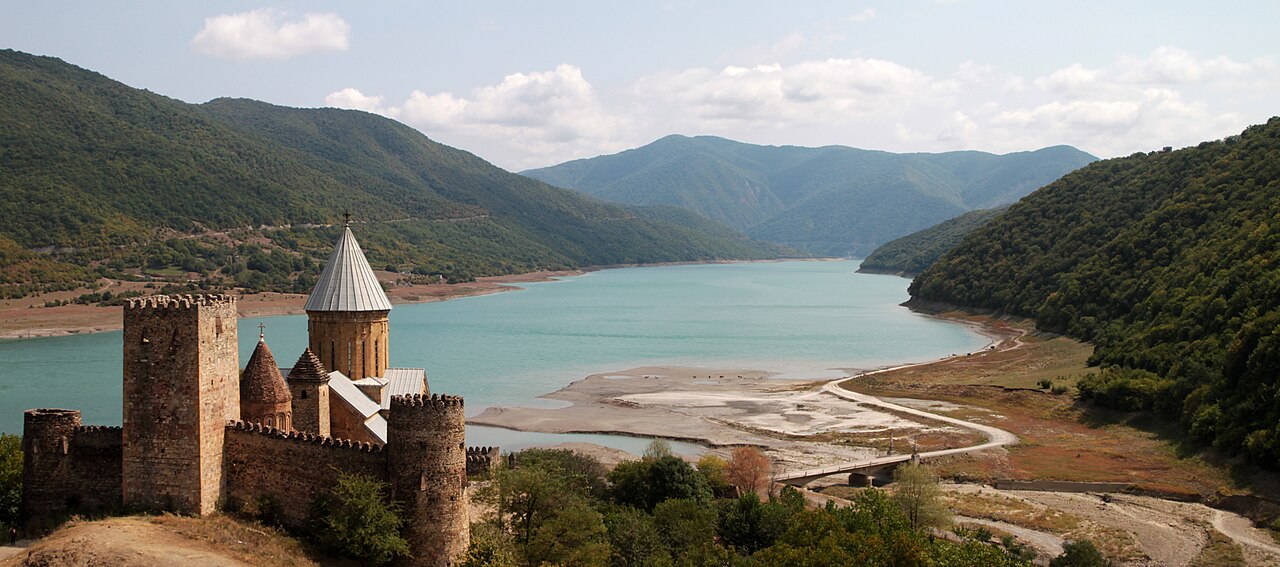
Rising straight out of a turquoise lake about 70 kilometres north of the capital, Ananuri is the photograph most people already have in their heads before they ever set foot in Georgia. This 17th-century fortress-and-church complex sits on the banks of the Aragvi River, right where the Georgian Military Highway climbs toward the high Caucasus. Almost everyone sees it the same way: as the first proper stop on the long drive up to Kazbegi. It is free to enter, takes little more than half an hour to explore, and rewards you with some of the finest carved stonework and best reservoir views on the entire road.
Ananuri at a glance
- What it is: a late-medieval castle complex with two 17th-century churches and defensive towers
- Where: on the Georgian Military Highway, roughly 66–72 km (about 1 to 1.5 hours) north of Tbilisi, overlooking the Zhinvali (Jinvali) Reservoir
- Entry: completely free, no ticket booth, open dawn to dusk year-round
- Time needed: 30 minutes for a quick look, 45–60 minutes to explore properly
- Best paired with: a day trip to Kazbegi and Gudauri
What is Ananuri?
Ananuri was the stronghold of the eristavis (dukes) of Aragvi, a powerful feudal dynasty that controlled this stretch of the Aragvi valley from roughly the 13th to the 18th centuries. Its position was strategic rather than decorative: whoever held Ananuri controlled the trade and military route running north into the mountains. That made it a target, and in 1739 rival forces from the neighbouring Ksani duchy stormed the fortress and set it ablaze. According to Lonely Planet, most of what stands today dates from the 16th and 17th centuries.
Today the site is an architectural monument of national significance and sits on Georgia’s tentative list for UNESCO World Heritage status. It is comfortably the most famous and most photographed spot on the Georgian Military Highway, which is exactly why nearly every organised tour rolls in here.
What to see at Ananuri
The towers and walls
The complex is ringed by stout stone curtain walls punctuated by towers. The tall, square Sheupovari Tower can be climbed by a narrow, dark internal stairway, and the effort pays off with a panorama over the churches, the reservoir and the highway snaking off into the mountains. It is often described as one of the best views on the whole road, so bring a torch or use your phone light and take it slowly on the steps.
The Church of the Assumption
The showpiece is the larger of the two churches, the Church of the Assumption of the Virgin Mary, built in 1689. Its exterior walls carry some of the finest medieval stone carving in Georgia: a large decorated cross on the facade, an intricate grapevine cross on the south wall, and carved inscriptions in scripts from across the region. Step inside and you will find fragments of 17th-century frescoes that survived the fire of 1739. The smaller, older Church of the Virgin nearby holds the graves of several Aragvi dukes.
The Zhinvali Reservoir
The vivid turquoise lake below the walls is the Zhinvali (Jinvali) Reservoir, created in the 1980s when the Aragvi River was dammed for hydroelectric power. That startling colour comes from suspended glacial sediment washed down from the high Caucasus, and it glows brightest on sunny days between May and September. Water levels do vary with the season, though. In dry years the reservoir can drop noticeably, sometimes exposing the ruins of the old village that was flooded when the dam filled, so the postcard-perfect blue is not guaranteed on every visit.
How to visit Ananuri
The honest truth is that almost nobody comes to Ananuri as a destination in its own right. It works best as a stop on the way to somewhere bigger, and there are three practical ways to reach it.
- On a Kazbegi tour (most common): group and private day trips from Tbilisi to Kazbegi almost always build in a 30–45 minute stop at Ananuri, with admission included since the site is free. This is the easiest option by far. See our full Kazbegi day trip guide for what a typical itinerary looks like.
- By private driver or rental car: the drive is about an hour each way with free parking at the fortress, giving you total control over timing. If you would rather self-drive the Military Highway, read our notes on renting a car in Georgia first.
- By public transport (hard): Kazbegi-bound marshrutkas (shared minibuses) pass Ananuri and cost only a few lari, and you can ask the driver to drop you off. The catch is the return, flagging down a passing bus with a free seat is unreliable, so this suits confident, flexible travellers only.
How long to spend and the best time to go
Realistically, 30 to 45 minutes covers Ananuri. That is enough to walk the walls, climb the tower, admire the church carvings and get your reservoir photos. If you are self-driving and want to linger, an hour is plenty.
The site is busiest between roughly 11am and 3pm, when the tour buses converge. If you have your own transport, arriving before 10am or after 4pm means quieter walls and better light. The reservoir looks its best on clear, sunny days from late spring through early autumn, when the glacial turquoise really sings.
Combining Ananuri with Gudauri and Kazbegi
Ananuri is the opening act of the classic Georgian Military Highway run. From the fortress, the road continues up to the ski resort of Gudauri, past the Soviet-era Russia–Georgia Friendship Monument with its sweeping viewpoint, and on to Stepantsminda (Kazbegi), where the Gergeti Trinity Church sits beneath Mount Kazbegi. Most 11-hour day trips from Tbilisi string all of these together in a single loop. If you are weighing up your options, our roundup of day trips from Tbilisi puts this route in context alongside the region’s other excursions.
Photography tips
- The strongest composition is from the top of the Sheupovari Tower, framing the church domes against the turquoise reservoir
- Late afternoon light, around 4–5pm in summer, hits the stone walls at a warm angle and deepens the water colour
- Get close to the Church of the Assumption’s south wall to capture the carved grapevine cross detail
- A wide-angle lens helps take in both the fortress and the lake in a single frame
Frequently asked questions
Is Ananuri Fortress free to enter?
Yes, entry costs nothing at any time of year. Nobody sells tickets at the gate, and the grounds, both churches and the climbable tower are accessible between sunrise and sunset.
How far is Ananuri from Tbilisi?
Around 66-72 km, a drive of roughly 60 to 90 minutes heading north on the Georgian Military Highway. Traffic leaving the capital and mountain weather decide which end of that range you land on.
How long do you need at Ananuri?
Half an hour to 45 minutes suits most people, covering the ramparts, the tower climb and both churches. Organised day trips usually allow about 40 minutes before pressing on toward Kazbegi.
Can you visit Ananuri without a tour?
Yes. Driving yourself or hiring a driver makes it a simple one-hour run, and parking costs nothing. Marshrutkas bound for Kazbegi will drop you at the gate for a few lari, but flagging one down for the trip back is a gamble, so having your own wheels is far smoother.
Sources: Lonely Planet – Ananuri Fortress, The Georgian Guide and GetYourGuide day trip listings.
Last checked: July 2026.
Featured image: Stomac (CC BY 3.0) via Wikimedia Commons.

Leave a Reply