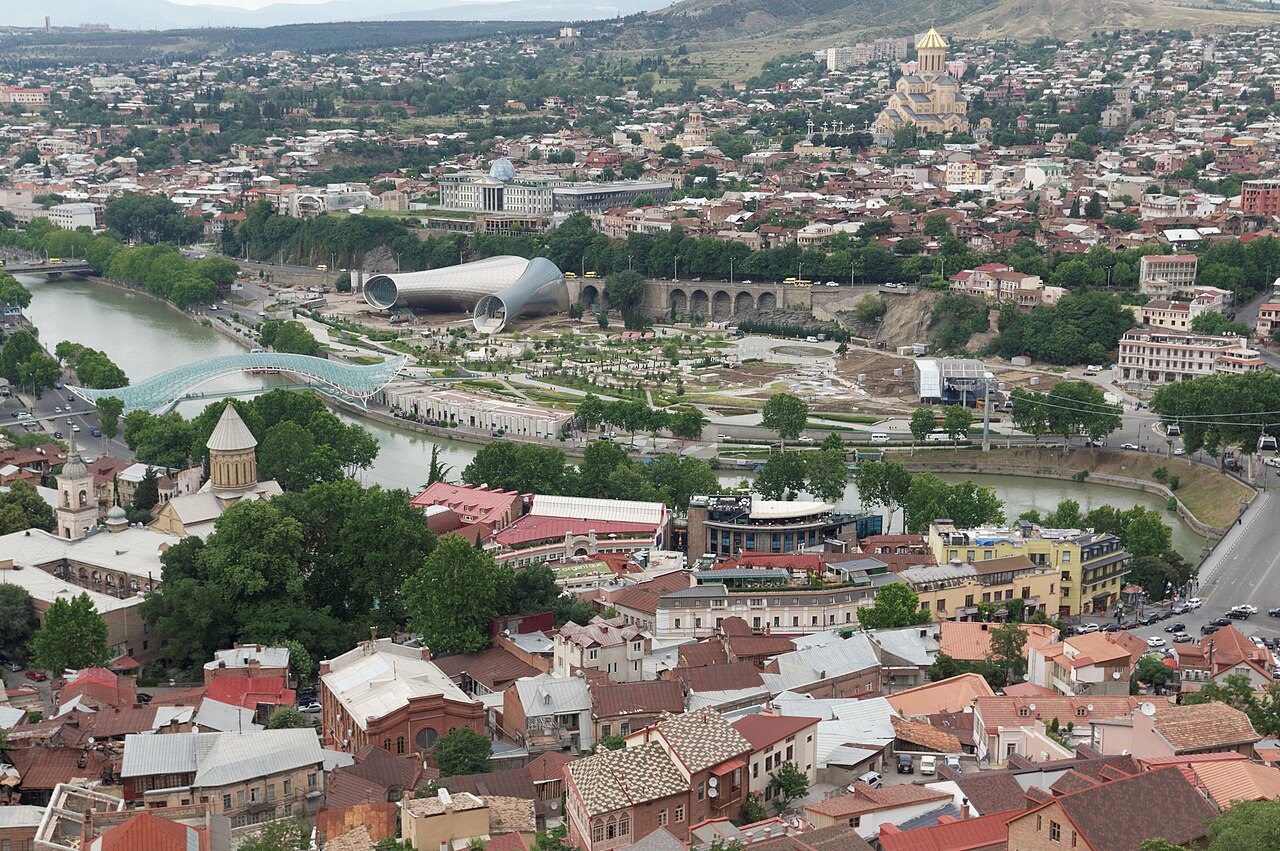
Almost no house in Tbilisi’s Old Town is medieval. Qajar Persian troops burned the city in 1795, so the district you walk through is a nineteenth-century rebuild on a much older street plan, with a Russian imperial quarter bolted on above it and a Soviet layer poured into the gaps.
Which makes it readable. Once you can separate an 1840s brick shell from a 2019 replica of one, the lanes stop being scenery. For the walk itself, in order and with distances, use our 3-day Tbilisi itinerary. This is what you are looking at while you do it.
Start with 1795, because everything dates from it
September 1795 is the hinge. Agha Mohammad Khan sacked and burned the city, much of the population was killed or deported, and the domestic fabric of Kala, the walled core between Narikala and the river, went with it. Rebuilding ran through the first half of the 1800s, which is why a district everyone calls ancient is full of buildings younger than the Louisiana Purchase.
Check before you climb: the fortress itself has been fenced off for a rehabilitation programme and was still closed to visitors as of spring 2026, per reporting on the works (checked August 2026). The cable car, the ridge path to Kartlis Deda, St Nicholas Church and the Botanical Garden below are all still open, so the trip up is not wasted — but do not count on walking the walls. Our Narikala guide has the detail.
First sorting rule, then. A timber balcony means post-1800, probably post-1830. Anything genuinely older is stone or brick, and either religious or military: churches, bath vaults, fortress walls.
The balconies face the wrong way, and that tells you what the house is
Stand on a street in Kala and look up. The facade is often flat and stuccoed: a few windows, a shallow cornice, maybe one modest balcony. Step through an open gate and the same building has a carved timber gallery running the full width of the courtyard, two or three storeys of it, spiral stairs at the corners.
The ornate side is the inside because the balcony is not decoration. It is a corridor.
These are courtyard houses, what Tbilisi calls “Italian courtyards” (italiuri ezo). A continuous open gallery links every family’s door around a shared yard, with a shared tap and, historically, a shared toilet. Most were not built that way. They went up as large merchant houses and were subdivided later, a little around 1900 and heavily under Soviet housing pressure, when one house took in six or eight households.
So walking the lanes without entering a yard is judging a house by its back fence. Our advice: cut one church from your list and spend those twenty minutes in courtyards instead, through the unlatched gates on Betlemi, Chakhrukhadze and Lermontov. Then behave. People live there: no shooting through windows, no laundry-line portraits, and leave if someone looks at you like you should leave.
Wood or iron? A rough way to date a facade
Two balcony traditions overlap here, and they belong to different economies.
- Carved timber fretwork. Cut by hand, so the panels do not match. Along one balustrade the scrollwork wobbles, a panel sits deeper than its neighbour, a repair is a different age of wood. The older, cheaper, vernacular layer.
- Cast iron. Identical castings every thirty or forty centimetres, stamped rosettes, foundry-catalogue patterns you also meet in Odesa and Baku. Iron came with Russian imperial industry, so it generally means the later 1800s.
- Masonry below, timber above. The standard Tbilisi section: brick or stone takes the damp and the street, and the upper storeys are timber because timber is cheap and can be pushed out over the yard.
One caveat: ornament dates the fashion, not the wall behind it. Balconies were salvaged from demolitions and moved between buildings, so check the guess against the masonry. Condition cuts the other way. Uniformly milled timber, spindles all identical, paint in a heritage-catalogue colour: that is restoration, which here almost always means after 2009.
The brick domes are the oldest working thing in the city
In Abanotubani the architecture is below your feet. The low brick humps in the paving are roofs: the halls sit underground, and the dome is engineering, not ornament. It holds heat in, vents steam through the opening at the crown, and drops a shaft of daylight onto the water. The form appears in the seventeenth century, and by the end of the 1800s about sixty baths were packed in here.
The blue-tiled Chreli Abano everyone photographs is the exception, not the type. Its Persian-style tile front is a late-nineteenth-century flourish, restored bright enough that it now reads as newer than the plain domes around it.
Plain private cabins run 15–40₾ an hour, Chreli Abano around 60–70₾, spa-grade rooms 150–300₾, and the public halls single-digit lari. Full detail in our Tbilisi sulfur baths guide.
Two street plans, stacked on top of each other
Down in Kala and Abanotubani there is no plan in the drawn sense. Lanes follow the contour and the property boundary, bend around plots rather than through them, change width inside a single block, and several simply stop. The streets here are what was left over once the plots were settled.
Walk uphill into Sololaki and the geometry snaps. Straight streets, regular blocks, corners at ninety degrees: the Russian viceroyalty laying out a European quarter in the mid-1800s, after the old water channels here were closed off. The buildings change with it, from timber to stone and stucco, two storeys to four, plus tiled entrance halls and Art Nouveau ironwork.
You can feel the seam in one turn of the head. Stand on Kote Abkhazi where the Sololaki streets come down to meet it: behind you the lanes wander, ahead they line up.
The Soviet layer nobody points at
It is the least photographed layer and it changed the most.
The riverside was rebuilt for traffic, and in 1951 the Shia mosque of Abanotubani was demolished for it. That is why the surviving Jumah Mosque now serves Sunni and Shia worshippers in one room: unusual, and a result of town planning rather than theology. In the same decades Sioni was the only functioning church in the city.
On the buildings, look for the joins. A flat concrete slab balcony directly beneath a carved timber one. An extra storey of pale block on a nineteenth-century shell, set back and never quite aligned. Open galleries glazed in with steel frames. Three centuries on one wall, and the concrete is the easiest to date.
The 2010s restoration, and the argument about it
From 2009 the city ran a rehabilitation programme under Mayor Gigi Ugulava called “New Life for Old Tbilisi”, continued afterwards by the Tbilisi Development Fund. Streets repaved, facades repaired, blocks repainted.
The numbers from Lado Gudiashvili Square, worked on since 2018, sum up what “restored” means here: three houses fully rehabilitated, seven reconstructed, four built from scratch. Some of what you photograph is a new building wearing an old shape.
That drew real criticism. ICOMOS and Georgian architectural historians argued the method was demolition and replica rather than conservation, with the early-1800s house at No. 2 Gudiashvili Square, the so-called Blue House, as the flashpoint. The Aghmashenebeli Avenue works drew the same complaint: old fronts, entirely new concrete behind.
How to spot new-build pastiche once you know to look:
- Mortar joints of identical width across a whole elevation, brick all one colour, nothing reclaimed or patched.
- No settlement anywhere: no cracks stepping through the masonry, no sagging lintels, no doors cut down to a dropped floor.
- Balcony timber unweathered underneath, where nobody paints and rain still gets in.
Our position, and plenty of people in Tbilisi will disagree: the replicas beat the collapsing shells they replaced, they are worse than the buildings that stood there in 1990, and the district would be far less pleasant to walk if nothing had been done. All three at once, which is why the argument has not ended.
Four living faiths in about four hundred metres, and one dead one
Around Sioni the religious buildings sit close enough to see inside ten minutes. Less tolerance than trade: a commercial city whose merchants came from everywhere.
- Sioni Cathedral: Georgian Orthodox, thirteenth-century core, rebuilt after repeated destruction. The free-standing bell tower across the street went up in 1812 to mark a Russian victory over the Ottomans, one of the earliest Russian Neoclassical buildings in the South Caucasus. An imperial monument parked in front of a Georgian cathedral.
- Anchiskhati Basilica: built between 522 and 534, the oldest church in the city, with a brick bell tower added in 1675 by Catholicos Domenti II.
- Norashen: Armenian Apostolic, closed for decades and disputed between congregations. The locked door is part of the reading.
- The Great Synagogue on Kote Abkhazi: brick, Moorish-inflected arches, built around 1900 by Jews from Akhaltsikhe.
- Jumah Mosque: red brick above the baths, rebuilt in 1895 on money from the Baku oil magnate Zeynalabdin Taghiyev.
The dead one is Ateshgah, a Sasanian-era Zoroastrian fire temple in a courtyard off Gomi Street: a mosque from the 1720s, then a storehouse, then somebody’s home. It looks like a small brick ruin, and it is the oldest structure most visitors walk past without noticing.
What is genuinely worth going inside
Most of the Old Town is exterior. Four interiors repay the time: Anchiskhati, dark and almost bare, the only place you stand inside pre-1795 Tbilisi, free and done in five minutes; Sioni, also free, for the contrast with the 1812 tower outside; a bathhouse, the only way to occupy the underground architecture rather than stand on its roof; and one courtyard.
Narikala is the opposite. The walls are the vantage point, not the exhibit, so read it as a fortress line before you climb, with our Narikala Fortress guide. Skip the souvenir arcades by the Bridge of Peace, and any wine tasting advertised on a laminated board.
Getting there, and the hours that matter
Metro to Avlabari or Freedom Square puts you at either end. Fares are 1₾ on a Metromoney card (2₾ refundable deposit) or about 1–1.5₾ on a contactless bank card, 90 minutes of transfers included. The Rike Park cable car to Narikala is 2.5₾ each way, Metromoney only, no cash, checked August 2026 against our Tbilisi transport guide.
One current complication: Rustaveli Avenue is closed to vehicles from 23 July 2026 to the end of November 2026, along the 2 km from Tamar Chovelidze Street to Freedom Square, so buses on that side are diverted. Walk in, or take the metro.
Go before 10am: better light on brick and timber, empty lanes, and courtyard gates unlocked while people come and go. Late afternoon is the second window, when the west-facing balconies on Betlemi catch the sun. Midday is the worst of both, flat light and full tour groups. Wear shoes with grip, because it is all river cobble, worn stone and steep stairs.
Frequently asked questions
How old are the buildings in Tbilisi Old Town?
Most houses are nineteenth century, not medieval. The 1795 Persian sack destroyed the domestic city and rebuilding ran through the early 1800s. The old survivors are churches, bath vaults and fortress walls: Anchiskhati dates to 522–534, the bath domes to the 1600s.
Why do Tbilisi houses have wooden balconies facing the courtyard?
Because the balcony is a shared corridor, not a view terrace. In a Tbilisi courtyard house the open gallery links every household’s door around the yard, so the carved side faces inward and the street facade stays plain.
Is Tbilisi Old Town restored or original?
Both, unevenly. City programmes from 2009 repaired a lot and replaced a lot. At Gudiashvili Square, three houses were rehabilitated, seven reconstructed and four built new. Uniform mortar and crack-free walls mark the replacements.
Can visitors go into the courtyards in Tbilisi Old Town?
Yes, where the gate is open, and mornings are the best chance. These are occupied homes, not monuments, so keep your voice down, do not photograph into windows or across laundry, and leave if a resident objects. Betlemi and Chakhrukhadze have the most accessible ones.
If you have twenty minutes and want the one walk that carries all of it, take the Betlemi stairs up from Gomi Street. In three hundred metres you pass bath domes, an unrestored timber gallery, a courtyard gate, a Soviet concrete addition and a freshly rebuilt facade. By the top you can date each one.
Featured image: Vyacheslav Argenberg (CC BY 4.0) via Wikimedia Commons.

Leave a Reply