Three days in Tbilisi comes to about 15 kilometres of walking, and 250 metres of that is vertical — worn stone stairs, mostly, in full sun. Plan the route rather than the clock and the city stops punishing you.
What follows is three continuous walking lines, each drawn so you climb once and descend once, with the distance between stops, where the gradient bites, where to eat halfway, and what to swap in when it rains. Day 1 and Day 3 hold one ascent each. Day 2 holds none, which matters more than it sounds.
The card problem, which ruins more first mornings than anything else
Buy a Metromoney card at the first metro station you pass. It costs 2₾, covers a whole group, and pays for the metro at 1₾ a ride, the buses, and the Rike Park cable car at 2.5₾ each way — fares checked August 2026 against Wander-Lush’s Tbilisi transport guide. The cable car turnstile reads that card and nothing else. Not cash, not a Visa, not your phone.
Two more facts shape the three days. The cable car doesn’t start until 11:00 and stops around 23:00, later in high summer. And the Mtatsminda funicular refuses Metromoney outright: it sells its own 2₾ park card at the desk, and a ride is 12₾ (checked August 2026 against Tbilisi Local Guide). Two cards, two systems, one city.
Day 1: Abanotubani to the ridge, then down the back stairs — 4.5 km
Start at the sulfur baths on Abano Street at 9:00. Not for atmosphere — the cable car you need at lunchtime isn’t open yet, so those two hours are otherwise dead, and private rooms fill from late morning.
A private room runs from about 60₾ an hour at the plainer houses and climbs past 150₾ for the tiled rooms at Chreli-Abano, the blue-fronted one in every photograph. The price is per room, not per head, so three of you pay barely more than one. The kisa scrub is 20–30₾ each on top and it’s the best value in the district; our Tbilisi sulfur baths guide compares the bathhouses. Book a day ahead. Walk-ins at the popular houses get told to come back at four.
Out of the door, turn uphill into the gorge. The Leghvtakhevi waterfall is 200 metres in, five minutes each way, free, and tour groups walk straight past the entrance.
Now the flat section, and it’s the only one today. Cross at Meidan, pick up the riverside path under Metekhi church, and it’s roughly 700 metres — nine easy minutes — to the cable car station at the north end of Rike Park. Eat before you get on it. The ridge at the top sells water, beer and churchkhela, and that is the entire menu up there. The lanes around Erekle II Street are 300 metres back from the bridge, and khinkali, a khachapuri and a jug of house wine for two still lands under 40₾; order khinkali by the piece, minimum five, and our Georgian food guide covers the rest.
The cable car is 90 seconds and 2.5₾, and what you’re actually buying is 100 metres of vertical you would otherwise take on steps in the afternoon heat.
At the top the walls are free, unticketed and largely unfenced — real drops off the upper sections, nothing between you and them. From the fortress, the ridge path to the Kartlis Deda statue is about 450 metres and ten minutes, near-level, Old Town falling away one side and the Botanical Garden valley the other. Our Narikala Fortress guide has the walls in detail.
Check before you climb: the fortress itself has been fenced off for a rehabilitation programme and was still closed to visitors as of spring 2026, per reporting on the works (checked August 2026). The cable car, the ridge path to Kartlis Deda, St Nicholas Church and the Botanical Garden below are all still open, so the trip up is not wasted — but do not count on walking the walls. Our Narikala guide has the detail.
The descent is where people get it wrong. Two ways down. The Betlemi steps drop into Sololaki in about 600 metres and fifteen minutes, on stone polished slick by centuries of feet, ending five minutes from Meidan. Or the Botanical Garden’s upper gate beside the fortress: 4₾ in, then a shaded valley walk nearer forty minutes with stops, which spits you out beside the baths where you started.
Our advice: ride up, walk down — here and on Mtatsminda both. Climbing Tbilisi’s stairs on a hot afternoon is the most reliable way to lose an evening you’d rather spend eating.
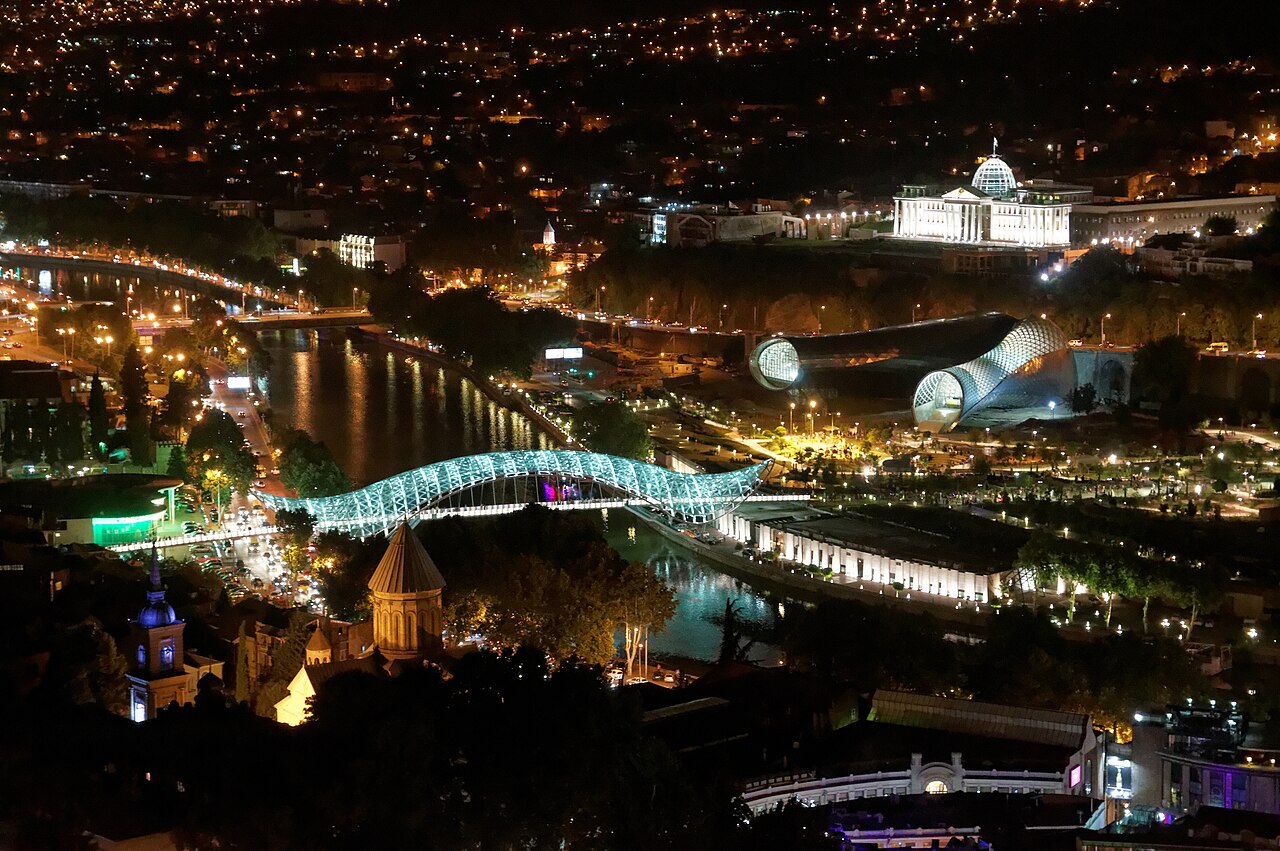
Finish across the Bridge of Peace after dark, when the LEDs are on: a 150-metre span, two minutes, and it lands you back on the Old Town side for dinner.
If it rains on Day 1
The cable car keeps running in rain. The ridge path and the Betlemi steps become a bad idea — polished stone, no handrail, unfenced edges. Swap the descent for a second hour in the bath, the one thing in Tbilisi that improves in bad weather, then stay flat: Sioni Cathedral, the sixth-century Anchiskhati Basilica and the Gabriadze clock tower sit within 400 metres of each other. Ride the cable car up and straight back down for the view, and leave the ridge.
Day 2: Freedom Square to Fabrika in one straight line — 5 km, no stairs
There is no climb in Day 2. That’s deliberate, and it’s why we’d tell you not to run these days in the order we numbered them: this is the wet-weather day, so move it to whichever morning the forecast looks worst.
Begin at Freedom Square under the gold St George. Rustaveli Avenue runs 1.5 kilometres northwest — flat, wide pavement, plane trees, Parliament and the Opera on the way. Twenty minutes if you don’t stop. You will stop.
The Museum of Georgia is 300 metres in on the left, and its ticket has moved sharply: budget 30–40₾, not the 10–15₾ still printed on older guides — a range nobody has settled yet, checked August 2026 against Wander-Lush’s 2026 Tbilisi museums roundup. Closed Mondays, last tickets around 17:30. Give it 75 minutes in two rooms: the Archaeological Treasury in the basement, pre-Christian goldwork older than Rome, and the Soviet Occupation hall upstairs, which explains more about modern Georgia than any walking tour.
For lunch, turn off at the Opera House and go 400 metres up into Vera — the only rise of the day, and a mild one. The bistros up there are where Tbilisi eats when it isn’t performing, and prices fall the further you get from Rustaveli.
Then cross the river: 2 kilometres and 25 minutes on foot over Baratashvili Bridge to Fabrika, or the metro from Rustaveli to Marjanishvili, two stops at 1₾, then 600 metres. Take the metro. After Day 1 your legs are usually done by three.
Fabrika is a Soviet sewing factory turned courtyard, and timing is everything. Before 16:00 it reads as a concrete yard with a coffee stand. From late afternoon the tables fill and the whole thing makes sense. Give it an hour, then wander the Chughureti backstreets for the collapsing art-nouveau balconies.
Dinner is 400 metres away on Aghmashenebeli Avenue’s pedestrianised “New Tiflis” stretch, then either the natural-wine bars around it or the techno clubs, which don’t fill before 01:00 and take their door policy seriously. Bolt home; a few lari beats negotiating with a street taxi at 3am.
If it rains on Day 2
Almost nothing changes, which is the point. Give the museum two hours instead of one, take the metro rather than the bridge, lean on Fabrika’s indoor bars. Rustaveli’s plane trees do real work in light rain, too.
Day 3: one decision — leave town, or go up
Mtskheta or Mtatsminda. Pick on the cloud base rather than on preference, because both payoffs are views and both are ruined by the same grey ceiling.
Option A: Mtskheta — 2 km of walking, plus one taxi you can’t avoid
Marshrutkas leave Didube for Mtskheta every 15–20 minutes at 2₾, and the honest journey is 45 minutes to an hour, not the 30 most itineraries print. The vans go when they’re full, not when a timetable says; fares checked August 2026 against Wander-Lush’s Georgia marshrutka guide, which also notes that several Didube routes rose in May 2026 on fuel costs. Carry small notes.
Here’s the part nobody tells you: Jvari Monastery is not walkable from the town. It’s 7 kilometres by road, fifteen minutes in a car, and on foot it’s a shadeless climb along a highway shoulder. A taxi is 20–25₾ each way, or 40–50₾ return with the driver waiting. Do Jvari first, straight off the marshrutka, before the coaches.
Back in the town everything is flat and close. Svetitskhoveli Cathedral to Samtavro Monastery is 500 metres, and the whole of old Mtskheta is under 2 kilometres of walking including detours. Lunch on the pedestrian street outside the cathedral, buy churchkhela from a stall, and you’re back in Tbilisi by mid-afternoon with the evening intact. Our Mtskheta day trip guide covers the churches.
Option B: Mtatsminda, then the Dry Bridge
The funicular’s lower station is on Daniel Chonkadze Street, and reaching it is the bit nobody warns you about: a 10 to 15 minute walk up from Rustaveli metro, steeper than anything on Day 1. The ride is 12₾ each way, the separate park card 2₾ and shareable, and the line runs 09:00 to around midnight. Our Mtatsminda Park and funicular guide covers the pantheon stop halfway up, worth breaking the journey for.
Our advice at the top: terrace, view, a plate of ponchiki at the old café, skip the Ferris wheel, then walk down the pine path — 40 minutes to an hour, all of it downhill.
That leaves the afternoon for the Dry Bridge Market, 900 metres and twelve flat minutes from Freedom Square along the river. Soviet cameras, enamel pins, chandelier crystals, medals, vinyl, and plenty that isn’t quite what the seller says. Cash only, haggle gently, and don’t go at 9am — half the tables aren’t out.
If it rains on Day 3
Both options lose. Dry Bridge vendors pack up when it’s properly wet, and Jvari in low cloud is a fogged windscreen and a 25₾ taxi fare. The honest swap is a second bath and a three-hour lunch, and we’d take it without embarrassment.
What this itinerary leaves out on purpose
The biggest omission is the Chronicle of Georgia — sixteen pillars over 30 metres tall on a bare hill above the Tbilisi Sea, carved with kings and saints, and arguably the most impressive single thing in the city. It isn’t here because it’s a 20-minute Bolt each way and it breaks every walking line on this page. Add it on a fourth day rather than wedging it into three.
- Sameba (Holy Trinity Cathedral) — vast, and a 1.5 km uphill detour on the wrong bank for a building finished in 2004.
- Turtle Lake and the Ethnographic Museum — a genuinely good half-day, and a spare half-day is what three days doesn’t have.
- Kazbegi and Kakheti — full days with three hours in a car each way. Either eats Day 3 whole and returns you after dark.
- The long church list — by the fourth they stop registering. Three, chosen well, is the right number.
One more deliberate absence: no clock times above, only distances. Bath queues, a marshrutka that fills slowly and your own Day 2 hangover wreck a timed schedule by 11am. The gap between Meidan and Rike Park is still 700 metres.
Frequently asked questions
How much walking is a 3-day Tbilisi itinerary?
Around 15 kilometres on these routes, split about 4.5, 5 and 4. Distance isn’t the hard part — the vertical is. There’s one ascent on Day 1 and one on Day 3, and you can buy your way out of both: 2.5₾ on the cable car, 12₾ on the funicular.
Do you need to book the Tbilisi sulfur baths in advance?
For a private room at the well-known bathhouses, yes — phone a day ahead, or turn up before 10:00 and take what’s free. The public halls need no booking and cost 5–20₾ a head, but they’re gender-separated and nobody wears anything.
Can you visit Mtskheta without a taxi?
Half of it. The 2₾ marshrutka from Didube puts you in the town centre, where Svetitskhoveli and everything round it is a flat walk. Jvari is the problem: 7 kilometres up a hill road with no footpath. Either pay 20–25₾ for a car, or accept you’re seeing the cathedral and skipping the famous view over it.
What should you skip in Tbilisi on a short trip?
Sameba cathedral, the fairground rides at the top of Mtatsminda, and every church after the third. If that frees an afternoon and you have a Bolt budget, spend it on the Chronicle of Georgia — the one major sight these walking routes can’t reach.
If one rule survives contact with your actual trip, make it this one: ride up, walk down. Cable car to Narikala, funicular up Mtatsminda, marshrutka out to Mtskheta — then use your legs going the other way, when gravity helps and the light is better anyway.
Featured image: Vyacheslav Argenberg (CC BY 4.0) via Wikimedia Commons.

Leave a Reply