Twenty dishes, arranged in the order a Georgian table actually serves them: walnut pastes and cold plates first, cheese bread second, khinkali in the middle, grilled meat and stews after that, churchkhela and chacha at the end. Learn two words before you land — khachapuri and khinkali — and treat the other eighteen as the reason to book more dinners.
Why this order? Because it’s how a supra works. At Georgia’s traditional feast nothing arrives in tidy courses; food comes in waves and the plates stack until the table runs out of surface. But the waves have a sequence, and if you copy it in a restaurant you’ll eat better: cold starters keep you busy while the kitchen fires the bread, dumplings land while you still have room, and the stews close things out. Portion logic, what arrives unasked and how not to over-order all get their own treatment in our guide to how to order Georgian food.
One warning about geography before the food: Georgian cooking is fiercely regional, and a single Tbilisi menu will happily mix highland Svaneti, coastal Adjara, western Samegrelo and wine-country Kakheti on one page. That’s why three different khachapuris sit side by side, and why a soup called kharcho means two different things in two different cities. Don’t fight it. Order across regions and let the table fill.
The cold table: what lands first
Walnuts, everywhere. Georgian cold starters lean on ground walnuts the way Italian cooking leans on olive oil, and the whole opening wave happens to be meat-free — a legacy of Orthodox fasting rules that our vegetarian and vegan Tbilisi guide covers in full. Add a tomato-and-cucumber salad with walnut dressing to any of the plates below; it’s the sharpest thing on the table and the only one that gets sharper as the meal gets heavier.
1. Pkhali
Minced spinach, beetroot or beans pounded with walnuts, garlic and herbs into small pâté-like balls, crowned with pomegranate seeds. A mixed plate gives you three colours and three flavours for ₾8–14. Verdict: the single best first order in Georgia, and the dish most first-timers wish they’d discovered on day one instead of day four.
2. Badrijani nigvzit
Fried aubergine ribbons rolled around the same walnut-garlic paste, again with pomegranate on top. Creamy, nutty, faintly sour-sweet. Nearly every kitchen makes a version, and the gap between a great one and an average one is small, so order it anywhere. ₾8–15.
3. Sulguni and the cheese plate
Sulguni is the salty, springy cheese from Samegrelo that shows up in half the dishes on this list; on the cold table it appears sliced, smoked, or — best of all — fried, crisp outside and molten inside. Imeruli (mild, fresh) and guda (sharp, sheepy, from the mountains) round out a plate. About ₾10–18.
4. Ajika and tkemali
Not dishes but non-negotiable table companions. Ajika is a fierce paste of pepper, garlic and herbs, red or green; tkemali is sour-plum sauce that cuts through anything grilled or fried. Both often arrive free, or cost a lari or two. Go easy on the ajika until you’ve calibrated.
5. Tone bread (shotis puri)
The canoe-shaped loaf slapped against the wall of a clay tone oven, sold warm from hole-in-the-wall bakeries all over Tbilisi for ₾1.50–2.50. Buy one on the walk to dinner. Yes, before dinner. It won’t survive the walk anyway.
The bread course: khachapuri three ways, plus a meat impostor
Three khachapuris on one menu isn’t indecision, it’s geography — each region shaped its own. Here’s how to pick without ordering all three. (Ordering all three is also acceptable.)
6. Imeruli khachapuri
The default: a round, flat bread from Imereti sealed around salty cheese and sliced like a pizza. Order plain “khachapuri” anywhere and this is what appears. ₾10–15. Verdict: the right call for a table of four, wrong for a party of one.
7. Megruli khachapuri
Imeruli built for people who think Imeruli is holding back — same round shape, extra cheese melted over the top as well as inside. ₾12–18.
8. Adjaruli khachapuri
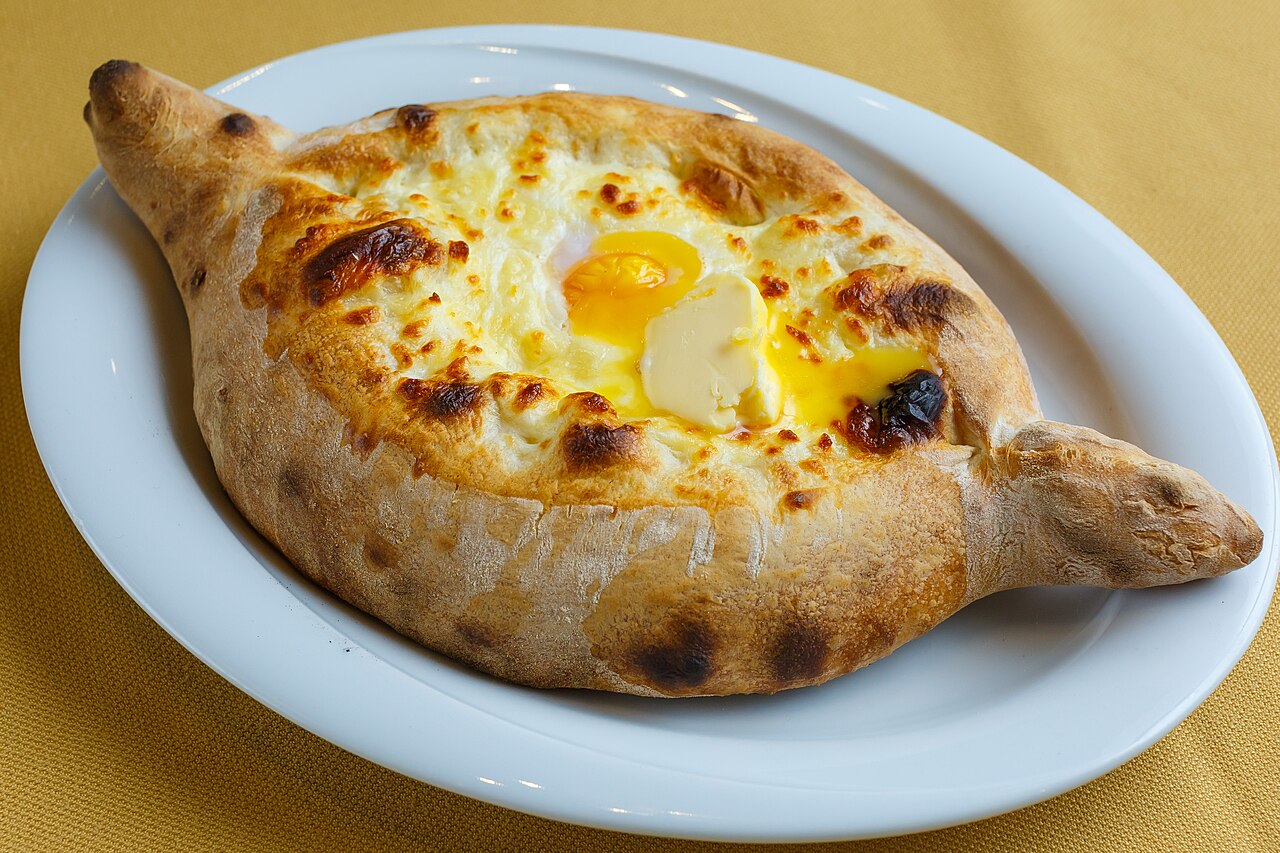
The boat. Molten cheese, a raw egg and a slab of butter stirred together at the table into cheese lava, from the Black Sea region of Adjara — the hull shape is supposedly a fishing boat, the egg its sun. Tear the ends off the crust and dip. Prices have climbed with its fame: expect ₾15–30 in Tbilisi restaurants in 2026, and the famous “big Adjaruli” at Retro runs about ₾20 and defeats two adults. One between two people is the correct ratio; one each is a rookie injury.
9. Kubdari
The impostor: a khachapuri-shaped bread from highland Svaneti stuffed with chopped spiced meat instead of cheese, seasoned with the herby Svan salt blend. Rarer on menus than the cheese breads, which is exactly why you should grab it when it appears. ₾12–18.
Khinkali: the course you clear space for
10. Khinkali
Georgia’s twisted-topknot dumpling, filled with spiced minced meat and a pocket of scalding broth. Technique matters: hold the knot, bite a small hole, drink the broth, then eat the rest — and leave the doughy stem on your plate, both because it’s tough and because the stems keep score. No fork. Black pepper, yes.
Prices have moved: central Tbilisi now charges ₾2–3 per dumpling for the classic kalakuri (herbed pork and beef), with specialty fillings like dambalkhacho aged cheese hitting ₾4–5 — checked August 2026 against Red Fedora Diary’s khinkali guide. Minimum order is five almost everywhere. Which filling first? Kalakuri, because the herbs make its broth the most interesting; the plainer mtiuluri mountain style is purist territory for round two, and mushroom or cheese versions keep vegetarians in the game. Eat them the moment they land — a cooled khinkali toughens fast, and no amount of technique rescues it.
For the real thing in Tbilisi, Sofia Melnikova’s Fantastic Douqan — reached through a garden courtyard behind the Literature Museum — has been the local answer to “where do I take visitors for khinkali” for years.
The grill and the clay pots
Now the heavy artillery. By supra logic these land when you’re already half full, which is why sharing everything isn’t a suggestion here, it’s survival.
11. Mtsvadi
Pork or veal grilled on skewers over grapevine embers, which lend a faint sweetness no gas grill can fake, served with raw onion and tkemali. In the mountains it’s practically a weekend religion. A skewer runs ₾14–22 in the capital. For a modern take on the grill and the classics around it, Shavi Lomi in Sololaki remains the Tbilisi standard: a relaxed courtyard, old recipes, light contemporary hands.
12. Shkmeruli
Chicken drowned in garlic, milk and cream, served still bubbling in its clay dish. Named for the village of Shkmeri, engineered for bread-mopping. ₾16–26. Verdict: order it once per trip, share it, and accept that you will taste garlic tomorrow.
13. Ojakhuri
“Family-style” in name and function: pork, potatoes, onions and herbs on a sizzling skillet, dropped in the middle of the table. Zero refinement, total satisfaction. ₾15–22.
14. Elarji
Cornmeal beaten with heroic amounts of sulguni until it pulls into long cheese strings — Samegrelo’s answer to a question nobody thought to ask. Stodgy in the best possible way. ₾10–15. The place to eat it properly is Mapshalia near Marjanishvili, an unfussy Megrelian canteen that’s become popular enough that booking ahead is now smart.
The stews that arrive when you think it’s over
15. Chakapuli
Lamb or veal simmered with tarragon, white wine and sour green plums — the brightest, greenest thing in the Georgian repertoire and the best counterweight to all that cheese. At its peak in spring when the plums are unripe and the herbs young. ₾18–28.
16. Kharcho
Thick beef soup with rice, walnuts and sour plum, garlicky and warming — the dish for a grey Tbilisi January. Confusingly, a walnut-based stew from Samegrelo shares the name; both deserve the space. ₾12–18.
17. Lobio
Kidney beans slow-cooked with onion and herbs in a clay pot: cheap, filling, quietly one of the great bean dishes of the world at ₾8–14. In Tbilisi the dish and one address are nearly synonymous — Salobie Bia, below the Rustaveli Theatre, where chef Giorgi Iosava’s clay-pot lobio with pickled jonjoli is good enough that Gault&Millau lists it.
18. Mchadi
Dense griddled cornbread, gluten-free by accident of tradition, whose real job is scooping lobio out of the pot. A lari or two per piece. Order it whenever beans are on the table; skip it otherwise.
The finish: churchkhela and chacha
19. Churchkhela
The candle-shaped strings of walnuts dipped in thickened grape juice that hang in every market — chewy, naturally sweet, and the souvenir that actually survives a suitcase. Darker sticks mean less added sugar. ₾3–6 at the Dry Bridge Market or roadside stalls; our churchkhela and Georgian sweets guide explains how it’s made and how to spot a fresh one.
20. Chacha
Grape-pomace spirit, home-distilled, anywhere from 40 to 65 percent, poured as a closing toast. Sip it; nobody respectable downs the first glass. At a proper supra the toasts are run by a tamada, a toastmaster who sets the theme of each round — to peace, to ancestors, to the guests — and a feast under a good tamada can outlast the food by hours. If you’re invited to one, cancel whatever else you had planned. If spirits aren’t your ending, chase the retro Georgian lemonades instead — the neon-green tarragon Tarkhuna looks like antifreeze and tastes like liquorice-adjacent childhood, and it’s worth one bottle of your life.
Only two dinners in Tbilisi? Order this
Dinner one is the khinkali dinner: a plate of pkhali, ten kalakuri khinkali, fried sulguni, house wine. Dinner two is the table-filler: Adjaruli khachapuri to share, badrijani, one clay-pot dish (shkmeruli or lobio), mtsvadi if there are three of you. Between the four kitchens named above, Sofia Melnikova’s Fantastic Douqan covers dinner one and Shavi Lomi or Salobie Bia covers dinner two, with Mapshalia the swap if you’d rather go Megrelian. More options across every price band are in our best restaurants in Tbilisi guide.
A few field notes for both dinners. Bread and sauces often arrive unbidden and land on the bill, so wave them off if you don’t want them. Menus come in Georgian and English but photos settle arguments faster; point without shame. And the reliable quality signal costs nothing: a room full of Georgian families beats a room full of cameras, every time.
Our advice: give the wine a whole evening rather than treating it as a side quest. This is the country where winemaking started — the buried clay qvevri method is around 8,000 years old and still in daily use — and a jug of house amber with the cold table is a better introduction to Georgia than any single dish on this list. The skin-contact whites are tannic, almost tea-like, unlike anything made in western Europe; inky Saperavi covers the red end. Our Georgian wine guide maps the styles before you commit to a bottle.
What it all costs in 2026
Georgia is still cheap by European standards, though less cheap than the older blog posts promise. Checked August 2026 against Wander-Lush’s 2026 Georgia budget guide, with 1 USD ≈ 2.7₾:
- Bakery run (shotis puri, a khachapuri slice): ₾2–5.
- Plate of 10 khinkali: ₾20–30 in central Tbilisi.
- Casual sit-down main: ₾14–25.
- Full meal with starters and a jug of house wine: ₾45–80 per person at a mid-range place.
- Modern-Georgian tasting territory: ₾90–140 per person, still rarely past $50.
For a full eating day, ₾60–100 per person covers a bakery breakfast, a khinkali lunch and a proper dinner with wine; a chacha-heavy supra blows through any budget you set, and that’s the correct outcome. Tipping: 10% at sit-down places, but check the bill first — a service charge is often already printed on it. And order in rounds, not all at once. Plates here are built for the middle of the table, and the kitchen won’t mind a second wave.
Frequently asked questions
How much do khinkali cost in Tbilisi in 2026?
Between ₾2 and ₾3 per dumpling at most central Tbilisi restaurants for the standard meat filling, with premium fillings such as dambalkhacho cheese reaching ₾4–5. Nearly every restaurant sets a five-piece minimum, so a light khinkali meal starts around ₾10–15.
What order is food served at a Georgian supra?
Cold walnut-based starters and salads open the table, breads and khachapuri follow, khinkali come mid-feast, then grilled meats and clay-pot stews, with fruit, sweets and chacha toasts at the end. Dishes stay on the table as new ones arrive rather than being cleared between courses.
What is the difference between Adjaruli and Imeruli khachapuri?
Imeruli is a closed round bread with cheese sealed inside, sliced and shared like a pizza. Adjaruli is an open boat holding molten cheese, a raw egg and butter that you stir together and scoop with the crust. Adjaruli is far richer and costs more, ₾15–30 versus ₾10–15 for Imeruli.
Can vegetarians eat well in Georgia?
Easily. The entire cold-starter tradition — pkhali, badrijani, cheese plates — is meat-free, and lobio, elarji, mushroom khinkali and all three classic khachapuris carry a meal. Vegans have a thinner but workable list built on beans, vegetables and walnut pastes, since cheese and egg dominate the rest.
One practical thing before you go: the good rooms fill. Shavi Lomi, Salobie Bia and even canteen-priced Mapshalia now take — and need — reservations on weekend evenings, so book two dinners the day you land and let the rest of the trip arrange itself around them.
Featured image: Eugene Krasnaok (CC BY 4.0) via Wikimedia Commons.

Leave a Reply