Yes, Tbilisi is safe, and the thing most likely to injure you here is a car rather than a criminal. Georgia’s capital carries no travel warning of any kind from the UK government — the FCDO travel advice for Georgia, updated 27 July 2026, restricts travel only to the Russian-occupied regions of Abkhazia and South Ossetia, which sit far outside any normal itinerary.
So this page is built backwards from every other safety guide you’ll read. Crime goes near the bottom, because crime is near the bottom of what actually happens. What follows is ordered by likelihood: the dull hazards that catch visitors out daily come first, the headline fears come last.
1. Traffic, and the specific way you cross a road here
This is the real one. WHO figures compiled in the Asian Transport Observatory’s 2025 Georgia road safety profile put the country at 12.7 road deaths per 100,000 people in 2021 — down sharply from 18.4 in 2010, but still close to three times an EU average of roughly 46 deaths per million (4.6 per 100,000), the Commission’s baseline figure that its 2025 update shows still inching down. You feel that difference the first time you step off a kerb.
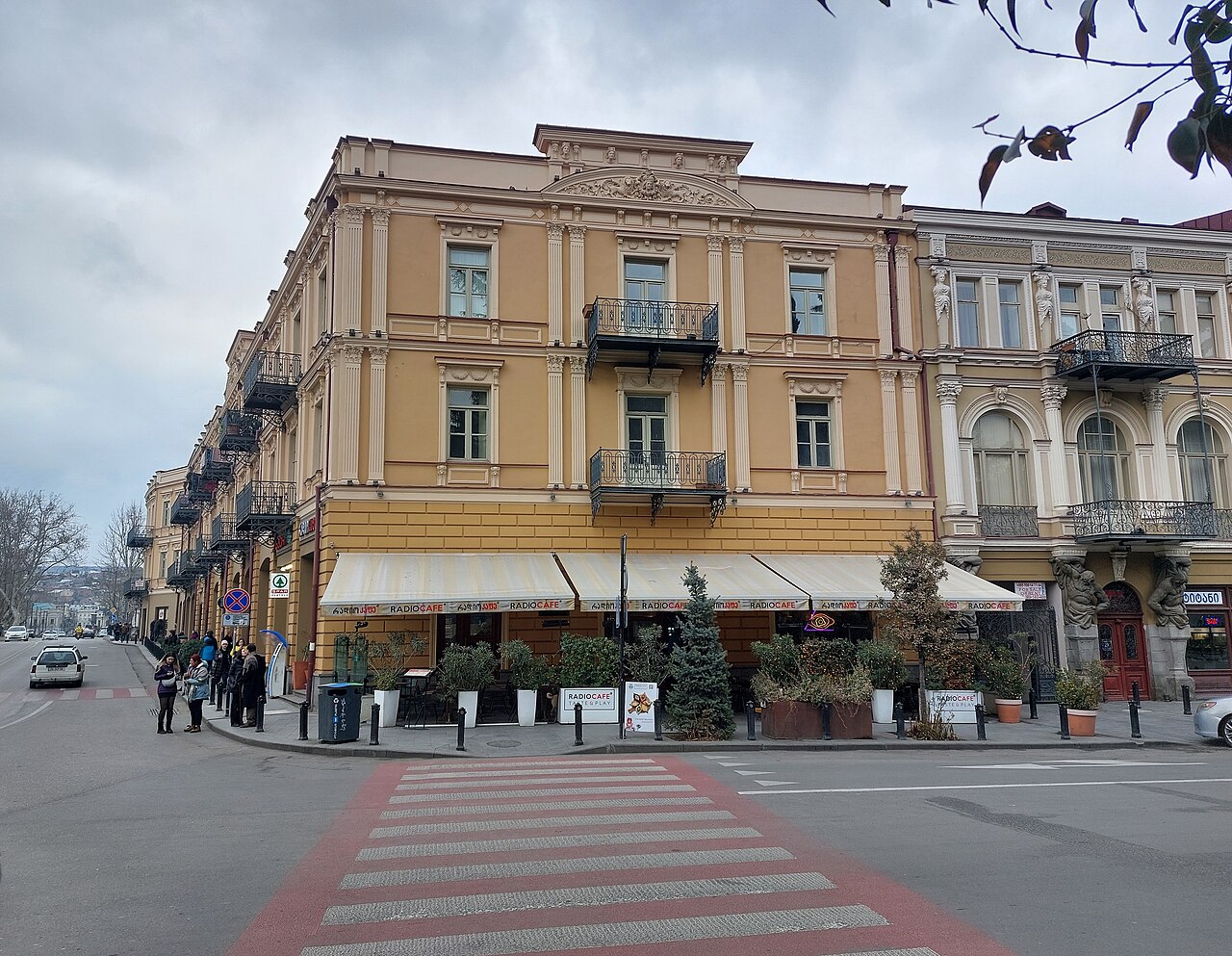
The mechanics matter more than the statistic. A green pedestrian signal here does not clear the crossing: drivers turning in from the perpendicular street get their own green at the same moment, and they thread past you rather than wait.
Our advice: cross in a clump. Wait the extra ten seconds for two or three Georgians to step out, and go when they go — they know which junctions the drivers actually respect. Where a pedestrian underpass exists on the big avenues, take it even when the surface crossing looks quicker.
One thing has changed the geometry of the centre this year. Rustaveli Avenue closed to vehicles on 23 July 2026 for a four-month rehabilitation running to the end of November, covering the two-kilometre stretch between Tamar Chovelidze Street and Liberty Square, as reported by Civil.ge. The closure takes in the adjacent stretch of Merab Kostava Street too, which means the lanes below Rustaveli and around Freedom Square are absorbing traffic they were never built for. For how the metro, buses and cards fit together while the works are on, see our guide to getting around Tbilisi.
2. Stray dogs, mostly at night
Tbilisi has an enormous free-roaming dog population — specialists quoted in Georgian media put it above 45,000 in the capital alone, against roughly 26,000 that the municipal shelter has tagged, neutered and vaccinated. The plastic tag clipped through a dog’s ear is the thing to look for: it means that animal has been sterilised and vaccinated against rabies and returned to its street.
By day they are furniture. They sleep across pavements, ignore you completely, and locals step over them without breaking stride. After midnight the same dogs behave differently, because after midnight they are a group with a block to defend. A pack that barks at you from twenty metres is telling you to walk on, not attacking.
What to do is unglamorous: keep walking at your normal pace, don’t run, don’t crouch, and don’t feed one dog while three others watch. Cyclists and joggers get chased far more often than people simply walking. If an untagged dog breaks the skin, wash it hard with soap and water and get to a clinic the same day. That is a rabies question, not a wound question.
A small aside that explains the whole system: many Tbilisians know the dogs on their street by name and feed them. Nobody is going to remove them for you.
3. Getting overcharged, but only if you flag a car in the street
The classic Tbilisi rip-off needs your cooperation. It happens when you raise a hand at an unmarked white sedan outside the airport, the train station or Meidan, and accept a price the driver invents by looking at your luggage. Quotes of 50 to 100 lari for rides the app prices in single digits are the standard version.
Bolt removes the entire category. The fare is fixed in the app before you accept it, the route is logged, and in August 2026 ordinary cross-town hops were quoting in the region of 6 to 15 lari, with the airport run higher and surging in the small hours. Yandex Go operates too, though Bolt has the deeper driver pool. Our full walkthrough is in the Bolt taxi in Tbilisi guide.
Install it before you land, while you still have hotel wifi and a working phone number.
4. Pavements, unlit stairwells and things with no railing
Tbilisi’s Old Town and Sololaki are beautiful partly because they haven’t been renovated, which is also why the ankle count is high. Paving slabs rock underfoot. Manhole covers go missing and don’t always get replaced. Kerbs vary by fifteen centimetres over a single block, and the wet limestone in the Old Town lanes turns genuinely slippery in rain.
The bigger hazard is indoors. Those carved wooden galleries everyone photographs sit above communal stairwells that are frequently unlit, sometimes missing a balustrade, occasionally missing a step. If your guesthouse is on the third floor of a 19th-century building, walk the stairs once in daylight and use your phone torch coming home.
5. Pickpocketing, in about four places
The FCDO’s own summary is blunt: crime levels are low, with pickpocketing a risk in crowded areas. That is an accurate description of the city. No organised phone-snatching scene, no moped grabs, no distraction teams working the cafés.
Where an opportunist has a realistic chance is narrow and predictable: the Sunday crush at Dry Bridge Market, a full marshrutka, the metro at 6pm on Rustaveli or Liberty Square, and the fringes of a large crowd. Front pocket or zipped bag in those four places and you have covered it. Use ATMs attached to TBC or Bank of Georgia branches rather than standalone machines in unlit passages, and count change at markets. Cards work almost everywhere in the centre now, so there’s little reason to carry more than 100 lari.
6. Demonstrations on Rustaveli Avenue
Reported neutrally, because it is a live political situation and not a spectacle. Continuous demonstrations have been held outside the Parliament of Georgia on Rustaveli Avenue since 28 November 2024, when the government suspended EU accession talks after disputed parliamentary elections. By August 2026 the count had passed 620 consecutive days. Protesters are calling for fresh elections and the release of people detained during the movement.
Most nights are sizeable and orderly. On a minority of nights police have used water cannon and tear gas to clear the avenue, and several thousand people have faced administrative proceedings over the period. With Rustaveli dug up for the roadworks, some gatherings have shifted to the square outside Tbilisi City Hall on Liberty Square.
The FCDO position is to avoid large political gatherings, noting that tensions can escalate without warning. Nobody is targeting foreigners, but tear gas does not check passports. Our advice: don’t treat a protest as an attraction to photograph from inside it. If you’re staying near Rustaveli, ask your host what time the crowd builds, and check our Tbilisi travel guide for neighbourhoods clear of it entirely.
What people worry about that almost never happens
Here is where the usual running order finally gets its turn, and it’s short.
- Violent crime against visitors. Rare enough that it makes the national news. Georgia rebuilt its police force in the mid-2000s and the everyday result is a city where laptops sit unattended on café tables.
- The Russia question. Abkhazia and South Ossetia are Russian-occupied and carry the strongest warnings going: the FCDO advises against all travel to both, and against all but essential travel to the strips beside the administrative boundary lines, while the US State Department rates both Level 4, Do Not Travel. Those warnings cover those regions, not Tbilisi, which has no advisory against it. No tourist route out of the capital, Mtskheta and Kakheti and Kazbegi included, crosses either line.
- Tap water. Drinkable. It comes largely off the mountains and residents drink it untreated every day.
- Food. Hygiene in restaurants and bakeries is good. The most common ailment visitors report is having said yes to a fourth glass of homemade wine.
- Terrorism and kidnapping. Not a feature of the risk picture here.
Solo women and LGBTQ travellers
For women travelling alone, Tbilisi is one of the easier cities in the wider region. Street harassment is mild by regional standards, a stare or an occasional comment rather than anything persistent, and solo diners are unremarkable. The real frictions are the ones already listed: the late-night ride home, the unlit stairwell, the pavement. Cover your head and shoulders in churches; wraps are usually at the door. Our Tbilisi solo travel guide goes into accommodation and meeting people properly.
For LGBTQ travellers the honest answer is more complicated than the crime figures suggest. Same-sex relationships are legal, and Tbilisi has a real queer scene around Fabrika and the techno clubs. But parliament passed a law on family values and the protection of minors in September 2024 that provides a legal basis to bar Pride events and public LGBT-related displays, and the FCDO explicitly warns that LGBT+ people may face harassment and assault. Discretion outside known-friendly venues is the practical norm rather than an over-caution. We cover the detail, including which venues are welcoming, in is Georgia LGBTQ friendly.
Two admin items that matter more than any of this
Since 1 January 2026 Georgia requires every visitor to hold health and accident insurance covering at least 30,000 Georgian lari for the full stay, arrival and departure days included. It applies to infants as well as adults, the policy must be in Georgian or English, and border officers can ask for it and refuse entry without it — the requirement is set out on the FCDO entry requirements page. This is now the likeliest way for a Tbilisi trip to go wrong, and it happens before you have left the airport at home.
The other item takes ten seconds. Georgia runs one emergency number for police, ambulance and fire: 112, with operators who handle calls in English. Save it, and save your accommodation address in Georgian script in the same note, because a driver or an ambulance crew needs the Georgian, not the transliteration.
If you take one habit away from this page, make it the crossing one: at every junction, find the car that is turning into the crossing you are already standing on. That single check covers the most likely thing that will ever go wrong here.
Frequently asked questions
Is Tbilisi safe to visit in 2026?
It is. No government advisory covers Tbilisi itself — the UK restrictions apply solely to Abkhazia and South Ossetia, several hours away and off every tourist route. Plan around road-crossing habits and a nightly protest outside Parliament, and the city behaves like an ordinary, low-crime European capital.
Do I need travel insurance to enter Georgia?
Yes, and this one has teeth. From 1 January 2026 every arriving visitor, children included, must carry health and accident cover worth at least 30,000 GEL for their whole stay, documented in Georgian or English. Border staff may ask to see it, and entry can be refused if you can’t produce it.
Are the stray dogs in Tbilisi dangerous?
Almost never during daylight, when they sleep through the city around them. An ear tag confirms the animal was sterilised and given a rabies shot. Groups get territorial late at night, so keep a steady pace past them, skip the sudden movements, and see a doctor the same day if an untagged dog breaks the skin.
Should tourists avoid the protests in Tbilisi?
Watch from a side street if you want to see one, and don’t stand inside the crowd. Gatherings outside Parliament have run nightly since late November 2024 and are overwhelmingly peaceful, but police have deployed tear gas and water cannon on occasion, and a dispersal makes no distinction between locals and visitors.
Featured image: Kober (CC0) via Wikimedia Commons.


Leave a Reply