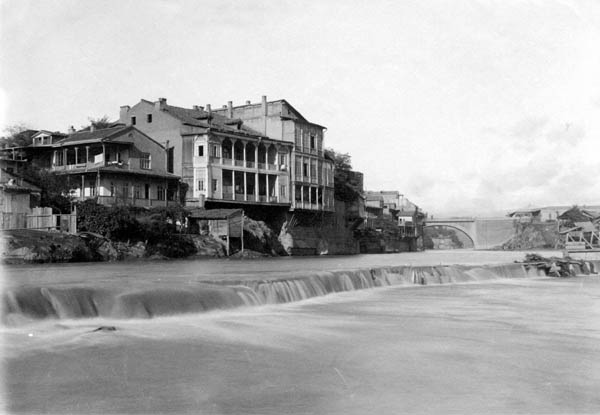
Tbilisi is about 1,500 years old and looks about 150. Hold on to that gap, because most visitors arrive expecting a medieval city and find a nineteenth-century one. The history of Tbilisi is long and real, but the buildings that carried it were nearly all destroyed in one week of September 1795, and what you walk through now is the rebuild.
So this isn’t a timeline. It’s a history arranged around things you can stand in front of. About a day’s walking, end to end.
The sulphur springs: why the city is here at all
Start in Abanotubani, the bathhouse quarter under the cliff, where the brick domes sit in the ground like half-buried kilns and the air smells faintly of struck matches. That smell is the founding document. Hot sulphurous water comes up here on its own, and a settlement grew on top of it.
The legend credits King Vakhtang I Gorgasali in the fifth century: hunting here, his bird brought down a pheasant, both fell into a hot spring, and the king ordered a city built on the spot. Tbili means warm in Georgian.
Historians are more cautious. People were living here well before Vakhtang, so the pheasant story is a foundation myth and the traditional date of around AD 455 is a convention, not a fact. His son is better attested: King Dachi moved the royal seat from Mtskheta in the 520s or 530s, and that’s when Tbilisi becomes a capital rather than a spa.
The one thing you can see from that century is a church. Anchiskhati Basilica, a low three-nave stone hall a few minutes from Freedom Square, is traditionally dated to Dachi’s reign and is the oldest surviving building in the city. Its brick bell tower is seventeenth-century and it has been re-roofed many times, but the walls are the walls. If you enter one very old room in Tbilisi, make it that one. Our guide to the city’s Georgian Orthodox churches covers the etiquette first.
Narikala: four centuries of foreign rule, in one hill
Look up from the baths and the fortress is right there. Narikala has a fourth-century citadel core, but the layer that matters most is Islamic. Arab armies took Tbilisi in the 730s and an emirate held it for close to four centuries. The emir’s palace stood inside these walls, and much of the fortress’s expansion is Umayyad work of the seventh and eighth centuries. For longer than the United States has existed, Georgia’s capital was a Muslim-ruled city inside a Christian kingdom, and that geography survives: the Jumah Mosque and the Great Synagogue are both a short walk from the baths.
Be honest about what you’re looking at, though. Most of the standing masonry is sixteenth and seventeenth century, Safavid-era, patched after an 1827 earthquake. The white church on the ridge was rebuilt from scratch in the 1990s. The ramparts are fenced off for restoration at the moment, so plan on the ridge path and the cable car rather than walking the walls. Our Narikala fortress guide has the access details.
The golden age you almost can’t see
David IV, called the Builder, beat a coalition of Muslim armies at Didgori in 1121 and took Tbilisi back the following year, capital of a unified Georgian kingdom again. He’s also remembered for not sacking it: the city’s Muslims kept their mosque and their tax privileges, unusual behaviour for a twelfth-century conqueror. His great-granddaughter Tamar then reigned from 1184 to 1213 over the largest and richest Georgia there has ever been. Georgians call her king, not queen.
Here’s the frustrating part. Barely anything of that Tbilisi stands. Jalal ad-Din of Khwarezm broke in and burned the city in 1226, Mongol rule followed, and Timur sacked it again in 1386. The golden age left its architecture in the countryside, at Gelati and Vardzia, not in the capital.
What you can stand in front of is Metekhi Church on its cliff above the river, rebuilt in the 1280s on the site of the royal chapel and heavily restored since, with the equestrian Vakhtang Gorgasali beside it. The statue is Soviet, 1967. Almost nothing here is as old as it feels.
1795: the week that erased the medieval city
If you remember one date, remember this one. King Erekle II had signed a protection treaty with Russia; Russia sent no troops when it mattered. Agha Mohammad Khan Qajar of Persia beat the outnumbered Georgian army at Krtsanisi over four days in September 1795, then let his men work through the city for about nine days, according to the standard account of the battle. Tens of thousands were killed or marched off as captives.
This is the answer to a question good visitors keep asking: why doesn’t anything domestic in Old Town predate 1800?
Because there was nothing left to predate it. The carved balconies, the internal courtyards, the pastel plaster fronts, the whole postcard idea of old Tbilisi is nineteenth century, built on the footprint of what burned. Knowing that makes the surviving churches feel like survivors rather than furniture. Our Old Town guide walks the quarter street by street.
Russian Tiflis and the invention of Rustaveli Avenue
Russia annexed the kingdom of Kartli-Kakheti in 1801 and ran the whole South Caucasus from here for a century, under the name Tiflis. The empire rebuilt the city in its own image, and the clearest statement of that is the avenue. Rustaveli was cut to link the cramped old town to the new administrative districts, and named Golovin Avenue in 1841 after a Russian commander stationed here. In 1918, during Georgia’s brief first independence, it was renamed for the twelfth-century poet Shota Rustaveli. A pointed thing to do to a street named after a general. The opera house, the theatre, the former Viceroy’s palace and the museums all sit on that stretch, checked September 2026 against RFE/RL’s history of the avenue.
One detail worth carrying with you: the parliament building stands where a Russian Orthodox military cathedral stood until the Bolsheviks pulled it down in 1930. The two halves went up between 1933 and 1938, and between 1946 and 1953. Every protest you’ve ever seen on the news from Georgia happens on that spot. See our Rustaveli Avenue guide for what’s worth going inside.
Soviet Tbilisi, and 9 April 1989
The Red Army took Tbilisi in February 1921 and Georgia spent seventy years inside the Soviet Union. The physical legacy is everywhere once you see it: the metro, opened in 1966, the housing blocks at Gldani and Varketili, and a lot of late-Soviet modernism only now being taken seriously as architecture.
The date that still matters is 9 April 1989. Soviet troops moved on a peaceful independence demonstration outside parliament and twenty-one people were killed, several beaten with sapper shovels. Most were women. There’s a small memorial on the pavement by the steps. Independence was declared on the same date two years later.
The dark years, 1991 to 2003
Then it went very badly wrong. In December 1991 opposition fighters shelled the parliament from Rustaveli itself, tanks and mortars on a street of theatres, and the fighting into January 1992 gutted several historic buildings and forced out the country’s first elected president. Wars in Abkhazia and South Ossetia followed. Inflation ran into the thousands of percent.
For most of the 1990s Tbilisi households had a few hours of electricity a day in winter, often less. People describe hauling water up unlit stairwells and burning furniture. Ask anyone over forty and you’ll get a version of it inside a minute.
It ended in November 2003. Rigged elections brought crowds onto Rustaveli, Mikheil Saakashvili led demonstrators into the parliamentary chamber carrying roses, and Eduard Shevardnadze resigned on 23 November. Nobody was shot. That restraint is why it’s the Rose Revolution and not something else.
The rebuild, and the argument about it
The Saakashvili government rebuilt fast and photogenically. The glass-and-steel Bridge of Peace opened in 2010, Rike Park went in opposite, and a 2009 programme called New Life for the Old Town poured money into the quarter.
Heritage specialists were not impressed, and the objection is specific rather than nostalgic. Much of the work was facadism: street-facing shell kept, interior gutted, or the original knocked down and replaced by a modern replica of itself. Buildings protected under the city’s own listing system came down anyway, and critics argued the point was property values, not conservation. The openDemocracy account of that period is the sharpest short read on it.
Our advice: judge it street by street, not as a verdict on the whole city. Some blocks near Meidan are stage sets and feel like it. Two streets uphill in Sololaki there are 1890s stairwells with their original painted tilework and a hole in the roof, decaying, and far more moving. Both are the modern history of Tbilisi. Only one survives without money.
Frequently asked questions
How old is Tbilisi?
The conventional founding date is the mid-fifth century, which puts the city at about 1,570 years. People lived on the site before that, so treat the number as tradition rather than measurement.
What is the oldest building in Tbilisi?
Anchiskhati Basilica, a sixth-century church near Freedom Square, though parts have been rebuilt since. For fortifications, the citadel core of Narikala is older. For houses, nothing beats the early 1800s.
Why was Tbilisi called Tiflis?
Tiflis was the Persian and then Russian rendering of the Georgian name, and it stuck as the international form through the imperial century. The modern spelling was officially adopted in 1936. You’ll still see Tiflis on old maps and wine labels.
Is one day enough to see historic Tbilisi?
For the core thread, yes. Baths, Metekhi, cable car to the fortress ridge, down through Old Town to Sioni and Anchiskhati, then Rustaveli late in the afternoon. Add a second day for the Soviet outskirts or the National Museum.
One last thing, and it’s the most useful. The National Museum on Rustaveli has a permanent exhibition on the Soviet period, built largely out of secret police files, and it isn’t a comfortable room. Go at the end, not the beginning. Everything else here is stone and dates; that floor is the part people you pass on the street still remember.
Featured image: Paata Vardanashvili (CC BY 2.0) via Wikimedia Commons.

Leave a Reply