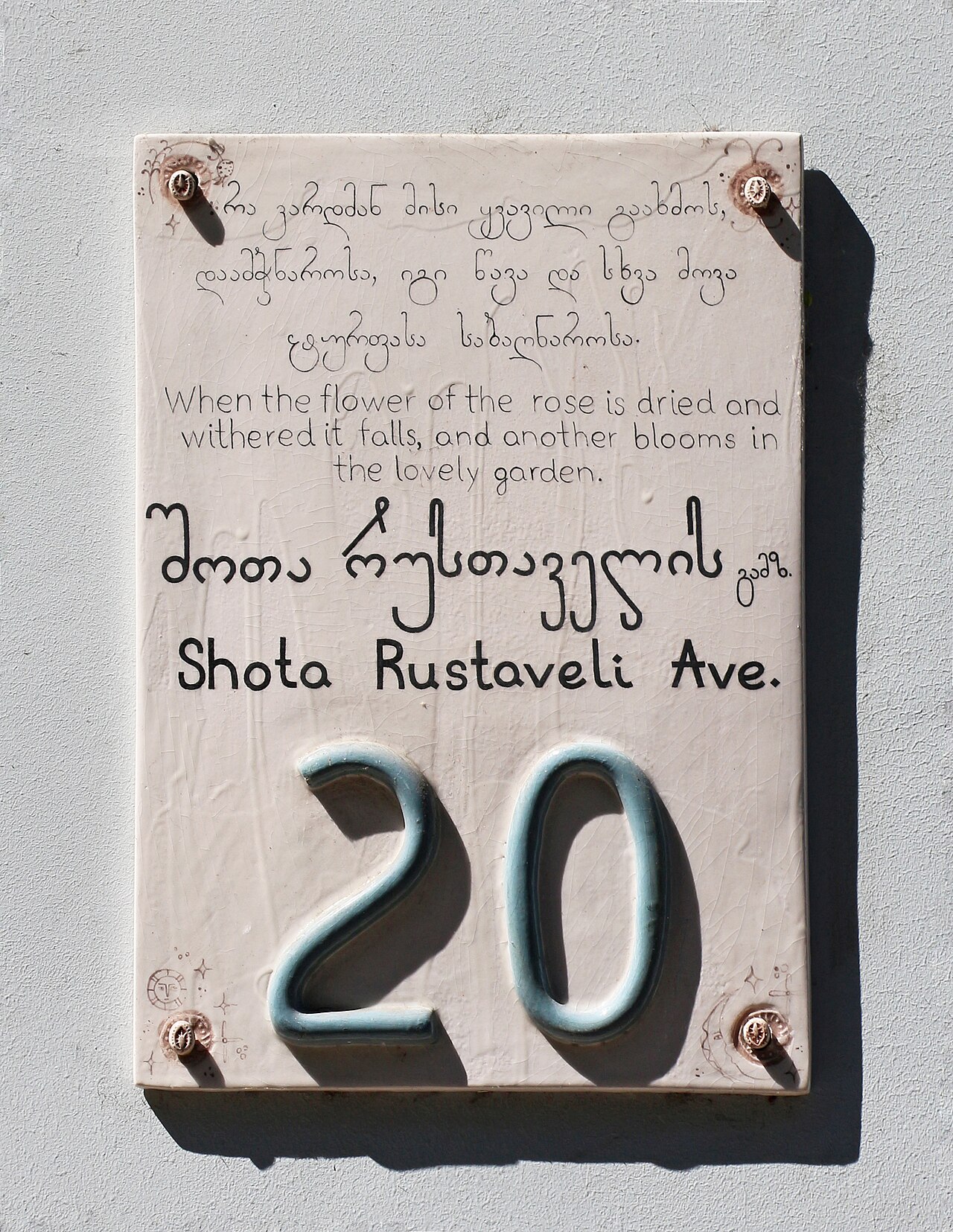
Rustaveli Avenue is the beating heart of central Tbilisi and the street most visitors walk first. Running roughly 1.5 kilometres from Freedom Square in the south to Rustaveli metro station in the north, this leafy boulevard lines up much of Georgia’s political, cultural and architectural weight in a single stroll. It carries the name of Shota Rustaveli, the medieval poet who wrote the national epic The Knight in the Panther’s Skin, and it has been the stage for the country’s grandest theatre and its loudest political moments alike. This guide covers what the avenue is, the landmarks that line it, how to reach it, when to visit, and what you should honestly know about the ongoing demonstrations before you go.
Before you go, one thing that changes the walk right now: Rustaveli Avenue closed to vehicle traffic on 23 July 2026 for a rehabilitation of the two-kilometre stretch between Tamar Chovelidze Street and Freedom Square, scheduled to run to the end of November, per Civil.ge (checked August 2026). You can still walk it and the landmarks stay open, but expect hoardings, dug-up pavement and rerouted buses along the way. If you want the boulevard at its best, this is a year to see it and come back.
Rustaveli Avenue at a glance
- Length: about 1.5 km, from Freedom Square to Kostava Street
- Named after: Shota Rustaveli, Georgia’s most celebrated medieval poet
- Former name: Golovin Street, until it was renamed in 1918
- Metro: Rustaveli station (north end) and Liberty Square / Freedom Square station (south end)
- Best for: walking, museums, cafes, theatre and architecture spotting
- Good to know: the pavement in front of Parliament is an active, near-daily protest site
What is Rustaveli Avenue?
Rustaveli is Tbilisi’s main ceremonial boulevard, laid out during the 1840s when the city was being modernised under Russian imperial rule. It was originally called Golovin Street after a Russian viceroy, and took its present name in 1918. Today it functions as the spine of the city centre: government offices, museums, theatres, hotels, banks and shopping all cluster along or just off it. Broad pavements, plane trees and grand facades give it a distinctly European, almost Parisian feel, which is why so many walking tours of the capital begin here.
One practical quirk: for much of its length there are no street-level pedestrian crossings, so you cross via underground passageways. These underpasses double as small marketplaces and are worth a look in their own right.
Landmarks along the avenue
Parliament of Georgia
The imposing Parliament building, with its curved colonnade, is the avenue’s most politically charged address. Beyond its Soviet-era neoclassical architecture, the pavement in front of it is Georgia’s default protest ground. It was here that Soviet troops violently dispersed pro-independence demonstrators on 9 April 1989, and the same steps saw the 2003 Rose Revolution and the 2019 unrest. It remains the focal point of the demonstrations that have continued since late 2024 (more on that below).
Georgian National Museum
The Simon Janashia Museum of Georgia, part of the Georgian National Museum at 3 Rustaveli Avenue, is the single best indoor stop on the street. Its collections span from prehistoric hominid remains found in Georgia to a sobering Soviet Occupation exhibit and a famous treasury of ancient goldwork. If you only enter one building on Rustaveli, make it this one.
Opera and Ballet Theatre
The Tbilisi Opera and Ballet Theatre (the Paliashvili Opera House) is arguably the avenue’s most beautiful building. Rebuilt in a striped neo-Moorish style after a nineteenth-century fire, its richly ornamented facade and gilded, red-velvet interior are a genuine spectacle. Catching an evening performance here is one of the loveliest things you can do in the city.
Rustaveli Theatre and Kashveti Church
The Shota Rustaveli State Academic Theatre, dating to the 1880s, is Georgia’s leading drama stage and worth admiring even from the outside. Almost opposite Parliament stands Kashveti Church of St George, completed in 1910 in a clean neo-classical Georgian style; step inside for a moment of calm and its modernist frescoes.
Hotels, the Gallery mall and more
The landmark hotel at the Freedom Square end, long known to travellers as the old Tbilisi Marriott, anchors the boulevard’s grand hospitality tradition. Nearby, the Tbilisi Gallery shopping mall combines high-street shops with a cinema and food court, while the Georgian National Academy of Sciences tower and assorted galleries and bookshops fill in the gaps. It is an easy street to browse for an hour or three.
Things to do on Rustaveli Avenue
- Walk it end to end: start at Freedom Square and head north, pausing at whatever facade catches your eye
- Museum time: budget at least 90 minutes for the Georgian National Museum
- Coffee and people-watching: the side streets and courtyards off Rustaveli hide some of Tbilisi’s best cafes and wine bars
- Catch a show: book ahead for the Opera House or Rustaveli Theatre
- Shop: the Gallery mall and the underpass markets cover everything from souvenirs to fashion
For a wider itinerary, our guide to the best things to do in Tbilisi slots the avenue into a full day around the city centre.
Getting there: metro and access
The avenue is bracketed by two Tbilisi Metro stations, which makes it very easy to reach. Rustaveli station, opened in 1966, sits at the northern end, and Liberty Square (Freedom Square) station, opened in 1967, at the southern end. A single metro or bus ride costs one lari on a MetroMoney card, and trains run frequently. Because the two stations are only a fifteen-minute walk apart, you can ride to one end, stroll the whole avenue, and catch the metro back from the other.
When to visit and events
Rustaveli is at its best on a mild morning, when the museums open and the plane trees throw shade over the pavement. On national holidays and festival days, sections of the avenue are closed to traffic and given over to concerts, parades and street stalls, and it becomes a genuinely festive pedestrian space. In October 2024 the historic cable car linking Rustaveli with Mtatsminda Park reopened after 34 years, adding a scenic ride up the mountain to the top of a Rustaveli itinerary.
Nearby: Freedom Square and Mtatsminda
At the southern end, Freedom Square with its golden St George column is a natural starting or finishing point, and the gateway to the cobbled Old Town beyond. From the northern end you can head up towards Mtatsminda, the mountain that overlooks the city, for panoramic views and the amusement park at the top. To understand how Rustaveli connects to the rest of the city, see our Tbilisi neighbourhoods guide.
Safety and the demonstrations: an honest note
Tbilisi is generally a safe, welcoming city for visitors, and Rustaveli in daytime is busy and relaxed. There is, however, one thing you should know before you go. Since 28 November 2024, when the government announced it was suspending Georgia’s EU accession talks, the pavement in front of Parliament has hosted near-daily pro-EU demonstrations. Crowds have at times filled the entire avenue, and by mid-2026 the protests had passed their 580th consecutive day.
Most gatherings are peaceful, but there have been episodes where police used tear gas, water cannon and rubber bullets, and roads were blocked. The sensible advice for travellers is simple: it is fine to walk the avenue, but avoid the immediate area around Parliament during large evening gatherings, keep an eye on local news, and do not get drawn into the crowds. For a fuller picture, read our dedicated piece on whether Tbilisi is safe.
Frequently asked questions
How long is Rustaveli Avenue and how long does it take to walk?
Roughly a quarter of an hour at a steady pace covers the full 1.5 km. Build in half a day instead if the National Museum, the cafes and the shops are part of your plan.
Which metro station is Rustaveli Avenue?
Both ends have their own stop: Rustaveli to the north and Liberty Square to the south, on the same line. Either gets you there for one lari, and since the two sit a short stroll apart, many people ride in at one end and out at the other.
Is it safe to visit Rustaveli Avenue right now?
By day, yes, it feels like any other lively European boulevard. The stretch outside Parliament is a different matter in the evenings, when the pro-EU rallies that began in late 2024 gather and have occasionally turned tense, so give that section a miss once crowds build.
Who was Rustaveli Avenue named after?
Shota Rustaveli, the poet behind The Knight in the Panther’s Skin, Georgia’s national epic. Before 1918 the boulevard was Golovin Street, carrying the name of a Russian viceroy instead.
Sources: Wikipedia: Rustaveli Avenue, Advantour: Rustaveli Avenue, Tbilisi, and Wikipedia: 2024–2025 Georgian post-election protests.
Last checked: July 2026.
Featured image: Bernard Gagnon (CC BY 4.0) via Wikimedia Commons.

Leave a Reply