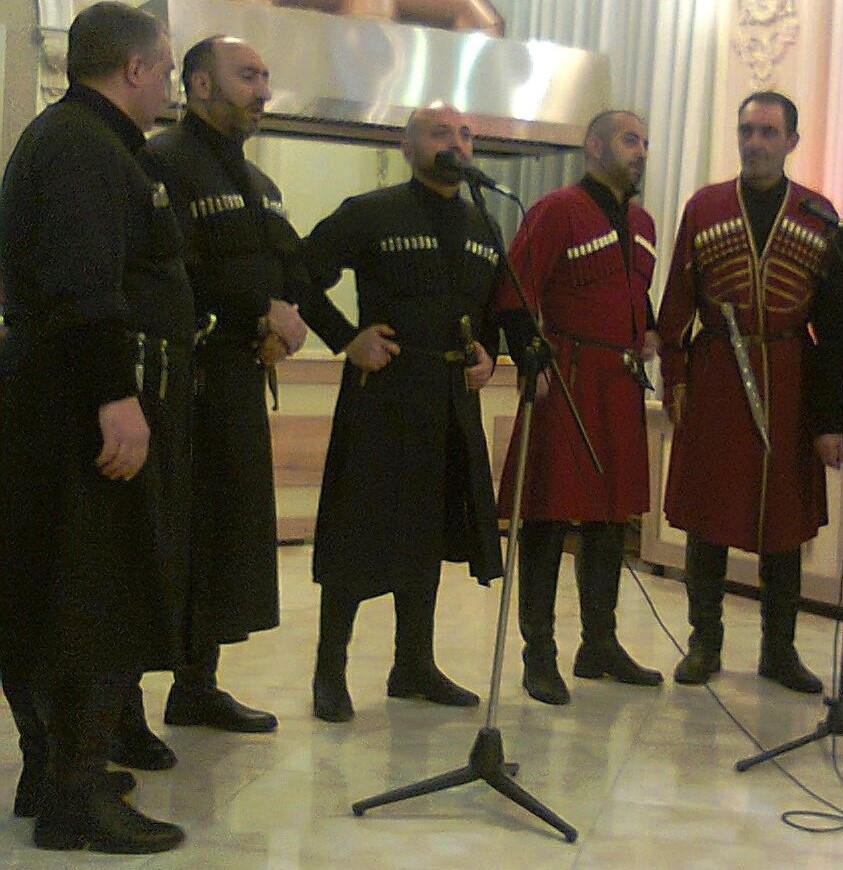
Three singers, three independent lines, and a tuning that matches no key on a piano. That is Georgian polyphonic singing compressed into one sentence, and it explains why the first thirty seconds often land on a Western ear as slightly out of tune. The choir is not out of tune. It is precisely in tune with a different system.
If you only want the practical half: Sunday liturgy at Anchiskhati Basilica in the Old Town, Folk Friday at Sheen-Aura in Saburtalo, and the Art-Gene festival in late July. Everything below explains what you are hearing and which of those actually deserves your evening.
Why it sounds wrong before it sounds right
Blame the piano. Almost every ear raised on Western music has been trained by equal temperament, the compromise that splits the octave into twelve identical steps so a keyboard can play in any key without retuning. Georgian singers never made that compromise. They had no keyboard to please.
Acoustic measurement of field recordings by Frank Scherbaum and colleagues, published in a 2022 corpus study of traditional Georgian singing, found fourths and fifths sitting almost exactly where physics puts them, at 500 and 700 cents. The thirds are the problem. They cluster near 350 cents, neither the 300 of a minor third nor the 400 of a major one. That is the crack between two keys, and no piano can play it.
That single interval does most of the strangeness. A chord built on a neutral third refuses to declare itself happy or sad, and your ear waits for a resolution that never arrives. The same study found a second sounding between two voices sits near 200 cents, while the same step sung one note after another runs narrower at 150 to 180. Harmony and melody are tuned by different rules inside one song.
Give it four minutes. The discomfort is a training artefact, and it wears off fast.
Three voices, not a tune with backing
The other adjustment is structural. In most Western choral music one line carries the melody and the rest support it. Here all three parts do their own work at once, and which one you follow is your choice, not the composer’s. There is no composer.
The regional styles differ sharply, and knowing which is in front of you changes what you listen for.
Kakhetian, from the wine east
Two ornamented solo lines wind around each other above a held bass drone from the rest of the room. The drone barely moves. The soloists move constantly. UNESCO describes this eastern form as polyphonic dialogue over a bass background, which is exact. It is a conversation with a floor under it, and it is the sound most closely tied to the long table.
Gurian, from the west, with the yodel
Western Georgia contributes contrasted polyphony with three partly improvised parts, and one unmistakable feature on top: the krimanchuli, a high male falsetto yodel that snaps between registers. Guria also produces a sound nicknamed the cockerel’s crow. If you think a man is imitating a bird over the top of a choir, you are hearing Gurian singing, and he is.
Svan, from the mountains
Svaneti sits behind the Caucasus and its singing sounds like it. The three voices move in tight blocks rather than independent curves, the intervals are harder, and the effect is closer to a wall than a weave. It is the least decorated of the three, and the one that most often shuts a room up.
The UNESCO listing, and the song that left the solar system
UNESCO proclaimed Georgian polyphonic singing a Masterpiece of the Oral and Intangible Heritage of Humanity in 2001, and the tradition was moved onto the Representative List in 2008 when that mechanism replaced the older one. Checked September 2026 against the UNESCO inscription page, both dates still stand as written.
Better story, though. In 1977 NASA bolted a gold-plated phonograph record to each Voyager probe, carrying 27 to 29 pieces of music depending on how you count. One is Chakrulo, a Kakhetian three-part song that dramatises men preparing for battle: two heavily ornamented solo voices over a choral foundation. It is also, like most Kakhetian repertoire, a table song.
Voyager 1 and Voyager 2 both carry it. Which means the furthest human-made objects from Earth are both playing a drinking song from a wine region east of Tbilisi, and that is a better fact than anything a guidebook can tell you about the region’s supra and its tamada.
Church liturgy: the honest place to hear it
Georgian sacred chant is a separate repertoire from village folk song, but it runs on the same three-voice logic and the same tuning, in buildings built to carry it. Sunday morning is the reliable window.
Anchiskhati Basilica on Shavteli Street is the standard recommendation for a reason. It is the oldest surviving church in the city, the acoustics are close and dry rather than cathedral-vast, and its resident choir has a long-standing reputation as a leading interpreter of the old chant. Services run Sunday mornings from around nine; arrive by half past and you are inside for the singing without walking in mid-liturgy.
Etiquette, because it matters more here than at any concert:
- Shoulders and knees covered. Women are expected to cover their heads, and most churches keep scarves in a basket by the door.
- No photography during the service. None. Put the phone away entirely rather than holding it face-down.
- There are no pews. Everyone stands, and standing near the back by the door is the correct place for a visitor.
- Do not applaud. It is a service, not a performance, and the singers are not addressing you.
- Leaving quietly partway through is fine. Walking across the front of the church to do it is not.
Sioni Cathedral nearby gives you a larger, wetter acoustic. Sameba above Avlabari has the biggest Sunday atmosphere and the least intimacy. The convent at Queen Darejan’s Palace pipes the service into its courtyard through speakers, the low-commitment option if you would rather not go inside. More on all of these in our guide to Georgian Orthodox churches.
Folk evenings, concerts and one honest warning
Our advice: skip the dinner-and-show restaurants unless the show is the point of the night. The big Dighomi venues, Ethno Tsiskvili and Ethnographer, run polished nightly programmes from around 8pm with dancing, sabre routines and full ensembles, and they are good at it. They are also ten kilometres out, cost well over 100 GEL a head, want a booking weeks ahead in summer, and enforce a smart-casual door policy. That is a whole evening committed to a floorshow.
The version to avoid is the Old Town restaurant that wheels three singers between tables for eight minutes, amplified over a room that never stops talking. You get the shape of the music and none of the tuning, which is the only part that makes it remarkable. Cheerful, forgettable, no reflection on the singers.
Sheen-Aura in Saburtalo is the better bet. It is a bar and restaurant inside an artist’s house, and its Folk Friday nights book strong ensembles into a small room with a garden used in summer. Small room, real ensemble, no sword dancing. For the wider picture of what else is on after dark, see our Tbilisi nightlife guide.
For concert halls, the Tbilisi Conservatoire and the Jansug Kakhidze Music and Culture Centre both programme folk and choral evenings in season, and tkt.ge aggregates the tickets. Check it days before you arrive, not on the night. The good ones sell out.
Art-Gene, and the July window
The single best concentration of regional singing in one place is Art-Gene, held at the Open Air Museum of Ethnography on the hillside above Vake. The 2026 edition ran 23 to 26 July with regional folk groups alongside the Sukhishvili company and contemporary acts, and four-day passes were priced at 145 GEL in the first release and 190 GEL in the second, per Georgia Today’s line-up announcement, checked September 2026.
That edition has passed. The festival has held to a late-July slot for years, so a 2027 visitor planning around it should pencil the last full week of July and watch artgeni.ge from spring for confirmation. Do not book flights on the strength of a pattern.
Frequently asked questions
Can tourists attend a Georgian church service just to listen?
Yes, and nobody will ask why you are there. Orthodox services in Georgia are open, free and continuous rather than seated and timed, so people come and go throughout. Behave as a guest at someone’s ceremony rather than an audience member.
Is Georgian polyphony older than European harmony?
Probably, though nobody can prove it. The tradition was oral for almost all of its life and only written down from the nineteenth century, so there is no manuscript trail to compare with the European one. Specific age claims in centuries, common in tour-guide patter, are not evidenced.
Do you need to be a musician to enjoy it?
No, but you do need a quiet room. This music is built on very small pitch differences between three voices, and any background noise erases exactly the detail that makes it worth hearing. A church, a small venue or a good recording on headphones all work. A busy restaurant does not.
Where can I learn to sing it while visiting?
Short workshops for visitors do run, mostly through independent teachers and small ensembles rather than any fixed school, and availability shifts season to season. Ask at the Conservatoire or at a folk evening instead of searching in advance. The good options rarely have the best websites.
One thing worth doing before you go. Find a Gurian recording and a Svan one, play them back to back, and notice how little they share beyond the three-voice principle. Six minutes of that does more for your ear than any amount of reading, and the first live performance you catch will land as something you recognise rather than something you endure. Pair it with a morning at Anchiskhati and you have the best hour in the city, which is saying something given everything else there is to do here.
Featured image: Ekkatterrinna (CC BY-SA 4.0) via Wikimedia Commons.




Leave a Reply