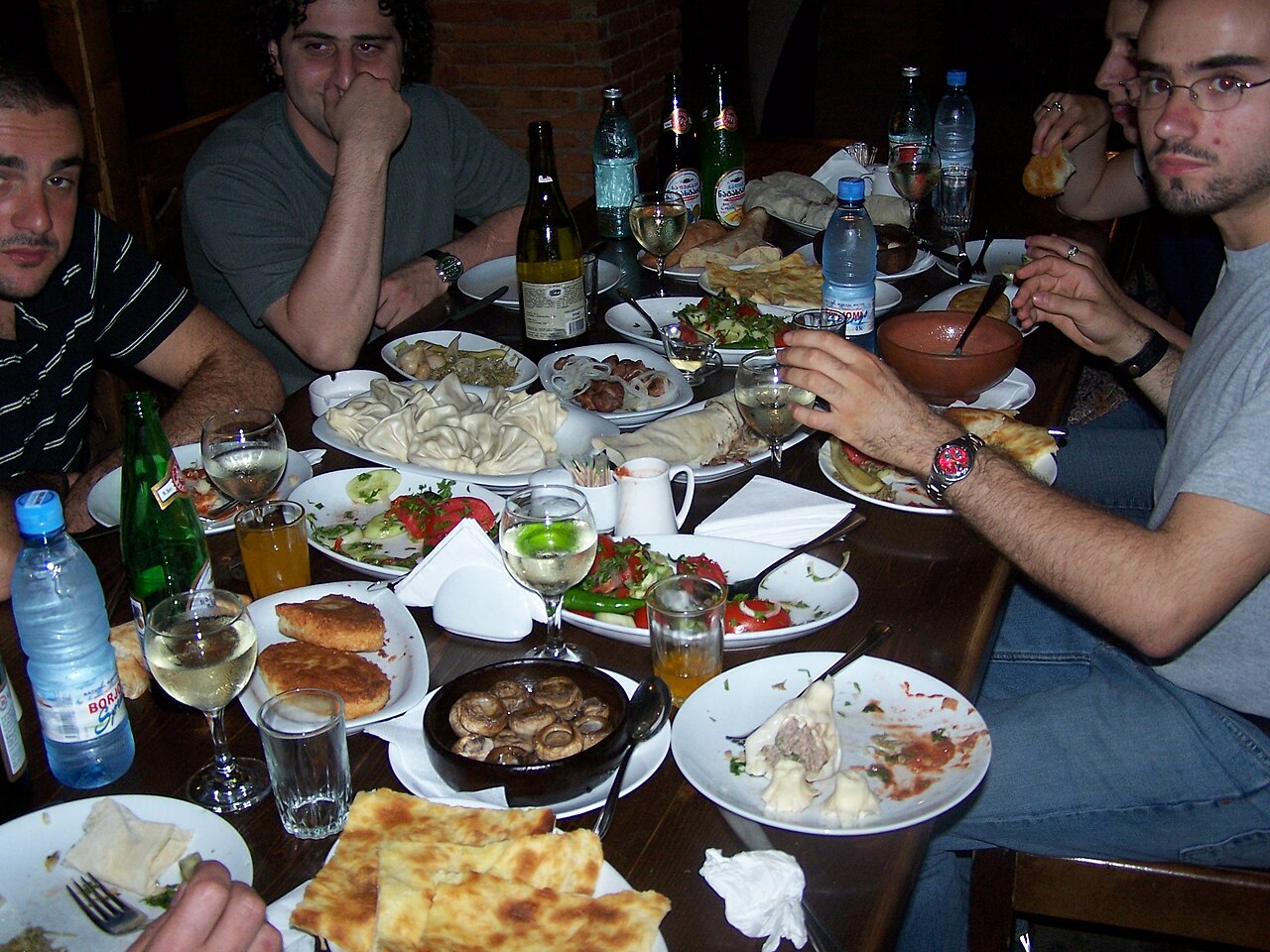
If you have been invited to a georgian supra, the single rule that keeps you out of trouble is this: don’t touch your wine until the tamada has finished speaking and drunk first. Everything else at the table is flexible. That isn’t.
A supra is a Georgian feast run by an elected toastmaster, the tamada, who sets the subject of every toast and decides when the table drinks. It is not a dinner party with speeches bolted on. The toasts are the structure, and the food sits there for hours while they happen.
What you have actually been invited to
Georgians split supras into two kinds, and the word people use tells you which evening you are walking into. A keipi is the celebratory one: a birthday, a wedding, a new job, a guest from abroad. A kelekhi is the funeral supra, held after a burial, with a fixed and sombre sequence of toasts and no singing. Both are supras. The tradition as a whole was inscribed on Georgia’s national list of intangible cultural heritage in 2017, as the reference record of the custom notes (checked September 2026).
So when someone says the word keipi, relax. It’s the good one.
The third version you will meet as a traveller is the restaurant supra: set menu, hired tamada, folk singers between courses. A real performance of a real tradition, but it ends when the booking ends. A supra in someone’s flat in Vera or a village house in Kakheti has no such brake on it.
The tamada is not the host, and not the entertainment
He is chosen at the start, either by the host or by acclaim from the table, and the qualifications are specific: he has to speak well and he has to hold his drink without showing it. Those two things together are the job. He decides the order of subjects, he decides who speaks next, and he decides how long the table stays on each theme.
What this means for you, practically, is that the supra has a conductor and you are in the orchestra. Nobody proposes a spontaneous toast over the top of him. Interrupting a toast in progress, yours or anyone’s, is the rudest available move. Eating while someone toasts is fine. Chatting across the table while someone toasts is not.
The tamada may also appoint a deputy at the far end of a long table, so the toast keeps its shape at both ends. If a stranger down the other end starts repeating what the tamada just said, that’s why.
The toast order, and what each one is for
The sequence shifts by region, by family and by occasion, and no two tamadas run it identically. But the spine of a keipi is recognisable, and the celebratory toasts have their own name: sadghegrdzelo, literally a wish for long life. At a kelekhi the toasts are shesandobari instead, and the mood is completely different.
A common shape runs something like this:
- Peace, or God, opening the table
- The reason everyone is here: the birthday, the couple, the guest
- Parents, then the wider family
- The dead, remembered by name
- Children, and whatever comes after all of us
- Georgia, and often the guest’s country alongside it
- Friendship, and the friends who aren’t at the table
- Women, sometimes as several separate toasts
- All the saints, kvelatsminda, which usually closes the table
Georgia’s national tourism board describes the same closing pattern, with the table then toasting the tamada himself once he has finished, in its own account of the custom (checked September 2026). That last one is your cue that the formal part is over.
When you drink, and when you only wet your lips
Here is the mechanic nobody explains to you in advance. The tamada speaks, sometimes for two minutes, sometimes for eight. The table holds its glasses up and waits. He drinks. Then the toast travels around the table, often to the right, and each person adds a sentence or two of their own before draining their glass.
Draining is the convention on the major toasts. It is not enforced on you.
Pour yourself less. That is the entire trick, and Georgians use it themselves. A half-finger of wine emptied with conviction reads as full participation; a brimming glass you sip at reads as reluctance. If you genuinely cannot drink, say so once at the start, to the tamada, not mid-table. Health, medication or driving are all accepted reasons and nobody will push after that. What is not accepted is skipping a toast silently while everyone else lifts their glass.
If a drinking horn appears, the kantsi, it cannot be put down until it is empty. That is the point of the shape. Take it if it is offered, but know what you are agreeing to. Our Georgian wine guide covers what will be in the jug.
The toast to the dead: put the glass down quietly
At some point the room changes temperature. The tamada names people who have died, the table goes quiet, everyone stands or sits still, and the glasses go up without touching each other.
Don’t clink. Not with your neighbour, not with anyone, not as a friendly gesture. Clinking belongs to the living toasts, and doing it here is the one mistake at a supra that lands as genuinely offensive rather than merely foreign. Watch the person next to you: if the glasses stay apart, keep yours apart too. When in doubt on any toast, wait half a second and follow the table.
Why nobody toasts with beer
Toasts happen in wine, and occasionally in chacha or brandy. Not beer. The old explanation is that beer was the drink reserved for cursing an enemy, and whatever the history, the reflex survives: raising a beer to someone’s health reads as a joke at best and a wish for their misfortune at worst.
You can drink beer in Georgia perfectly happily. Just not into a toast. If beer is what you have in front of you when a toast starts, reach for the wine, or leave your glass on the table and say the words without lifting anything. Chacha is the other thing that will land in front of you late in the evening, and it is far stronger than it tastes cold; our piece on chacha, the Georgian grape brandy explains what you are dealing with.
Alaverdi: the moment it becomes your turn
The tamada will at some point look at you and say alaverdi. He is handing you his voice. For the length of your toast, you are the tamada, and the table will listen properly. The word comes into Georgian from Turkish, and it is used both to pass the floor to a chosen person and to run a competitive round where speakers try to outdo each other on the same theme, as the entry on the expression sets out (checked September 2026).
Do not try to be clever. Stay on the subject he gave you, add one concrete thing of your own, and finish. Three sentences is a fine toast. Thanking the hosts by name, saying something true about why you came to Georgia, and wishing the same thing back to the table will do more for you than a rehearsed speech.
Our advice: prepare exactly one toast before you go and keep it in your pocket all evening. Not a party trick, just a few honest lines about your own parents or your own home that you can attach to whatever theme lands on you. Improvising in a second language, four glasses in, at a table of people who do this professionally, is a bad plan.
How long it goes, and how to get out
Four hours is a short supra. Six is normal. A village wedding can run past midnight and then restart the next day. Plan nothing afterwards, and if you have a morning flight, mention it early rather than at the moment you want to stand up.
Leaving is the part travellers handle worst. You cannot slip out mid-toast, and you should not leave before the all-saints toast if you can help it. The clean exit: wait for a gap between toasts, thank the tamada directly and by role, thank whoever cooked, and go. Offering a short toast of your own to the host on your way out converts a departure into a gift.
Bring something. Wine, a cake, flowers for the woman of the house. Money never.
Frequently asked questions
Can a woman be a tamada in Georgia?
Yes, and it happens more every year, especially in Tbilisi and among younger tables. Historically the role sat with men and the table oratory was treated as a marker of masculinity, which is why some older or rural gatherings still default that way. Nobody will object if the host names a woman.
Do I have to eat everything put on my plate?
No. Dishes arrive stacked on top of each other and the volume is deliberate, since a table that empties looks mean to the host. Take a little of many things rather than clearing anything. Saying you liked a specific dish by name counts for far more than quantity, and knowing the names helps: see what the main dishes are and how ordering works in restaurants.
What should I say in Georgian at a supra?
Gaumarjos is the word you want. It means victory to, and it closes almost every toast: gaumarjos Sakartvelos, victory to Georgia. Madloba is thank you. Attempting even those two badly will be received warmly, so don’t hold back over pronunciation.
Is it rude to refuse alcohol at a Georgian supra?
Refusing the toast is rude. Refusing the alcohol is not, provided you still raise something and still speak. Ask for water or juice in your glass at the beginning, tell the tamada why in one sentence, and take part in every toast from then on. The ritual is about the words being shared, not the volume consumed.
One last thing, and it’s the one that changes how the evening goes for you: when the tamada toasts guests, he means you specifically, and the table will turn and look. Have your reply ready from the moment you sit down.
Featured image: rugbyxm (CC BY 2.0) via Wikimedia Commons.




Leave a Reply