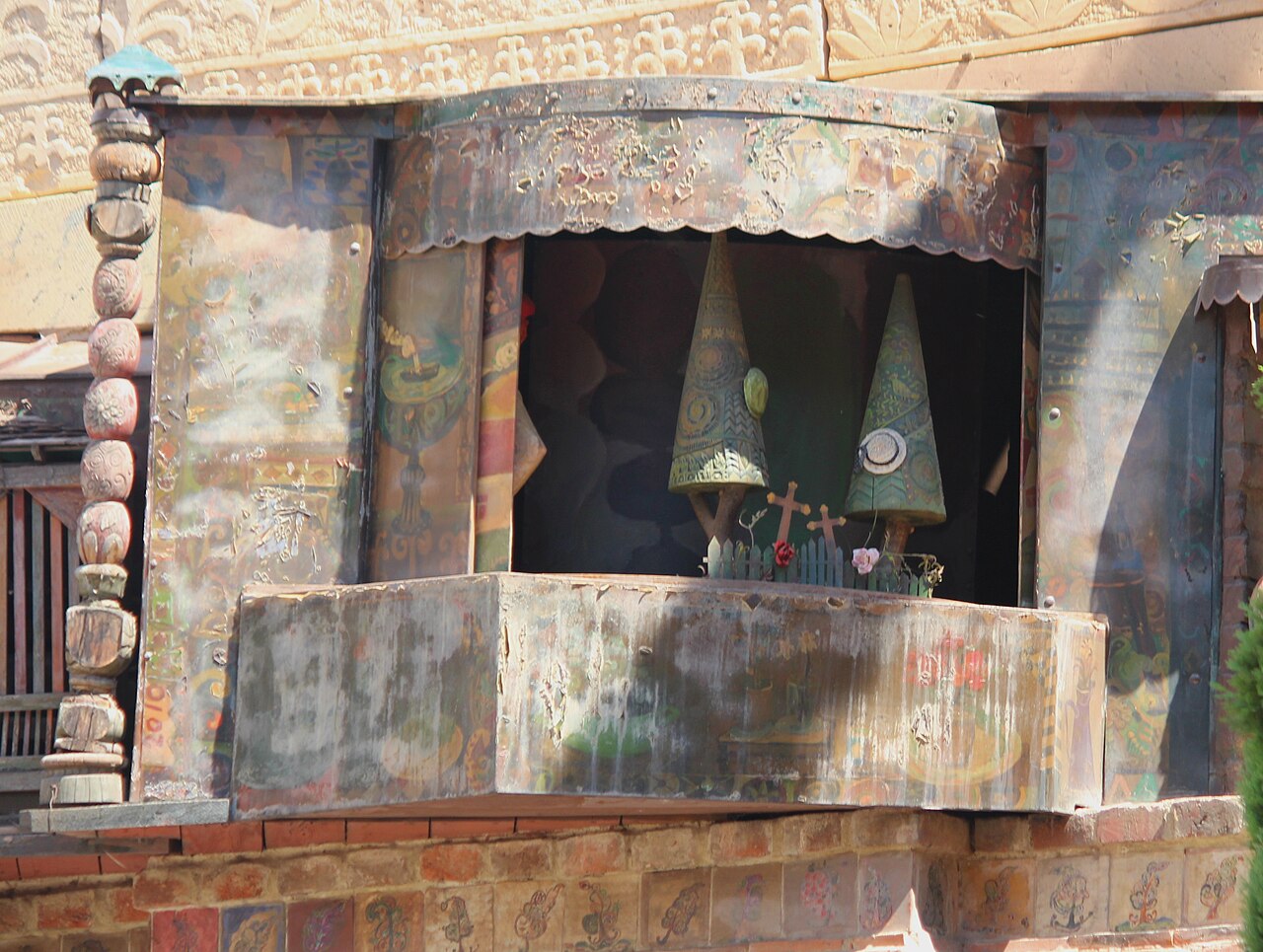
The Gabriadze Theatre is a marionette theatre for grown-ups, not a children’s puppet show, and the leaning clock tower outside it is free to stand under any hour of the day. Those are the two things most people get wrong before they arrive. The shows inside are wordless-adjacent tragicomedies about war, love and death; the tower is a separate, no-ticket attraction that draws a crowd on the hour.
It sits on Ioane Shavteli Street in the old town, a two-minute walk from Sioni Cathedral. You can enjoy the outside for nothing. Getting inside takes some planning, because there are only 80 seats.
It is not a show for kids, and that trips people up
Rezo Gabriadze, the painter, screenwriter and director who founded the place in 1981 and died in 2021, made puppets do the work that Soviet censors wouldn’t let living actors do. The result is theatre that happens to use marionettes, not marionette entertainment. His best-known piece, “The Battle of Stalingrad,” follows two horses yearning for each other through the wreckage of the 1942–43 siege. The Washington Post once wrote that it’s as far from a normal puppet show as a sneeze is from a hurricane. That’s the register.
So if you’re picturing a Punch-and-Judy booth for a five-year-old, recalibrate. The theatre generally doesn’t admit children under 12, and the material — grief, wartime loss, a bird mourning a dead street musician in “The Autumn of My Springtime” — earns that line. Bring a restless toddler and you’ll spend the hour in the lobby.
The clock tower and the angel — the free part
Gabriadze built the tilting tower next door in 2010 out of fragments of demolished old-town houses, then tiled it by hand in his own designs. It leans on purpose. It’s open to the street around the clock and costs nothing to look at, which makes it one of the easiest free stops on any walk through the old town.
Every hour a small painted door swings open near the top and a gilded angel leans out to strike a bell with a hammer. Here’s the detail nobody tells you: the sequence starts about three minutes before the full hour, so if you rock up at 3:00 sharp you’ve already missed the opening. Be at the base by :57.
There’s a bigger performance twice a day. At roughly noon and 7pm the tower stages a wordless puppet playlet often listed as “The Circle of Life” — a couple meet, marry, have children, grow old, part. It runs a couple of minutes and, like the angel, kicks off around 11:57 and 18:57 rather than dead on the hour. Free, from the pavement, no booking. If you can only spare fifteen minutes for the whole site, come for the 7pm one.
Getting tickets: the 80-seat problem
This is where visits fall apart. The hall seats 80, performances don’t run every night, and the good ones sell out. Turning up on the day and hoping for a return is a coin toss in high season.
Book ahead. Two ways that actually work, checked September 2026 against the theatre’s own performances page:
- Online through the theatre’s site or the Georgian platform tkt.ge, which handles most Tbilisi theatres and takes foreign cards.
- In person at the box office on Shavteli Street, open daily 12:00–19:00.
Prices sit in a fairly narrow band — roughly 10 to 60 GEL depending on the row and the production, with the cheaper front-of-schedule seats going first. That’s about £3 to £18, or the price of two or three khinkali dinners for a whole evening of something you can’t see anywhere else on earth. For a venue this small and this famous, it’s almost suspiciously cheap.
Our advice: book one to two weeks out if you’re travelling May through October, and don’t agonise over the seat map. In an 80-seat room there’s no bad view. Put your money toward getting a seat rather than the perfect one.
What you’ll actually watch, and in what language
The repertoire rotates through a handful of pieces. As of the current season the theatre lists shows including “The Autumn of My Springtime,” “Ramona” (a love story between two steam locomotives — yes, really), “The Eccentrics,” “Marshal de Fatie’s Diamond,” and the 1981 debut “Alfred and Violetta.” “The Battle of Stalingrad” is the one people cross borders for.
Language is the thing to check before you pay. Performances are staged in Georgian, sometimes Russian, and most carry English surtitles projected above the stage — but not every show, every night, does. Don’t assume. Read the language note on the specific date you’re booking, or ask the box office, so you’re not decoding a wartime requiem from body language alone.
Even with surtitles, a lot of the meaning lands through the puppets themselves — the way a horse’s head drops, the pause before a hand reaches out. Gabriadze designed these figures to be read that way. It’s slow, deliberate, and unlike anything you’ll have queued for back home.
Café Gabriadze, right next door
Sharing the little courtyard is Café Gabriadze, decorated in the same whimsical hand as the tower. It does Georgian dishes, coffee, cake and wine, and it’s the obvious place to sit before a show or to sit with the piece afterwards, because a Gabriadze production is not something you want to walk straight out of into traffic.
On show nights it fills with the same 80 people, so reserve a table if you want one either side of the performance. If you only came for the clock tower, it’s still a pleasant coffee stop with the best seat for the hourly angel.
The whole corner pairs neatly with a wider old-town wander — it’s an easy addition to a list of things to do in Tbilisi, and from Shavteli you’re only a short walk from the lower end of Rustaveli Avenue.
Frequently asked questions
Is the Gabriadze clock tower worth seeing without a show?
Yes, and plenty of people only do that. The tower stands on the street with no gate and no fee, so you can photograph it, catch the angel on the hour, or watch the noon and evening puppet vignette without ever buying a ticket to the theatre proper. Time your visit for just before the hour.
Can I get Gabriadze Theatre tickets on the day?
Occasionally, if there’s a matinee with gaps or a last-minute cancellation, but it’s risky. With 80 seats and no performance on some nights, walk-ups are the exception. Booking online a week or two ahead is the only reliable route in the busy months.
Are the puppet shows suitable for children?
No, treat this as adult theatre. The under-12 line reflects the content — these are meditations on war, ageing and death told through marionettes, not slapstick for small kids. Older teenagers who’ll sit quietly through subtitled drama are fine; younger children won’t get it and may struggle to stay still.
How long is a performance?
Most run around 90 minutes to two hours without an interval, so use the bathroom first and settle in. The street playlet on the tower, by contrast, is over in a couple of minutes — a completely different, bite-sized thing you can catch for free.
One last practical note: photography inside is restricted and the room is dark and hushed, so charge your phone for the tower and put it away for the show. The angel outside will happily pose again next hour.
Featured image: Benreis (CC BY-SA 4.0) via Wikimedia Commons.




Leave a Reply