Most visitors leave Tbilisi without ever seeing the strangest thing in the city. The chronicle of georgia sits on a bare hill about 12 kilometres north of the centre, sixteen dark pillars taller than an eleven-storey building, and on an ordinary weekday you can walk among them with maybe a dozen other people. There is no ticket office, no gate, no gift shop and no bus stop at the door — which is precisely why it stays quiet, and why it takes a small amount of planning to get there.
Key facts at a glance
- Sixteen columns, roughly 30–35 metres tall, clad in copper and bronze relief
- Designed by Zurab Tsereteli, begun in 1985 and never formally completed
- Marks 3,000 years of Georgian statehood and 2,000 years of Christianity in Georgia
- Free to enter, open 24 hours, no gate and no staff
- About 20–30 minutes from central Tbilisi by taxi; roughly 16–25 GEL each way by Bolt
- Allow 45–90 minutes on site, longer if you pair it with the Tbilisi Sea
What the monument actually is
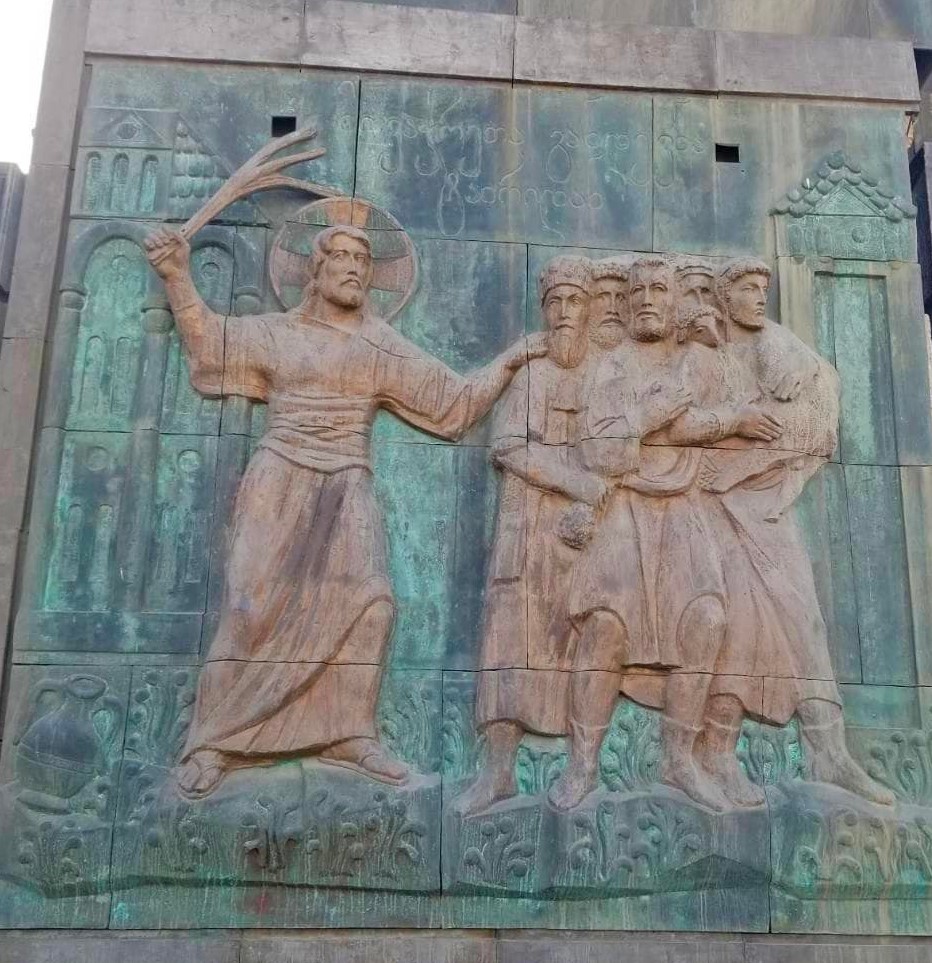
Zurab Tsereteli — the Georgian-born sculptor better known abroad for enormous public works in Moscow and New York — started the complex on Keeni Hill in 1985, and it was never brought to the finish the plans implied. Sixteen pillars stand in two facing rows on a stone platform, each one wrapped in dark metal panels that read from the ground upward: scenes from the life of Christ along the lower sections, then Georgian kings, queens and scholars above them, with figures from ordinary Georgian life and festivity higher still. Wikipedia’s entry on the monument records the 35-metre height and the twin anniversaries it commemorates.
Unfinished is not the same as ruined. Nothing is falling apart; it simply stops. Some panels are crisply detailed, others are blank metal, and the plaza between the rows is plain concrete rather than the landscaped approach a state-commissioned monument would normally get. That incompleteness is a large part of the atmosphere. You are not looking at a polished national showpiece. You are looking at something colossal that history moved on from — the Soviet Union dissolved six years after work started, and Georgia had considerably more urgent problems than metalwork on a hillside.
A small stone chapel of the Annunciation sits alongside the columns, with cloisonné enamel iconography inside, and craft workshops occupy part of the structure below the platform. Neither is the reason to come, but both are worth the two minutes.
Why it feels so empty
Three things keep the crowds down. There is no direct public transport, so casual foot traffic never materialises. There is no admission charge, which means no operator has a commercial reason to bus people in. And the site is genuinely inconvenient — far enough out that it competes with a half-day trip to Mtskheta rather than with an hour in the Old Town.
The exception is late afternoon in summer, when photographers and small tour vans do arrive. It is still nothing like the density on Rustaveli or at Narikala. If you want the plaza close to yourself, come mid-morning on a weekday, or in shoulder season when the hill is empty in almost any weather.
How to get there
By taxi app
This is what almost everyone does, and it is the sensible choice. Set the destination to Chronicles of Georgia in Bolt and expect 20–30 minutes from the centre. Fares quoted by visitors run from about 16 GEL up to 25 GEL one way depending on time of day and demand; Journal of Nomads and Wander-Lush both report figures in that band. If you have not used the app in Georgia before, our guide to Bolt taxis in Tbilisi covers payment, tipping and the usual friction points.
The important part is the return leg. Cars are thin on the ground up there and drivers sometimes decline the pickup because the hill is out of their way. Either book your ride back while you are still walking down the staircase, or ask your original driver to wait — 15–20 GEL for a half-hour wait is a fair, commonly accepted arrangement and removes the only real stress of the trip.
By metro and bus
It is possible. Take Line 1 to Ghrmaghele, then a local bus toward the Military School stop, then walk 10–15 minutes uphill. Reported bus numbers differ between sources, which tells you how reliable the routing is. Budget an hour each way, carry a Metromoney card, and treat it as an experience in itself rather than a shortcut. For most people the taxi saves ninety minutes for the price of two coffees.
What to expect on site
From the drop-off point a broad stone staircase climbs to the platform. It is not long, but it is exposed, and the steps are uneven in places. Anyone with mobility limitations should know there is no alternative route up.
Then there is the wind. The hill is open on every side and there is nothing to break it, so a day that felt mild in the Old Town can be genuinely cold at the top. Bring a layer you would not otherwise carry, and secure hats and loose scarves.
Facilities are effectively nil: no café, no reliable toilets, no shade, no water. Buy a drink before you set off. In July and August the metal and stone radiate heat and there is nowhere to escape it, which is another argument for going late in the day.
Best time to visit
Late afternoon into sunset, without much competition. The columns face broadly west, so low sun rakes across the relief panels and pulls the figures out of the dark metal — at midday the same panels flatten into an unreadable brown mass. From the platform edge you also get the reservoir and the ridgelines behind it going gold.
Early morning is the alternative if solitude matters more than light. Avoid arriving after dark on your own: the hill is unlit, unstaffed and a long way from anywhere.
Combining it with the Tbilisi Sea or Lisi
The monument alone does not justify a dedicated half day for everyone, so pair it. The Tbilisi Sea reservoir lies immediately below the hill, with swimming spots, beach clubs in season and walking paths along the shore. A natural rhythm is water first, then the columns as the light drops, then one taxi back.
Lisi Lake sits on the other side of the city and is better as its own outing — greener, more local, with a proper loop path. If you are deciding how these outer areas fit around the centre, our Tbilisi neighbourhoods guide maps out what is where.
Photography tips
- Stand at the base of a column and shoot upward — it is the only framing that conveys the height
- Walk the corridor between the two rows; the receding pillars give you natural leading lines
- Include a person for scale, otherwise the images read as models rather than a 35-metre structure
- Zoom in on individual relief panels — the storytelling detail is the part most photographs miss
- Shoot the reservoir from the platform edge in the last half hour of light
Is it worth the trip?
Honestly: for some people, no. If you have two days in Tbilisi and have not yet seen the sulphur baths, Narikala or Mtskheta, this should not displace them. It is one sight, in one place, with nothing else within walking distance, and you will spend an hour of travel on it.
But if you have four days or more, and you respond to scale, Soviet-era monumentalism, or places that feel abandoned mid-sentence, it is one of the most memorable hours available anywhere near the city — and it costs nothing but the fare. Visitors consistently rate it highly on Tripadvisor despite the effort involved, which is telling. Slot it in after the essentials on our best things to do in Tbilisi list rather than instead of them.
Frequently asked questions
Can I bring a drone?
Nobody is on site to stop you and pilots do fly there regularly, but Georgian aviation rules still apply and the hill sits within reach of controlled airspace on some approaches. Check current national drone regulations before you launch, and keep clear of the chapel and any visitors below you.
Are there guided tours?
Several Tbilisi operators bundle the site into half-day circuits that also take in the reservoir and sometimes Mtskheta. Going independently is cheaper and gives you control over timing, but a guide adds context that no signage on the hill provides — there is essentially no interpretation panel to read.
Is it suitable for children?
Yes, with supervision. Kids tend to enjoy the sheer size, but the platform has drops without barriers in places, and there is nothing to occupy a bored child once the initial impression wears off. Thirty minutes is a realistic ceiling with younger ones.
Will anything ever be added to it?
No completion programme has been announced, and the blank panels have stayed blank for decades. Assume what stands today is what you will find, and treat any restoration talk you hear locally as speculation rather than schedule.
Last checked: August 2026
Featured image: Eka Samkharadze (CC BY-SA 4.0) via Wikimedia Commons.

Leave a Reply