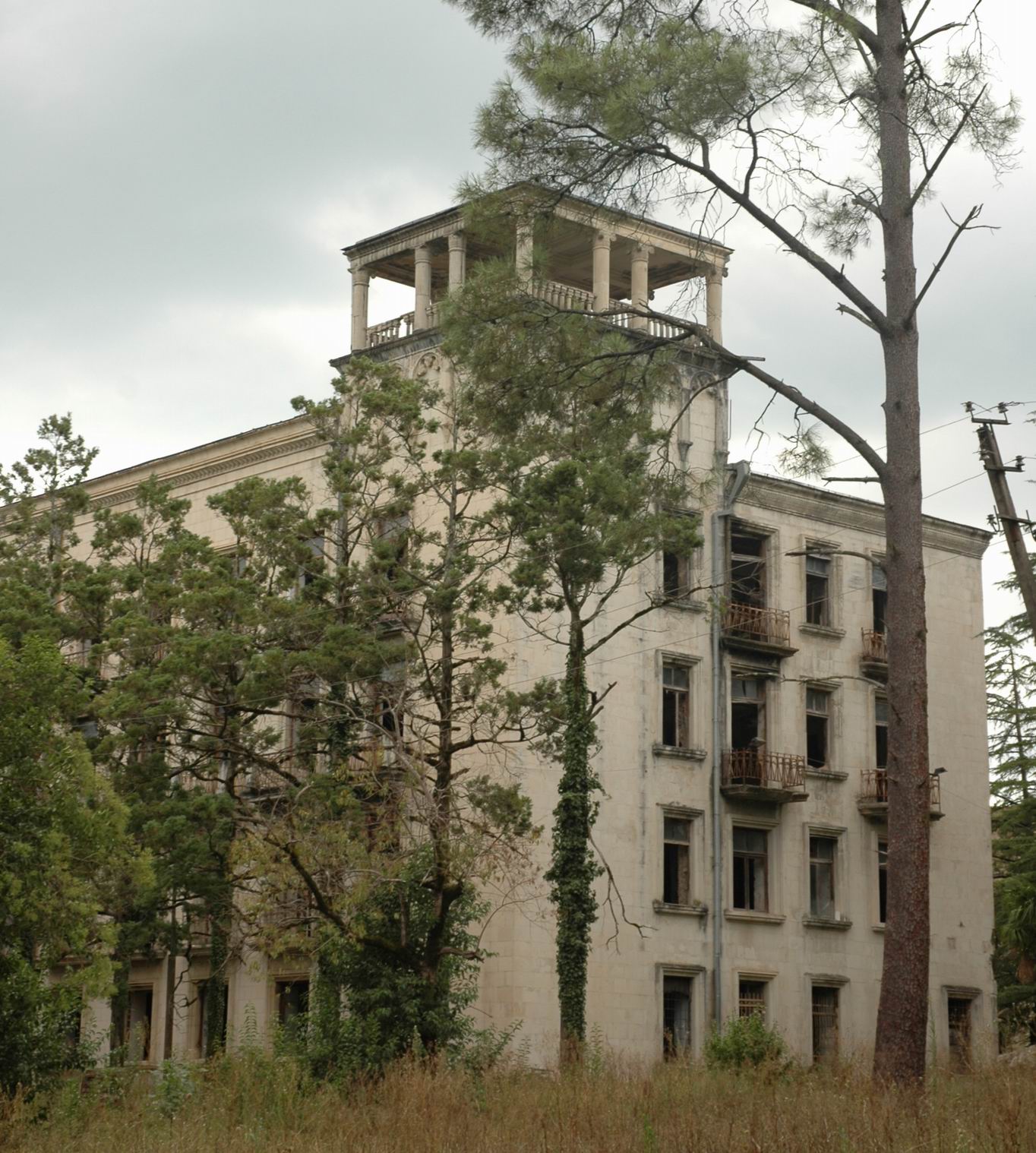
Tskaltubo is the half-ruined Soviet spa town about 15 km west of Kutaisi, and the honest version of the trip goes like this: you come for the abandoned sanatoriums, and then you realise people still live in some of them. That single fact is the one that should shape your whole day here, more than any photo you’ve seen of a collapsed staircase lit by a shaft of afternoon sun. It is a wildly photogenic place. It is also somebody’s address.
So let’s take the awkward part first, because it’s the part most guides skip.
Some of these ruins are people’s homes
When the war in Abkhazia forced hundreds of thousands of Georgians out of their homes in 1992–93, thousands of them were housed in Tskaltubo’s empty sanatoriums as emergency shelter. Estimates of how many ended up here vary between roughly five and eight thousand people. The government has spent years relocating families into new apartment blocks, and many buildings are now genuinely empty. But not all of them. As of 2026 several sanatoriums still have laundry on the balconies, a working doorbell, a kid’s bike in the lobby.
You can usually tell an inhabited wing from an abandoned one within a few seconds: curtains, glass in the windows, a swept step. If a corridor looks lived-in, it is. Don’t walk into it, don’t photograph through open doors, and don’t point a lens at a person without asking first. Researchers who have studied the resettlement, including the Jordan Russia Center, have noted that restoration plans have repeatedly ignored the people still living in these buildings. The least a visitor can do is not treat their front room as a backdrop.
Here’s the plain rule I’d give anyone: if you’d be uncomfortable with a stranger doing it outside your own window, don’t do it here.
Getting there from Kutaisi
Tskaltubo is a day trip from Kutaisi, full stop. It’s close, it’s cheap, and there’s no reason to base yourself in Tbilisi for it. If you’re still in the capital, this is one of those places you reach by first getting to Kutaisi rather than going direct.
The marshrutka is the local move. Van #30 leaves from the Red Bridge in central Kutaisi roughly every 20 minutes between about 07:30 and 19:00, and #34 runs hourly from the central bus station; both cost 2 GEL and take 20 to 25 minutes, per current visitor guides like Wander-Lush (fares and times checked September 2026). A Bolt is the lazy alternative at around 13–20 GEL one way. Both drop you at the big central park, which is the whole layout you need to understand: Tskaltubo is a doughnut. A round green park sits in the middle, the bathhouses and springs ring it, and the grand sanatoriums fan out along the avenues behind them.
Give yourself four to six hours on the ground. That’s enough for the working baths and four or five buildings at a walking pace, with time to sit in the park when your feet give out.
Which buildings you can actually get into in 2026
This is the part that changes fastest, so treat any list, including this one, as a starting point rather than gospel. Money has arrived in Tskaltubo. In 2022 the state auctioned off a batch of buildings under a “New Life for Tskaltubo” programme, and investors from Georgia, Qatar and beyond bought several. The result is a town splitting into two: ruins you can still wander, and construction sites behind new steel fences.
The headline redevelopment is Sanatorium Tbilisi, which is being rebuilt into a 122-room Marriott, its facade under scaffolding and closed to casual visitors. Sanatorium Iveria is fenced and sealed. Shakhtiori, the old miners’ sanatorium, has also been walled off for a hotel conversion. If a building is behind fresh metal with a guard, that’s your answer, and it’s not worth the argument.
What’s left open shifts. Medea, long the most jaw-dropping ruin here for its sweeping colonnade and theatre, was reported closed off and guarded in mid-2026 after a tourist was injured inside, so check before you build your whole visit around it. Metalurgi (sometimes written Metallurgist) still holds chandeliers and plasterwork and is a reliable favourite. Gelati has a children’s playground with faded animal mosaics that hits harder than any grand staircase. Imereti has its rotunda. Sakartvelo, Aia and Savane round out the usual walking loop. Floors, ceilings and stair rails inside all of these are genuinely dodgy: watch where you step, and don’t lean on anything.
The baths still work
People forget this. Tskaltubo isn’t only a ruin-tourism destination; the mineral water that made it famous is still flowing, and you can still get in it. The springs run at a natural 33–35°C, so they’re warm rather than hot, and the draw is the chemistry: radon and carbonate. The old Soviet claim was that a course of these baths helped circulation, joints and nerve complaints.
The working option day-trippers use is Spring No. 6 (Bath No. 6), the balneo-resort built directly over a spring, which according to the resort’s own site runs 10:00–17:00 every day of the year (checked September 2026). It’s a medical centre first and a tourist attraction second: proper treatment courses run 14 to 21 days and a full day of procedures sits around 130–170 GEL, though you can ask about a single bathing session rather than the full programme. The staff will tell you the water has to be used fresh at the source because it loses its properties within minutes of being drawn, which is exactly why the building sits on top of the spring.
Quick tangent worth knowing: “radon bath” makes people flinch, because radon is radioactive. The doses in balneotherapy are low and the practice is old and widespread across the former Eastern Bloc, but if you’re pregnant or just not comfortable with the idea, skip it and enjoy the town dry. Nobody will mind.
Guided or on your own?
You can absolutely do Tskaltubo solo, and plenty of people do. The park is safe and easy, the marshrutka is simple, and the open sanatoriums don’t require a ticket or a fixer. So why pay for a guide?
Two reasons. First, safety and orientation inside the buildings, where a local knows which staircases hold and which floors you should stay off. Second, and more useful, is context: a guide who knows the families can steer you away from lived-in wings and tell you what each ruin actually was, which turns a photo walk into something you understand. Our advice: go with a guide if the ethics and the history matter to you, and go solo if you mainly want the park, the baths and a couple of easy ruins. Both are valid; they’re just different trips.
Where to stay, if you stay
Most visitors don’t, and I’d agree with them: Kutaisi has better food and more to do in the evening, and it’s 20 minutes away. But if you want to actually take a proper bath course, staying makes sense. The Tskaltubo Spa Resort is the refurbished 4-star on the park (around 135 rooms) and also sells a 20 GEL walk-in tour of its concert hall, small museum and Stalin’s old suite if you just want a look inside a restored one. Beyond that it’s guesthouses and a scatter of newer hotels near the park. The town is quiet after dark, which is either the point or the problem, depending on you.
Tskaltubo pairs naturally with Prometheus Cave and Sataplia, and the whole cluster sits inside the wider set of trips people run out of this corner of Georgia. If you’re building a route, our full Kutaisi guide covers the base, the day trips from Tbilisi post shows how it fits a longer loop, and if the architecture is what pulls you, our piece on Soviet Tbilisi gives you the design language before you arrive.
One last practical thing that will change your visit more than any building choice: go on a bright day and start by late morning. These sanatoriums have no lighting, no power and no windows in places, so the interiors are only readable when the sun is high enough to pour through the broken roofs, and the whole town empties into gloom well before the baths shut at five.
Frequently asked questions
Is Tskaltubo worth visiting in 2026?
Yes, if faded architecture and post-Soviet history interest you more than a polished attraction. Just adjust your expectations: it’s a patchwork now, with a few ruins sealed for hotel projects and others still wide open, so the exact experience depends on the week you turn up.
Can you actually swim in the Tskaltubo mineral water?
You can bathe in it rather than swim laps. The functioning centre over the spring lets visitors soak in the warm radon-carbonate water, either as part of a prescribed programme or, if you ask, a shorter single session. It’s a wellness dip, not a swimming pool.
Is it disrespectful to photograph the sanatoriums?
The empty shells, no. The wings where displaced families still live, yes, unless you’ve asked and been welcomed. Read the building before you raise a camera: signs of daily life mean someone’s home, and their privacy comes before your shot.
How long do you need in Tskaltubo?
Half a day covers it comfortably. Budget four to six hours for the park, a couple of open ruins and a bath, then head back to Kutaisi for dinner rather than overnighting, unless you’re committing to a multi-day treatment course.
Featured image: Photo: Yarkolp / Wikimedia Commons (CC BY-SA 3.0)




Leave a Reply