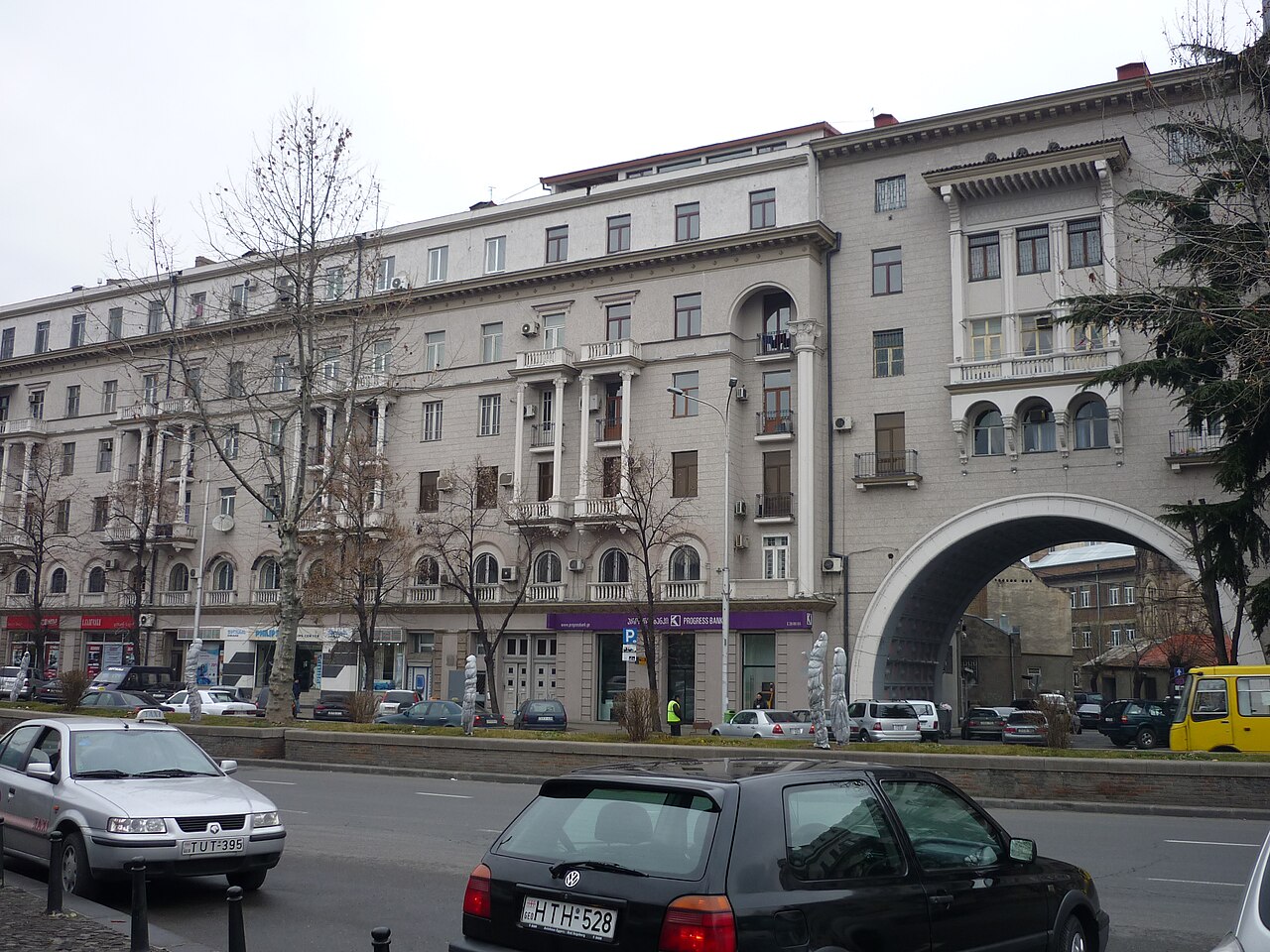
Most of Soviet Tbilisi is still here, and almost none of it is labelled. Seventy years of construction left an eighteen-storey concrete puzzle above a river gorge, a metro dug deep enough to double as a shelter, mosaics on bus stops nobody has cleaned since 1985, and whole districts of prefabricated blocks where much of the city still lives.
What follows is sorted by what kind of thing it is, not by date: the monumental, the everyday, the reused, and the removed. That order matters, because the first category is the one you travel to see and the second is the one you are standing in without noticing.
Read the politics first, or you will misread the buildings
Georgians are not nostalgic about this. That needs saying before anything else, because a certain kind of visitor arrives treating brutalist concrete as a wry aesthetic and gets a very cold response from the person serving them coffee.
The short version: Georgia was annexed by the Red Army in 1921 after three years of independence, and the Soviet period ended in blood on the street you are walking down. Before dawn on 9 April 1989, Soviet troops broke up a peaceful pro-independence demonstration outside parliament on Rustaveli Avenue with sapper shovels and gas. Twenty-one people were killed, most of them women, several of them teenagers, and hundreds were hospitalised — figures confirmed by the USSR’s own parliamentary commission and summarised in RFE/RL’s account of the crackdown. April 9 is now a national holiday. There is a memorial on the parliament steps and people still leave flowers on it.
Then the legal side. Georgia’s Freedom Charter of 2011 set up a state commission to identify and remove Soviet symbols, monuments and street names, with a 1,000 GEL fine after a warning. Enforcement has been patchy, which is much of why so many mosaics and bas-reliefs survive. The rule that follows: hammers-and-sickles and Lenin portraits were targeted; abstract decoration, industrial imagery and anything read as Georgian rather than Soviet mostly was not. That distinction explains what is still on the walls better than any other fact here.
For the wider arc of the city before and after all this, see our history of Tbilisi.
The monumental: three you can build a day around
These are the set pieces, and they are scattered. Do not try to walk between them.
The Chronicle of Georgia
Sixteen pillars over thirty metres tall on a bare hill above the Tbilisi Sea reservoir, carved with Georgian kings on the upper band and scenes from the life of Christ on the lower. Zurab Tsereteli began it in 1985 and never finished it, which is the whole experience: monumental sculpture with no fence, no ticket office, no roof, no staff. Open at all hours, free, and bitterly windy at the top in winter. Getting there means a taxi or a marshrutka from Sarajishvili metro, and arrange your ride back before you climb, because the taxis waiting at the base know you have no alternative. Full practicalities are in our Chronicle of Georgia guide.
The old Ministry of Highways, now Bank of Georgia HQ
The famous one. Eighteen storeys of concrete boxes stacked crosswise into a lattice on a wooded slope at 29a Gagarini Street, finished in 1975 for the Ministry of Highway Construction of the Georgian SSR. George Chakhava designed it while serving as the ministry’s own deputy minister, which is how a building this strange got approved at all. His logic, patented as the Space City method, was to touch as little ground as possible and hand the hillside back to the trees: vertical cores as trunks, horizontal blocks as canopy. It became a listed Cultural Heritage Monument of Georgia in 2007, the same year the bank bought it (details on the building’s record).
It is a working head office. You cannot wander in. What you can do is photograph it from the road below, and that is where everyone gets it wrong — the view that makes sense of the structure is from across the valley, not from the gate.
The Palace of Rituals
Victor Djorbenadze’s wedding palace, completed in the mid-1980s, borrows at once from 1920s expressionism and medieval Georgian church interiors: a curving, cave-like thing that reads as sacred architecture built for a state that had abolished the sacred. The businessman Badri Patarkatsishvili bought it in 2002 as a private residence, and since 2013 it has been leased to an events company running weddings and corporate functions.
Which means access is a lottery. Message ahead, turn up on a weekday, and hope nothing is booked. Our advice: treat this one as optional. Plenty of people make the trip across the river and get as far as the door, and the exterior alone does not repay the journey the way the Chronicle does.
The everyday: the layer you are already standing in
Here is the honest recommendation buried in this article. Skip a monument and ride the metro instead.
The Tbilisi Metro opened on 11 January 1966, the fourth system in the USSR after Moscow, Leningrad and Kyiv, and it was cut into the rock deep enough that the escalator rides are events in themselves. Rustaveli is the deepest station, and the sources disagree: the network’s own site puts it at around 60 metres below ground, while several guidebooks repeat 120 metres, a figure that likely measures escalator run rather than vertical depth. Either way, you are on that escalator a while. Fares checked September 2026 against the same source: a flat 1 GEL per journey on a Metromoney card that costs 2 GEL, with 90 minutes of free transfers. Our Tbilisi metro guide covers the rest.
Above ground, the everyday layer is decoration and housing. Large facade mosaics survive across Saburtalo and Gldani — workers, cosmonauts, harvests, sport, families — plus panels on ordinary bus shelters that nobody has restored and nobody has removed. The apartment districts are the real monument: standardised blocks thrown up from the late 1950s to house a city that doubled, and still the ordinary address of a huge share of Tbilisians.
The one purpose-built oddity worth the trip out is the Nutsubidze Plateau skybridge complex in Saburtalo, built 1974–76 to designs by Otar Kalandarishvili and Gizo Potskhishvili: three towers on a steep slope linked by raised concrete walkways, so that residents halfway up the hill could enter at their own level. A fragment of a much bigger plan that ran out of money. People live there. Go quietly, and do not treat stairwells as a photo set.
The reused: factories with cocktail menus
Tbilisi’s most successful answer to this inheritance has been to gut it and reopen it.
Fabrika, opened in 2016 in Chughureti, was a Soviet sewing factory making women’s clothing. It is now a hostel with a courtyard of bars, coffee places, studios and small shops, and it works as a neighbourhood meeting point rather than a tourist site. Free to walk into. See our Fabrika Tbilisi guide for what is actually in the courtyard now.
Stamba in Vera is the same instinct with a bigger budget: a 1930s state publishing house where five floors were removed to leave a canyon of a lobby, structural columns bare, and some of the original printing machinery left standing where it sat. It is a hotel, so the lobby, bars and the photography museum inside are open to non-guests. Buy a coffee and nobody minds you looking.
The removed: absences you can still stand in
Freedom Square is the clearest one. It carried Lenin’s name and, from 1956, his statue at its centre; the statue came down as Soviet rule collapsed at the turn of the 1990s, the square took back the name Freedom, and in 2006 a gilded St George on a column by Tsereteli went up in the vacancy. Two monuments by the same sculptor, one Soviet and one emphatically not, thirty metres apart in this city.
Street names went the same way, in waves: after 1991, then again under the 2011 charter. Older maps, older signage and older residents have not all caught up, a small nuisance when an address predates a renaming.
For the state’s own account of the period, the Museum of Soviet Occupation occupies a floor of the Simon Janashia Museum of Georgia on Rustaveli Avenue, ticketed as part of the national museum and closed Mondays. It is one room and deliberately not neutral. Go anyway: it is the one place in the city where the concrete gets an explanation attached.
Frequently asked questions
Can you go inside the Bank of Georgia building in Tbilisi?
No. It is a working headquarters with security on the door and no visitor programme. Art events have opened parts of it in the past, but nothing scheduled. Photography from the public road outside is fine.
Is it rude to call these buildings Soviet in Georgia?
The term itself is fine and used locally. What lands badly is admiration for the system that built them, or the assumption that Georgians look back fondly. Talk about the architects — Chakhava, Djorbenadze — rather than about the USSR, and the conversation goes somewhere interesting.
Where do you find the mosaics without a guide?
Ride to the outer stations on either metro line and walk. Saburtalo and Gldani carry the most, on apartment gables, sports halls and transport shelters. They are unmapped, unsigned and sometimes half-demolished, so allow an afternoon and accept a hit rate rather than a checklist.
How much time should I set aside for all this?
One full day covers the Chronicle plus Gagarini Street plus a wander through a residential district. Two days if the Palace of Rituals is on the list, since access there is unpredictable and you may need a second attempt.
One last thing, and it is the one that changes your day rather than your itinerary: nearly every site listed here except the Chronicle sits in a neighbourhood where people live and work right now. There is no admission gate to pass through and therefore no signal telling you where the private part starts. Ask before you photograph a stairwell, a balcony, or somebody’s front door.
Featured image: Brejnev (CC0) via Wikimedia Commons.




Leave a Reply