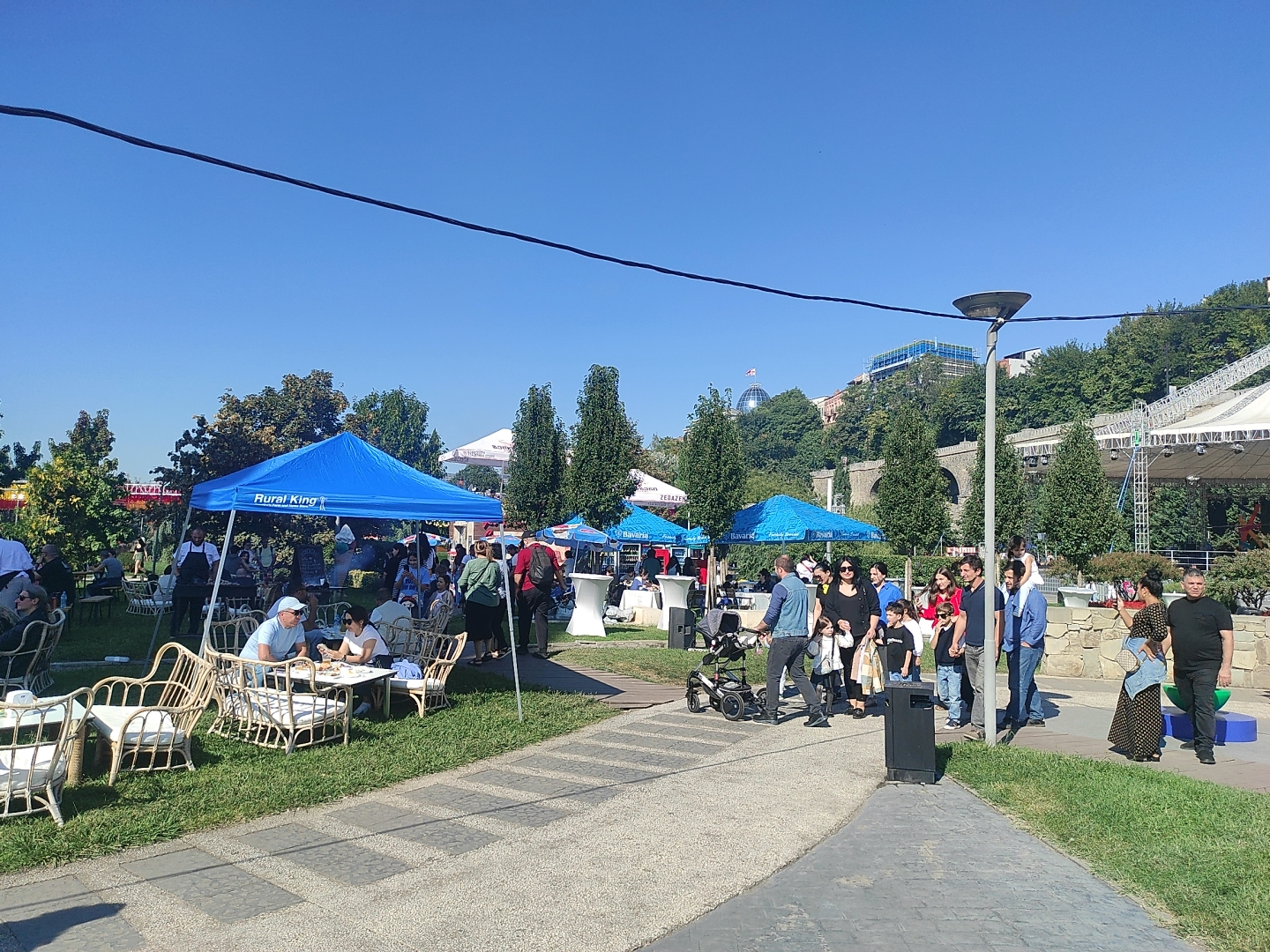
Tbilisoba is Tbilisi’s own birthday party: a free, one-day-turned-two-day city festival held on a weekend in October, when the harvest is in and the new wine is still fermenting in clay. You do not buy a ticket, you do not book a slot — you turn up in the Old Town, mostly around Rike Park, and eat, drink and watch your way through it.
The catch is that the exact date moves every year and is confirmed late, and one big thing about central Tbilisi has changed for autumn 2026. Both of those decide whether it is worth building a trip around, so start there.
When it actually happens (and why you can’t book flights on it yet)
Tbilisoba lands on the first or second weekend of October in most years, and the dates are confirmed only a few weeks out — a pattern Wander-Lush’s Georgia festival calendar flags for almost every event here. In 2024 it ran 5–6 October. In 2025 the city moved it forward to 20–21 September to clear the calendar for local elections on 4 October, per Georgia Today — a reminder that “first weekend of October” is a habit, not a rule.
As of early September 2026 the city hall has not published the 2026 dates. That is normal here. Georgian public festivals are confirmed a few weeks out, sometimes days, and Tbilisoba is no exception.
So the honest planning advice: if your dates are flexible, aim for the first full weekend of October and watch the mayor’s office announcements through late September. If you have already booked and your trip brackets that weekend, good — you will almost certainly catch it. What you should not do is buy non-refundable flights months out purely to hit a date nobody has announced.
What you’ll actually see on the day
The centre of gravity is Rike Park, the flat riverside strip below the Old Town where the Peace Bridge lands. The main concert stage goes up there, and so does the crafts market the city calls the “City of Masters.” Orbeliani Square and the Abanotubani bathhouse quarter host the overflow — smaller stages, exhibitions, food rows — so the whole thing threads through the medieval core rather than sitting in one field.
Music runs all day and turns into a proper evening concert. You get folk ensembles in costume, polyphonic singing (the deep three-part harmony Georgia is known for), traditional dance, then bigger-name pop and a headline set after dark. It is loud, unpolished in the good way, and free to stand in front of.
The part most people come for is the food and wine. Producers drive in from every region and set up stalls, so this is Georgia’s pantry compressed into a few hundred metres. Expect skewers of mtsvadi over coals, khinkali by the plateful, cheese-stuffed khachapuri, and long strings of churchkhela — the grape-must-and-walnut “Georgian Snickers” — hung up by the dozen. The Wine Parade is the signature set piece: winemakers pour straight from qvevri and barrel, and a glass of something drinkable costs very little compared with a seated tasting in a wine bar.
There is more if you look: handicraft bazaars, folk-dance processions with district delegations, occasional vintage-car displays, children’s corners, and the city’s ceremonial handing-out of honorary Tbilisi citizenship. None of it is essential viewing. The food, the wine and the music are the reason you go.
Free vs paid: what actually costs money
Entry is free. There is no gate, no wristband, no festival fee — Tbilisoba is a public celebration the city puts on for its own residents, and visitors are simply welcome in the crowd.
What you pay for is what you consume. Food from the stalls, wine by the glass, anything you buy at the crafts market. Bring cash in small notes. Stall vendors move fast and are not set up for you to tap a card for one skewer, and the queues at the busy stands do not wait while someone fishes out a phone.
The crowds — and the 2026 wrinkle nobody tells you
This is the single biggest event on Tbilisi’s calendar, and it feels like it. Rike Park and the bridge get shoulder-to-shoulder by mid-afternoon, and the food rows are worst right at the dinner hour. If you dislike being packed in, come when the stalls open around late morning, eat early, and let the density build behind you as you drift up into the quieter Old Town lanes.
Here is the wrinkle. Through autumn 2026, Rustaveli Avenue is closed to vehicle traffic along its full 2 km run from near Freedom Square, and there have been nightly pro-EU protests outside Parliament on Rustaveli since November 2024. Tbilisoba itself happens down by the river, not on Rustaveli, so it is not directly affected — but it changes how you move around the centre that weekend. Plan to walk between the festival and your hotel, expect road detours for taxis on the Rustaveli side, and do not be surprised by a protest crowd a few blocks uphill from a folk concert. The two coexist.
One more, smaller thing: Narikala Fortress above the Old Town has been fenced off for restoration through much of 2026, so the classic “climb the walls and look down on the festival” plan is off. The cable car up to the ridge and the walk to the Kartlis Deda statue are still fine for a view over the crowd.
Is it worth planning a trip around?
Our advice: no — don’t build the whole trip around Tbilisoba, but do time your trip to catch it if the calendar lets you. That is a real opinion and some people will disagree, so here is the reasoning.
The festival is genuinely good, but it is one crowded weekend of things Tbilisi does year-round anyway. The wine, the khinkali, the polyphony and the churchkhela are all here in October and in April, minus the crush. Early October is also simply a lovely time to be in the city — warm days, the harvest season in full swing, and the same window covers Rtveli, the grape harvest out in the wine regions, which is arguably the better reason to come in autumn. See our take on the best time to visit Tbilisi for how October stacks up against the rest of the year.
So treat Tbilisoba as a bonus that makes an already-good week better, not as the anchor. If you happen to be here for it, spend a full afternoon and evening at Rike Park and eat your way down the wine parade. If you miss it by a week, you have lost almost nothing.
Frequently asked questions
How long does Tbilisoba last?
Two days in recent years, a Saturday and Sunday, though it began life on 28 October 1979 as a single-day event, per Wikipedia’s history of the festival, and has stretched over time. The evening concerts are the late-running part; the markets and food stalls wind down earlier than the stage does.
Where is the main stage and market?
Rike Park, on the left bank of the Mtkvari river directly below the Old Town and the Peace Bridge. Orbeliani Square and the Abanotubani sulphur-bath quarter carry the secondary programming. Everything is walkable from the historic centre — you will not need transport once you are down there.
Is Tbilisoba good for families with kids?
Yes, with one caveat. There are dedicated children’s concerts and activity corners, and the daytime hours are relaxed and open-air. The crush around the food rows near dinnertime is the hard part with a stroller or small children, so do the family stuff early and clear out before the evening headliner draws the biggest crowd.
Do I need to book anything in advance?
Not for the festival itself — it is free and open. The one thing worth booking ahead is accommodation, because that October weekend is popular and central hotels fill. Sort your bed early and leave the rest to the day.
Last practical thing, and the one that trips people up: since the date is confirmed so late, set a reminder to check the Tbilisi City Hall channels in the third week of September. That single check is what turns “I think it’s that weekend” into a plan you can actually eat and drink your way through.
Featured image: Photo: David Osipov / Wikimedia Commons (CC BY 4.0)




Leave a Reply