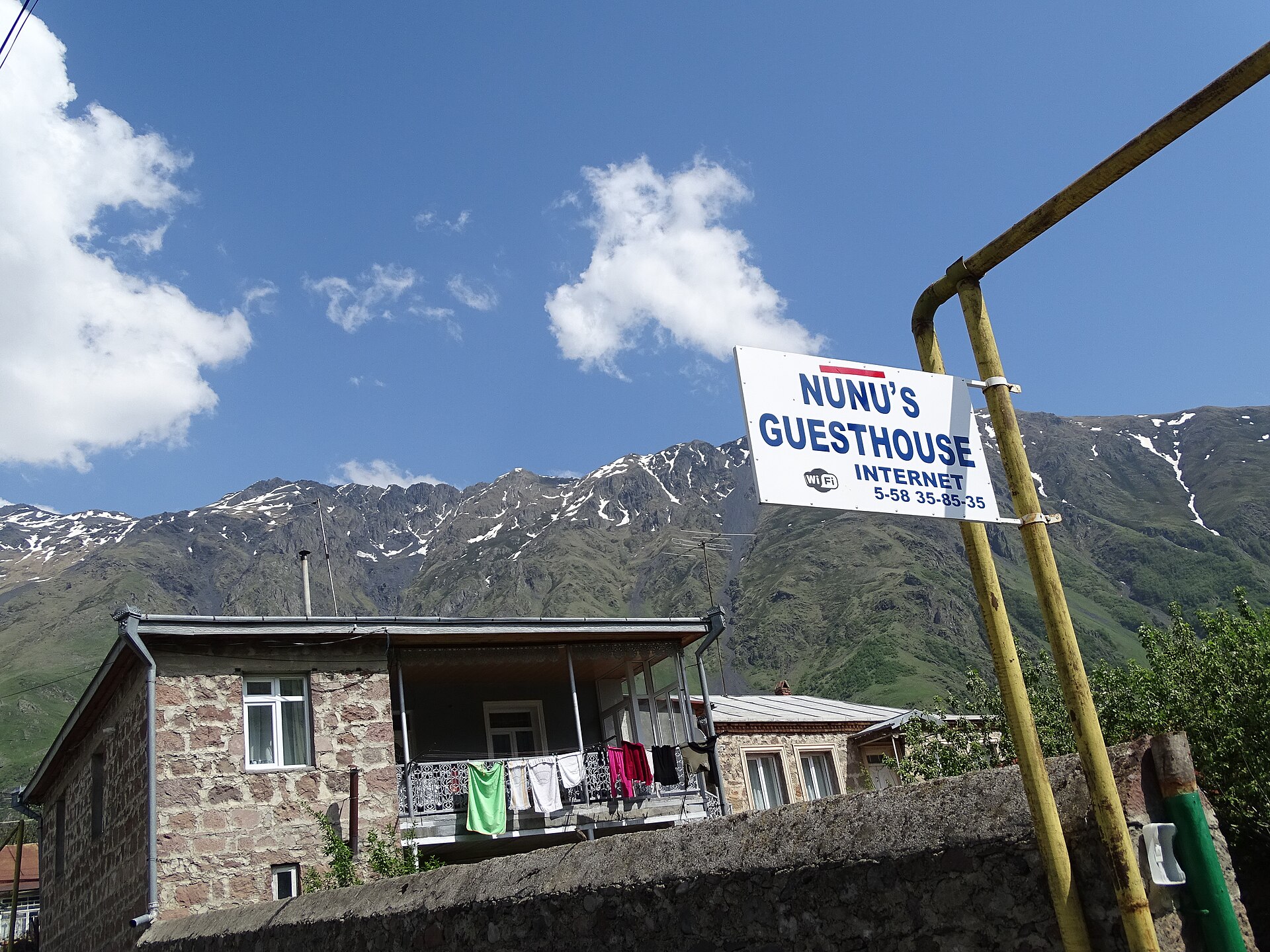
A Georgian guesthouse is a family home that rents rooms, and the family part is not decoration: you’ll be fed more than you paid for, poured drinks you didn’t order, and treated less like a customer than a guest who happens to be settling a bill. If that sounds good, it’s the best-value accommodation in the country. If it sounds exhausting, book a hotel and skip the guilt.
Nobody hands you the rules on arrival, though. So here they are, written down for once, followed by what rooms actually cost in Tbilisi, Kazbegi and Kakheti, and how to book.
The unwritten contract
Every guesthouse stay in Georgia runs on terms no listing mentions. They aren’t obligations exactly. More like clauses everyone else in the house already knows.
Clause one: you will be overfed, and it’s not upselling
Book a room with breakfast and the table will hold khachapuri, eggs, homemade jam, bread, cheese, tomatoes and cucumbers from the garden, and often something extra the host made because she felt like it. Dinner, where offered, is the same instinct scaled up. Georgian hospitality treats a guest leaving the table hungry as a household failure, and no invoice adjusts for it.
Refusing the third helping is a negotiation, not a statement. A flat “no thank you” registers as an opening position. What works: eat slowly, leave a little on the plate to signal you’re done, and praise a specific dish by name. Praise redirects the energy. Emptying your plate fast reads as a request for more, which is the exact opposite of how most visitors assume it works.
Clause two: the chacha will appear
Chacha is grape spirit, home-distilled, anywhere from 45 to 65 percent, and at some point during your stay a bottle without a label will land on the table. This is a gesture of welcome, not a sales pitch. One small glass, drunk to a short toast, honours it completely.
You can decline. “I don’t drink” is accepted everywhere without offence, and pointing at your stomach with an apologetic face works in any language. What doesn’t work is accepting the first glass enthusiastically and then trying to stop at two, because a willing drinker is assumed to be in for the evening. Decide your position before the bottle arrives, not after.
Clause three: schedules are suggestions
“Breakfast at 9” means breakfast will exist in the general vicinity of 9. It may be ready at 8:40 because the host was up anyway, or at 9:25 because the bread wasn’t. If you have a marshrutka to catch, say so the night before, with the actual departure time. Hosts move mountains for a guest with a stated deadline and float serenely past one who just looks anxious at the table.
Clause four: your laundry may come back folded, unasked
Leave washing draped over a chair and there’s a real chance it returns clean and folded. Hosts also water down hiking boots left muddy in the hall, refill water bottles, and quietly fix the zip on a bag if they spot it broken. This is care, not a service with a price attached, and the correct response is warm thanks. Offering money for it can land badly. If you want to reciprocate, bring something small from your country, or buy the household wine when it’s offered for sale, which it often is.
Clause five: privacy works differently
Your room is yours. The rest of the house is shared, and shared means shared: children doing homework at the kitchen table, a grandmother watching television at volume, a neighbour who dropped in an hour ago and shows no sign of leaving. Doors between family space and guest space stay open. You’ll be talked to, asked where you’re from, shown photographs of relatives in Germany.
None of this is intrusion by local standards. It’s inclusion. But it means a guesthouse is a poor fit for anyone who recharges alone, and there’s no shame in knowing that about yourself.
Guesthouse, hotel or hostel: the actual difference
A hotel sells you a room and leaves you alone. A hostel sells you a bed and other travellers. A guesthouse sells you a room inside a family’s life, with home cooking as the headline benefit and thin walls, shared bathrooms and social obligation as the fine print.
In the mountains and in wine country the guesthouse wins on food alone, since the alternative is a limited restaurant scene. In Tbilisi the calculation flips: the city’s restaurants are the point, breakfast is cheap on any corner, and a well-located hotel or apartment buys you anonymity after a late night. Our picks by neighbourhood are in the where to stay in Tbilisi guide.
What rooms cost, region by region
Figures below are for a private double, checked September 2026 against Wander-Lush’s Georgia budget guide and live Booking.com listings. At about 2.6₾ to the dollar:
- Tbilisi: $25–45 (₾65–115) for a private guesthouse room, breakfast often included. Below $25 you’re into shared-bathroom territory or the far edges of town.
- Kazbegi (Stepantsminda): the bookable, reviewed places cluster at $45–70 in season, with simpler unlisted rooms in the village going for less. Mountain premiums are real; summer weekends sell out.
- Kakheti (Sighnaghi, Telavi and the villages): $27–45 on average, and this is where the guesthouse formula peaks, because the family making your dinner is often also making the wine you’re drinking with it.
- Meals beyond breakfast: 20–50₾ per person where charged. Half board in popular mountain areas runs to $50 a night for the room and both meals together, which given the portions is closer to three meals.
Prices have been the fastest-rising cost in Georgian travel for two years running. Treat anything printed, this included, as a floor in July and August.
Booking: three ways, ranked
Booking.com dominates in Georgia and most guesthouses are on it, so that’s the default: photos, reviews, free cancellation. Book direct by phone or WhatsApp (numbers are on listings and Google Maps) and many hosts will knock something off the platform price, though you’ll want a few words of Russian or Georgian, or patience with translation apps.
Just showing up still works in villages and in shoulder season. Walk down the main street of any settlement near a sight and look for “guesthouse” signs, or ask in the shop. It fails in Kazbegi on August weekends and in Sighnaghi during festivals, so have a fallback.
Our advice: book the first night of any stop online, then decide in person whether to extend. You learn more about a guesthouse in one breakfast than in fifty reviews, and hosts nearly always hold a room for a guest already at the table.
When a guesthouse is the wrong choice
Skip the guesthouse if you need guaranteed strong Wi-Fi for work calls, if you keep late hours in a city with nightlife, if solitude is the point of your trip, or if dietary restrictions make a table groaning with cheese, bread and meat a nightly negotiation. Vegetarians do fine, since half of Georgian cooking is vegetable-based during church fasts. Vegans and coeliacs will spend real energy explaining, every meal, to a host who wants to fix it with more food.
Day-trippers don’t need one either. Kazbegi works as a long day from Tbilisi; the Kazbegi day trip guide covers the timings. It’s only when you stay the night that the second khachapuri and the unlabelled bottle enter the picture.
The harvest-season stay
One timing beats all others. In late September and October, Kakheti’s guesthouses sit in the middle of rtveli, the grape harvest, and guests are routinely pulled into the picking, the pressing and the long table that follows. It’s the closest a paying visitor gets to being family, and it needs booking well ahead because Georgians travel for it too. The full picture, dates included, is in our rtveli grape harvest guide.
Frequently asked questions
Do Georgian guesthouses have private bathrooms?
Increasingly yes in towns, where competition has pushed en-suites into most listed rooms. In villages and older houses the bathroom is shared with the family or with one or two other rooms. The listing photos tell you honestly; if no bathroom appears in them, assume shared.
Is it rude to refuse food or drink from your host?
Refusing everything, coldly, yes. Declining alcohol for health or religious reasons, never, and hosts hear it daily. The middle path is accepting something small and naming what you liked. If you’re invited to a proper feast with toasts, the rules deepen; the supra and tamada guide explains how those evenings run.
Can you pay by card at a guesthouse in Georgia?
Prepaid platform bookings, yes. On the doorstep, cash rules, and in villages it’s cash only. Carry lari; hosts quoting in dollars or euros still want lari in hand, and the nearest ATM can be a town away.
How far ahead should I book a guesthouse in Kazbegi or Kakheti?
For July–August in Kazbegi and for rtveli weeks in Kakheti, two to four weeks out for the well-reviewed places. The rest of the year, days ahead is fine and same-day is possible. Winter in the mountains is the quiet exception: many family guesthouses simply close, so check before setting off.
Last thing, and it matters: learn the word gaumarjos, the toast that means “victory to you.” Say it once, glass raised, on your first evening. It costs nothing, and it changes how the whole house treats you for the rest of the stay.
Featured image: Photo: Adam Jones from Kelowna, BC, Canada / Wikimedia Commons (CC BY-SA 2.0)




Leave a Reply