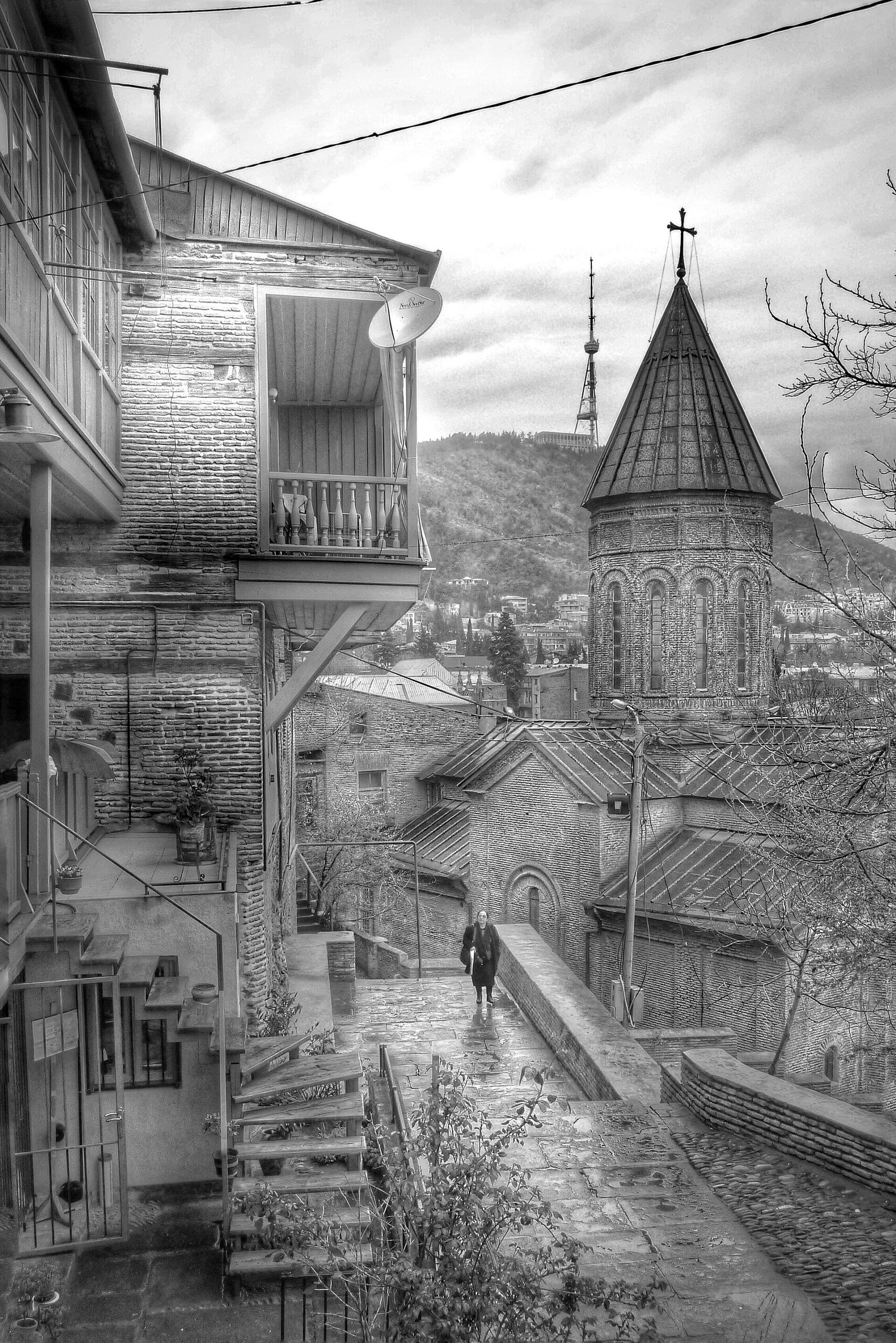
The Betlemi Quarter is the steep knot of lanes and staircases that climbs the hillside straight below Narikala, on the western edge of the Old Town. You walk it, not drive it. The climb runs up a stone stair-street of 120 steps, and the reward at the top is two old Bethlehem churches, a stretch of restored balconied houses, and a garden terrace with one of the best free views in Tbilisi.
Georgians call it Kldisubani, the cliff district. Most people find it by accident, heading up from the Old Town in search of a shortcut to the fortress, then losing an hour to it. Here is how to walk it in the right order, and what has changed on the slope this year.
Where the stairs actually start
This is the first thing that goes wrong, so deal with it first. The Betlemi Rise is not sign-posted from the main tourist drag, and the entrance reads like someone’s private alley. Aim for Betlemi Street off Asatiani, in the block behind the sulfur bath domes, and look for stone steps threading up between houses. Once you are on them you cannot really get lost. The stairs only go one way: up.
Wear something with grip. The steps are worn stone, uneven, and slick after rain, and there is no handrail for long sections.
Our advice: climb it in the morning, before about 10am. The light falls across the rooftops from the east then, the lane is quiet, and you are not fighting the afternoon crowds that spill over from the cable car station.
The two Bethlehem churches
The stairs are named for the churches, not the other way round. Both carry the name Betlemi, the Georgian form of Bethlehem, and the story goes that soil carried back from Palestine gave the first chapel its name around 1500.
The Lower Betlemi Church sits midway up the flight, roughly at the point where your legs start to complain. The domed church you see now went up in 1868 on the footprint of an older Armenian convent, and its interior was painted in the 1990s, according to Georgia’s national tourism board. It is a working parish, so keep your voice down inside.
Keep climbing and you reach the Upper Betlemi Church near the top of the stairs, beside the garden terrace. The forecourt here is the money shot: the whole lower city opens up below you, terraced roofs stacked down the slope toward the river. Both churches are Orthodox and active. Cover shoulders and knees, and women may be asked to cover their hair before going in.
The balconied houses and a fire temple hiding in plain sight
The reason the lanes look this good is not luck. Between 2007 and 2009 the international heritage body ICOMOS ran a rehabilitation of the Betlemi district, which is why the carved wooden balconies and stone facades here survived when so many elsewhere in the Old Town were left to rot. These are the filigreed hanging balconies Tbilisi is known for, up close and lived-in rather than staged for a hotel lobby.
Look for Ateshgah while you are up here. It is a plain brick cube on Gomi Street, about 100 metres east of the upper church, and it is easy to walk straight past. That box is one of the oldest structures on the hill, a Zoroastrian fire temple usually dated to the Sasanian era, described by Georgia’s tourism board as the northernmost fire temple of its kind. It was patched up with a temporary roof during the same ICOMOS project. There is not much to enter, but standing beside a 1,500-year-old temple in a residential courtyard is the kind of thing the Betlemi Quarter does without making a fuss about it.
The viewpoints, and which one to hold out for
The quarter does not hand you one big panorama and call it done. The views come in pieces as you climb, framed between a balcony rail here, a church dome there. That is the charm of it, and also the trap: you stop for the first decent gap in the rooftops and think that is the view.
It is not. Hold out for the garden terrace by the Upper Betlemi Church, a flat landing with benches and vine-covered trellises. From there the Mtkvari River, the Bridge of Peace and the roofs of Avlabari across the water line up in one frame. It is quieter than the Narikala platform and you rarely have to wait for a bench.
Going higher: the fortress ridge and Mother of Georgia
From the terrace a rough, unmarked stone path carries on uphill toward the fortress ridge and the Kartlis Deda statue, the aluminium Mother of Georgia holding a bowl in one hand and a sword in the other. This is where a lot of Betlemi walks join up with the Narikala route.
One thing to be clear about, because older guides still get it wrong. As of August 2026 the fortress itself is fenced off for restoration, so you pass alongside Narikala rather than walking its walls, confirmed by the closure note on Tbilisi Local Guide. The ridge path, the St Nicholas church inside the walls, the Kartlis Deda statue and the walk down to the Botanical Garden are all still open. If anyone tells you to climb the ramparts, they are working from an out-of-date page.
Don’t want the climb at all? The cable car from Rike Park drops you on the ridge in a couple of minutes for 2.5₾ each way. It takes Metromoney only, no cash and no reliable foreign contactless, so load a card first. From the top station you can walk down through Betlemi in reverse, which is the lazy way to see it and easier on the knees.
Remember people live here
This is not a museum quarter with a ticket booth. The balconies you are photographing have laundry on them because someone hung it there this morning. Keep off private courtyards and stairways unless you are clearly welcome, don’t point a lens through anyone’s window, and take the noise down a notch on the residential stretches. A cat asleep on a warm step is fair game. The family eating lunch behind the open shutter is not.
Frequently asked questions
How long does it take to walk the Betlemi stairs?
Allow 30 to 45 minutes end to end if you stop at both churches and the terrace. The pure climb is short, only 120 steps, but they are steep and you will keep pausing for the gaps in the rooftops. Add another half hour if you carry on up to the ridge and Kartlis Deda.
Is the Betlemi Quarter free to visit?
Yes. The stairs, the churches, the viewpoints and Ateshgah cost nothing to walk through or enter. The only thing you might pay for nearby is the cable car up to the ridge at 2.5₾, or a coffee at one of the small cafes near the base.
Can I reach Narikala from Betlemi on foot?
You can walk up to the fortress ridge and the Mother of Georgia statue on the stone path above the upper church. The fortress interior is closed for restoration in 2026, so you will be walking beside the walls and along the open ridge, not on the ramparts themselves.
What is near the Betlemi stairs at the bottom?
The base of the quarter sits a two-minute walk from the Abanotubani bath district. Plenty of people pair the two: soak first, then climb. Our guide to the sulfur baths covers how that works and what a private cabin runs.
If you only have time for one thing here, make it the garden terrace by the Upper Betlemi Church at first light. The whole point of the Betlemi Quarter is that it rewards the walk up, and that landing is where the walk pays you back.
Featured image: Photo: Roberto Strauss / Wikimedia Commons (CC BY-SA 2.0)




Leave a Reply