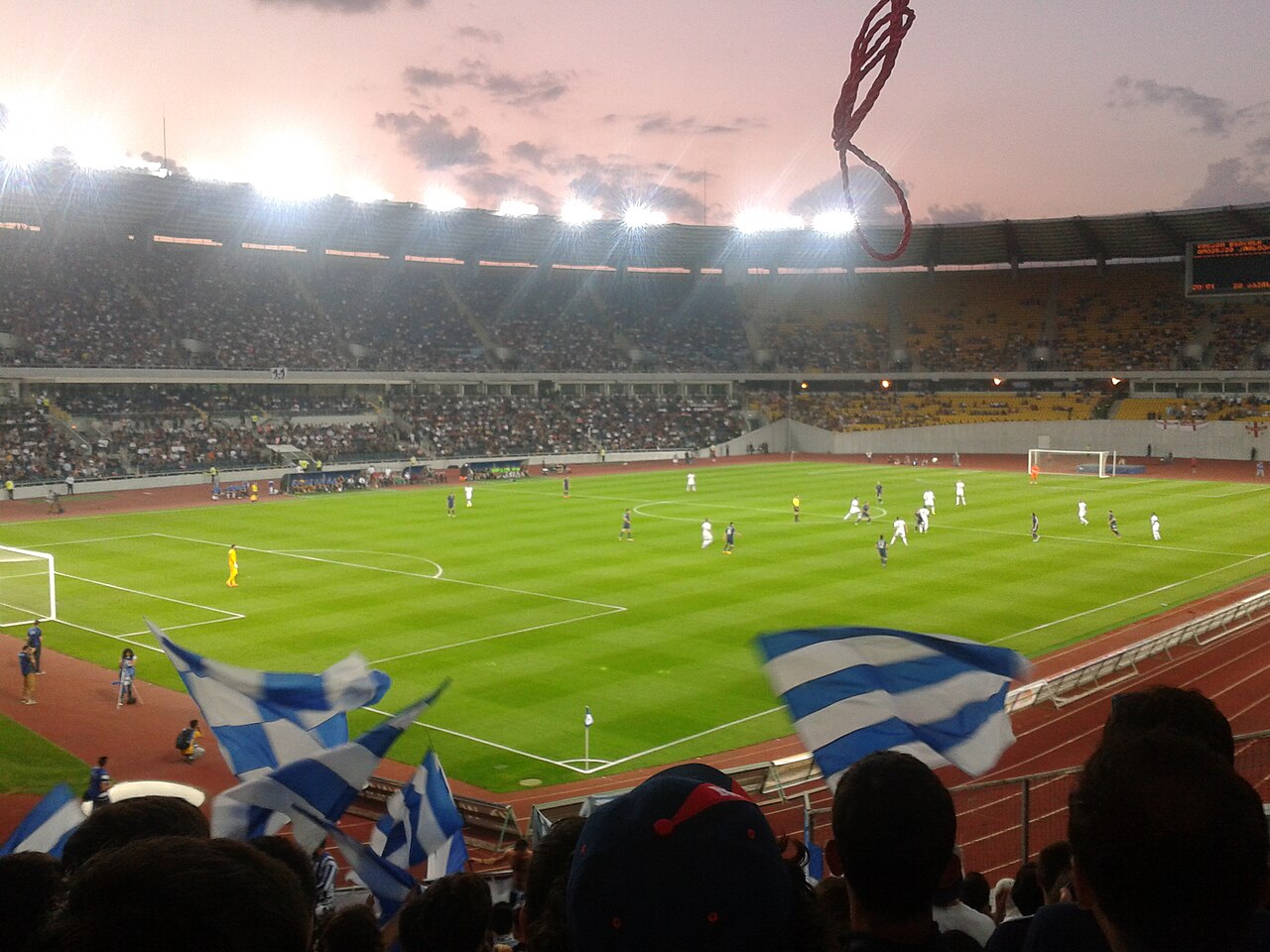
Bassiani is a techno club inside a drained Soviet swimming pool under Tbilisi’s Dinamo Arena, and it is the single venue people fly into Georgia for. It opened in 2014, holds around 1,200 people, and has spent a decade doubling as the loudest political statement in the country.
That second part is not marketing. In May 2018 armed police raided the club, and thousands of Georgians answered by dancing outside parliament. You can’t explain Bassiani as a nightlife listing. It needs explaining as an institution first, a night out second — which is how this guide is ordered.
A swimming pool with a sound system
The main floor is the basin of an Olympic-sized pool that sat abandoned under the national football stadium for years before the founders moved in. You dance below ground level, inside concrete walls built to hold water, with a Funktion-One rig where the swimmers used to be. The room does strange, wonderful things to bass. There’s almost no light. Nobody is performing for a camera, because cameras aren’t allowed.
Tbilisi is full of repurposed Soviet architecture — a printing house turned hostel at Fabrika, whole districts of it covered in our Soviet Tbilisi guide — but Bassiani is the sharpest version of the idea. The state built this pool. The generation the state failed turned it into the best club between Berlin and Tokyo. That reversal is the whole story of the place, compressed into one room.
Upstairs sits a second, smaller room called Horoom. On most nights it runs as the gentler counterpart to the pool — and once a month it becomes something with no real equivalent anywhere else in the region.
May 2018: the raid and the rave outside parliament
Early on 12 May 2018, masked, armed police stormed Bassiani and Café Gallery mid-party, citing drug enforcement. Dozens of people were arrested, including Bassiani’s founders, as reported at the time by Mixmag. The clubs had spent years campaigning for drug-policy reform through the White Noise Movement, in a country where possession of a gram could then mean prison. The raid read as retaliation, and Tbilisi treated it as such.
What happened next is why the club’s name travels. Thousands of young Georgians — around 15,000 at the peak — gathered on Rustaveli Avenue in front of parliament and, instead of chanting, danced. DJs played on the steps of the legislature for two days under the slogan “We dance together, we fight together.” Dazed called it the moment techno became the sound of protest in Georgia, and the footage went around the world. The interior minister apologised. Within months, Georgia’s constitutional court made it the first post-Soviet state to decriminalise cannabis consumption.
A club night forced a public apology from a government and moved national drug law. Once you know that, the strict door and the covered cameras stop looking like Berghain cosplay. They’re the habits of a place that has actually been raided.
Horoom Nights: a queer night that requires trust
Horoom Nights, held in the upstairs room, is one of the very few recurring queer club nights in the entire Caucasus. In a country where Pride events have been attacked in the street — context we cover honestly in is Georgia LGBTQ-friendly? — a safe, regular, joyful queer party is not a small thing. It runs on a vetted-registration model: you apply in advance, the team verifies who you are, and only then can you buy in. Slower than a normal ticket link, and that’s the point. Everyone in that room has been vouched for, so everyone in that room can relax.
If you qualify and you’re in Tbilisi on the right weekend, go. There are bigger queer parties in Europe. There are none carrying this much weight.
The no-photo culture
At the entrance a sticker goes over your phone’s camera lens, and it stays there. Filming inside is forbidden, full stop. Part of it is atmosphere — a dance floor where nobody is filming behaves differently within the first hour. Part of it is protection: plenty of guests, queer guests especially, can’t afford to appear in someone’s story. Peel the sticker off inside and you’ll be walked out. This rule is enforced with none of the flexibility the door itself has.
Registration, tickets and ID
Now the practical half. Bassiani sells tickets online, per event, through bassiani.com — checked September 2026 against the club’s own site and current Tbilisi scene guides. Standard nights run ₾25–50, set by the lineup: a resident-only Friday sits at the bottom of that band, a marquee international booking at the top. Big names sell out days ahead, so don’t plan on paying at the door for those. Registration asks for your ID or passport details, and verification isn’t instant — for Horoom Nights it can take days, so sort it at least a week before you land, not from the taxi.
Bring the physical passport or ID that matches your registration. One more thing worth knowing before you build a trip around it: the club refuses entry to Russian citizens, a stance it has held publicly since the full-scale invasion of Ukraine.
Which night, and when to turn up
- Friday — main-room techno, heavier on Bassiani’s residents. The more local of the two nights, and the cheaper ticket.
- Saturday — the flagship. International headliners, both rooms open, sells out first.
- Horoom Nights — the vetted queer party, held about monthly. Watch the club’s channels for dates; they aren’t on a fixed calendar.
Doors open around midnight, and nothing meaningful happens before 1am. The room peaks between 3am and dawn, and on a strong Saturday the music runs to mid-morning — walking out of a windowless pool into full Sunday daylight is a rite of passage here. Arriving at 11pm buys you an empty basin and a long wait.
Is it for you?
Honest answer: not for everyone. If your ideal night involves table service, requests, or a soundtrack that changes genre hourly, Tbilisi has venues for that and this isn’t one — our Tbilisi nightlife guide maps the full spread, along with how door selection works across the city’s clubs generally. The selectors here are reading for genuine interest in the music, not your outfit’s price tag, and sober, unbothered, knowing whose set you came for gets you further than any dress code.
Our advice: go even if techno isn’t your genre, and go on a resident night rather than chasing a headliner. The ₾25 Friday with a local selector in the pool is the truer Bassiani experience than a sold-out ₾50 Saturday spent shoulder-to-shoulder with other tourists, and a rejection at the door stings less when you haven’t built the whole weekend around one booking. Some clubbers will tell you the big Saturdays are the point. We think the room is the point.
Frequently asked questions
How much does it cost to get into Bassiani?
Between ₾25 and ₾50 per event, priced by who’s playing — around $10–19 at the current rate. Drinks inside are reasonable by European club standards, so the ticket is most of the night’s cost.
Do I need to register before going to Bassiani?
Yes for Horoom Nights, where vetting can take several days, and it’s the smart move for any event you’d be gutted to miss: buy through bassiani.com in advance with matching ID details. Walk-up entry exists on quieter nights but gives the door every reason to say no.
Why is Bassiani so famous?
Three reasons stacked together: a genuinely unusual venue (a drained Olympic pool under a stadium), world-class programming with fourteen resident artists, and its role at the centre of the 2018 protests that ended with Georgia decriminalising cannabis use.
Can you take photos inside Bassiani?
No. Staff sticker your phone camera at the door and removing it inside means removal from the club. Treat the night as one of the few left with no record of it.
Last thing, and it matters: check the club’s own channels the week you travel. Bassiani’s calendar shifts with festivals, closures and one-off events, and the difference between a legendary night and a locked door is a thirty-second look at bassiani.com before you commit your Saturday.
Featured image: DJMX (CC BY-SA 3.0) via Wikimedia Commons.




Leave a Reply