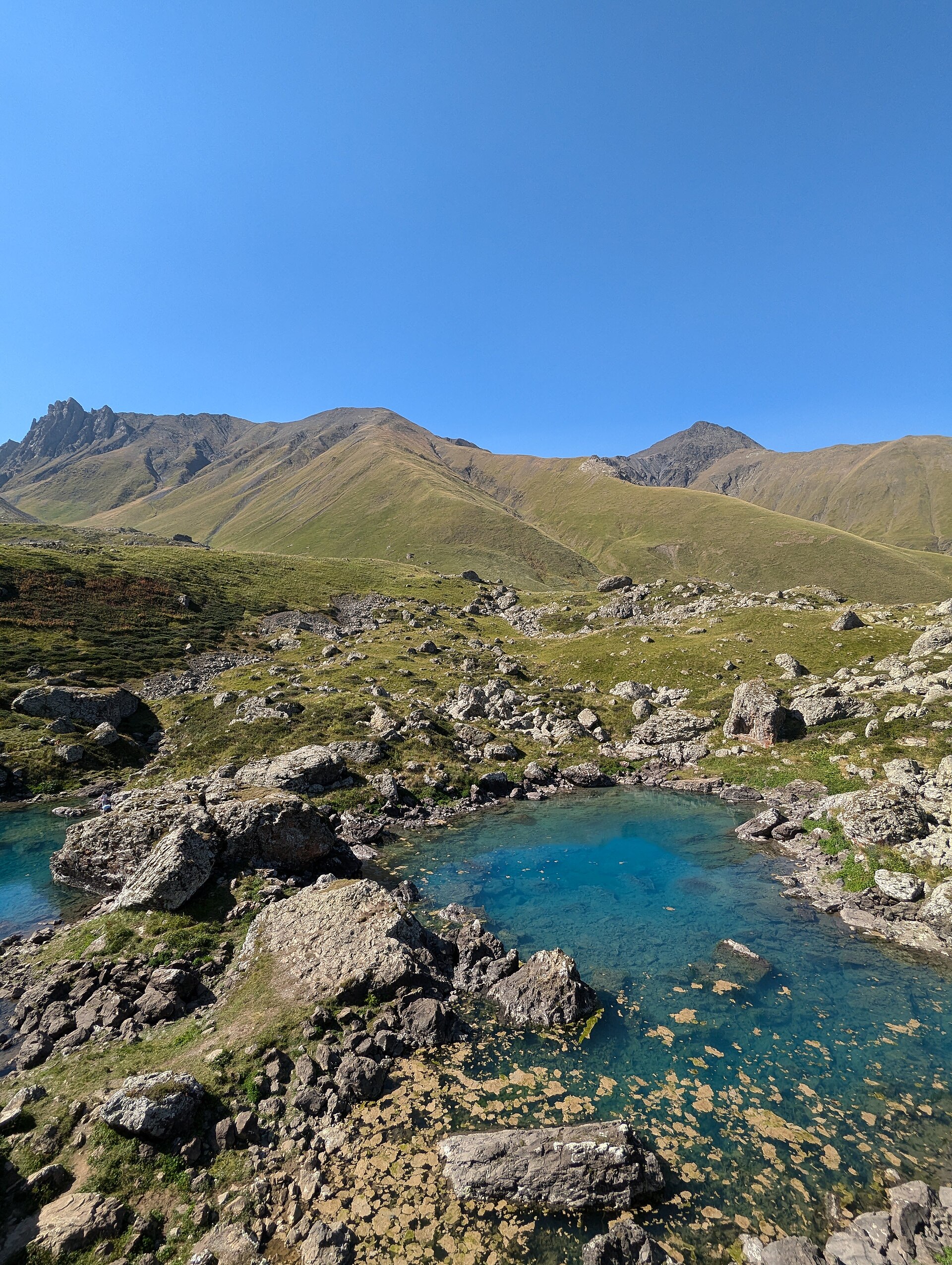
The Abudelauri Lakes are three small glacial lakes — one green, one milky blue, one grey-white — scattered on a high shelf below the sawtooth Chaukhi massif in Khevsureti. They’re reached on foot from the village of Roshka, and the honest headline is this: getting to the trailhead is harder than the hike itself. The lakes only make sense from roughly July to late September, and even the “easy” one asks for a proper day on your feet.
So this isn’t a spot you drift out to on a whim. It’s a plan. Let’s deal with the part that trips people up first: actually getting to Roshka.
Getting to Roshka from Tbilisi
Roshka sits at around 2,000 m in the Dusheti Municipality, about 106 km north of Tbilisi. On paper that’s a two-hour drive. In practice the last stretch is a slow, rough climb, and there is no marshrutka that runs straight to the village.
Public transport gets you close, not all the way. Marshrutkas for Khevsureti leave from Didube station in Tbilisi — the vans for Shatili run on Wednesday and Saturday around 10:00 for about 35₾ per person and take roughly 4.5–5 hours (schedule and price checked September 2026 against Wander-Lush). There’s also a daily Barisakho van in the late afternoon. Any of these can drop you at Korsha or Barisakho on the main valley road. The catch: from there to Roshka is a rutted, muddy track that a normal car won’t manage, so you’ll want a 4×4 or a local taxi for the final 16-ish km. Ask your guesthouse to arrange it before you arrive, because you won’t always find a driver waiting.
Renting a car or hiring a private driver is the cleaner option if there are two or three of you splitting the cost. The road from the Zhinvali reservoir up through Korsha has been improved in recent years, but the Roshka spur is still the kind of surface where a low sedan bottoms out. If you drive yourself, take the high-clearance vehicle seriously. This is not marketing.
One small bonus on the way in: the Roshka Rocks, a field of giant boulders left behind by an old glacier, sit right by the trail. Two of them rank among the largest glacial erratics on record. Worth the ten minutes.
The day hike: Roshka to the Green and Blue lakes
From Roshka to the first two lakes is about 7 km one way, climbing roughly 700 m, which most walkers cover in around three hours up and a bit less down. Call it a full day with lunch and photos — five to six hours of moving time on the return trip, per Georgia.to (checked September 2026).
The trail leaves the village, crosses a stream, and climbs steadily up the Abudelauri valley toward the wall of Chaukhi. It’s not technical. There’s no scrambling, no exposure. It’s just a long, honest uphill on a rough path, and the altitude makes the last section feel steeper than the map suggests. The Green Lake shows up first, a shallow, vivid pool that gets its colour from mineral sediment in the meltwater. The Blue Lake sits close by at about 2,600 m, and this is where most people stop, eat, and turn around.
Here’s the thing nobody mentions in the brochure photos: by mid-August the lakes shrink. Snowmelt is what fills them, and a dry late summer can leave the Green Lake looking more like a large puddle. Early season means fuller lakes but more snow underfoot on the approach. You’re trading one problem for the other.
The White Lake — higher, harder, and often skipped
The White Lake is the one people underestimate. It sits higher, at about 2,900 m, fed directly by the Chaukhi glacier, and reaching it means another climb of roughly 3 km beyond the Blue Lake over rougher, rockier ground. Add it on and your day stretches well past six hours of walking.
Is it worth the extra push? If the weather’s holding and you’ve got the legs, yes — it’s the wildest of the three, tucked right under the glacier with almost nobody around. But it’s also the first thing to cut when clouds build in the afternoon, which they do here with very little warning. Turn around if the sky goes grey. The lake will still be there next summer.
The multi-day option: over the Chaukhi Pass to Juta
The Abudelauri Lakes are also the middle of one of Georgia’s best-known crossings: Roshka to Juta (or the reverse) over the Chaukhi Pass at about 3,340 m. This links Khevsureti with the Kazbegi side, and it’s a serious walk — the full one-day traverse runs close to 18 km with over 1,200 m of climbing, according to Georgia.travel (checked September 2026).
Most people split it over two days and camp near the lakes. Direction matters more than the distance. Started from Juta (2,100 m), the climb to the pass is graded moderate. Started from Roshka, the same route is graded hard, because you gain altitude faster on a rougher path and hit the steep pass with more of the day behind you. The independent trekking outfit Caucasus Trekking rates the Roshka direction as the tougher of the two and puts the good window from early July to the end of September (checked September 2026).
Our advice: if you want the pass crossing and have only one direction in you, walk it Juta to Roshka. You climb the gentle side and descend the brutal one, which is far kinder on the knees than doing it backwards.
Season and weather: the July–September window
Snow lingers on this trail into May, and the Chaukhi Pass usually doesn’t clear until mid-to-late June. From October the weather turns fast and the road access degrades. So the real season is short. Think July through September, with the pass at its most reliable in high summer.
Even inside that window, mountain weather does what it wants. Mornings are often clear and calm; by early afternoon cloud can pile against the Chaukhi wall and drop rain, hail, or a cold wind within the hour. Start early. Being back below the Blue Lake by mid-afternoon is a much safer plan than pushing for the White Lake at 15:00 with a storm brewing. There’s no shelter up there and no phone signal to speak of.
No facilities: what you carry is what you have
There are no shops, cafés, or toilets at the lakes. None. Roshka itself has a handful of family guesthouses and that’s the last point for a real meal or a bed. Above the village you’re on your own — pack water or a filter, food, sun protection, a warm layer, and a rain shell even on a blue-sky morning.
Camping near the lakes is allowed and popular, with flat pitches around the Blue and Green lakes. A hut was built near the lakes in 2024, but treat it as a maybe rather than a guarantee and carry a tent if you plan to stay. If you camp, take every scrap of rubbish out with you. This is a fragile alpine basin and it stays beautiful only because most people leave it exactly as they found it.
If you’d rather test your legs closer to the city first, we round up gentler options in our guide to the best hikes near Tbilisi. And if a high-mountain day trip is what you’re after but Khevsureti feels like too much of a mission, the Kazbegi day trip reaches the same range from an easier base. For more ways out of the capital, see our full list of day trips from Tbilisi.
Frequently asked questions
Can you visit the Abudelauri Lakes as a day trip from Tbilisi?
It’s a very long day and only works with a private car or an organised tour. You’re looking at four hours or more of driving each way plus five to six hours on the trail, so the timing is brutally tight. Staying a night in a Roshka guesthouse turns a punishing dash into a relaxed hike.
How hard is the Abudelauri Lakes hike?
The walk to the Green and Blue lakes is a sustained uphill of about 700 m with no technical sections, and it’s manageable for a reasonably fit walker who’s comfortable on rough ground. Adding the White Lake or crossing the Chaukhi Pass to Juta bumps it firmly into hard territory.
Do you need a guide for the Abudelauri Lakes?
For the day hike to the coloured lakes, no — the route up the valley is straightforward in clear weather. For the two-day pass crossing to Juta, a guide or solid navigation skills are worth it, since fog on the high ground can hide the trail fast.
When do the lakes have the most colour?
Early to mid-summer, when snowmelt keeps them full. By late August a dry spell can shrink the Green Lake dramatically, so if the vivid water is your main reason for coming, aim for July over September.
Last practical thing, and the one that saves people the most grief: confirm your Roshka pickup and pin the exact trailhead on an offline map before you leave the tarmac, because signal disappears past Korsha and the turn-off is easy to miss.
Featured image: Photo: FingerWiki / Wikimedia Commons (CC BY-SA 4.0)




Leave a Reply