
They hang in market stalls like rows of colourful candles, and first-time visitors almost always mistake them for exactly that. But churchkhela is not a candle. It is Georgia’s oldest and most beloved sweet: strings of walnuts or hazelnuts dipped again and again in thickened grape juice, then hung to dry into a chewy, fruity, protein-packed snack often nicknamed the “Georgian Snickers.” Churchkhela is only the beginning, though. Georgian dessert culture runs deep, seasonal and almost entirely built on three humble ingredients: nuts, honey and grapes. Here is your sweet-tooth guide to what to taste, where to buy it and what to carry home.
The quick facts
- What it is: nuts threaded on a string, dipped in grape must, dried into a candle shape — not a candle, despite the look.
- Nickname: the “Georgian Snickers,” though it is far older and more natural.
- Season: made in autumn after Rtveli, the grape harvest, and stored for winter.
- Heritage: recognised by UNESCO as intangible cultural heritage in 2015.
- Price: roughly 2–5 ₾ from market vendors; premium hand-made pieces run 10–25 ₾.
- Vegan? Traditional churchkhela is just grape juice, flour and nuts — usually vegan.
What exactly is churchkhela?
Churchkhela is a brittle-yet-chewy confection built from just a few ingredients: grape must, nuts and flour. Most commonly walnuts or hazelnuts are threaded onto a string, dipped repeatedly into thickened grape or fruit juice, and hung upside down to dry in a candle-like shape. That resemblance to a votive candle fools nearly everyone, but there is no wax and no wick — just fruit and nuts. Historically it was portable, calorie-dense energy food, carried by travellers and soldiers through the winter, which is why some call it an ancient energy bar as much as a candy.
How it is made — and the Rtveli link
The heart of churchkhela is tatara: concentrated grape juice thickened with flour. Fresh grape (or sometimes mulberry) juice is boiled, flour is stirred in, and the mixture is cooked down to the consistency of warm honey. Strings of nuts are then dipped into this warm coating — seven to ten times, sometimes more for thick premium pieces — with each layer left to set before the next dip. Finally the strings are hung in a cool, airy room, often an attic or covered porch, to cure for two to three weeks.
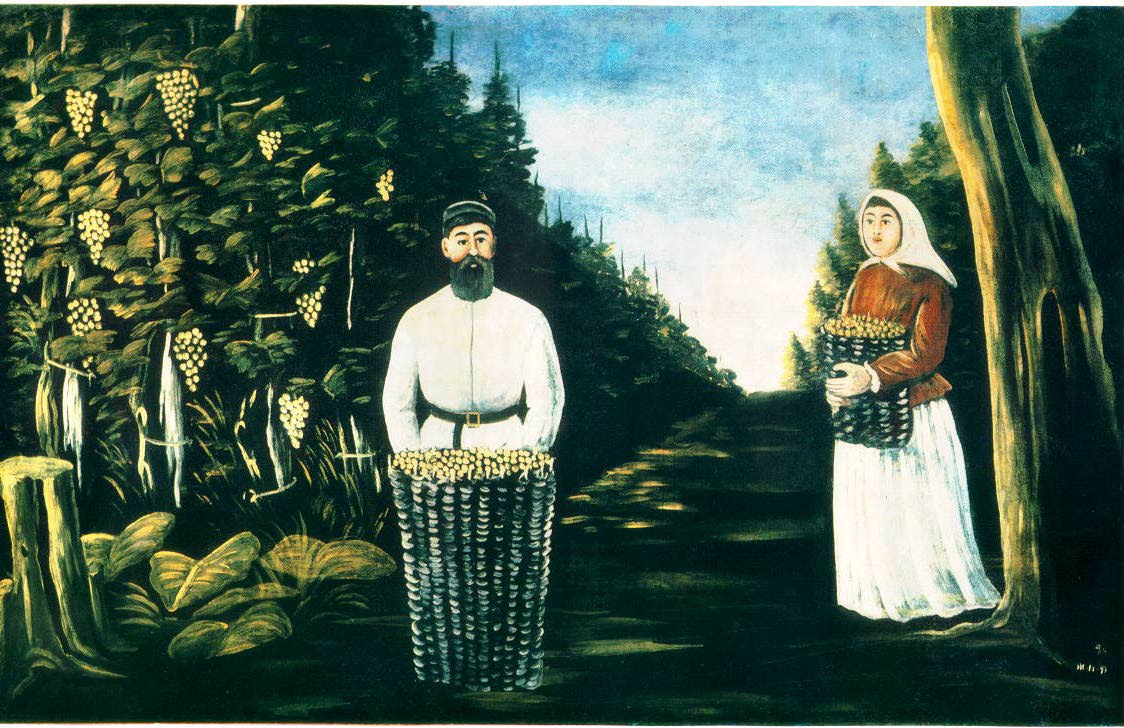
This is inseparable from Rtveli, Georgia’s autumn grape harvest. When families press grapes for wine in September and October, the leftover must becomes churchkhela and other grape sweets. It is a festive, communal time across the wine regions, and it is why the best churchkhela appears in markets in late autumn. To understand how central grapes and the harvest are to the whole cuisine, see our Georgian food guide.
Flavours and regional styles
Churchkhela varies by region and by juice. In eastern Georgia — Kakheti, Kartli, Meskheti — wheat flour is used and the thickened juice is called tatara; walnuts are the classic filling. In western Georgia — Racha, Guria, Samegrelo, Adjara and beyond — corn flour is more common, hazelnuts appear frequently, and a hazelnut-heavy western style is sometimes called janjukha.
Colour follows the grape: deep purple-brown from red grapes, warm amber or pale peach from white varieties. You will also see versions made with pomegranate or mulberry juice, and some with almonds instead of walnuts. None of it uses artificial colour — the shade tells you which grapes went in.
Beyond churchkhela: Georgia’s other sweets
Pelamushi
The soft sibling of churchkhela, pelamushi is a thick grape-juice pudding set with flour or cornmeal. It shares the same tatara base but is poured into moulds rather than wrapped around nuts, then chilled and sliced. Its colour ranges from deep purple to pale peach, and it is another star of the harvest table.
Gozinaki
The New Year sweet. Gozinaki is chopped walnuts caramelised with honey until firm, then cut into glossy diamonds. It appears on virtually every Georgian table at Christmas and New Year’s Eve and is closely tied to the Guria region. Note that because it contains honey, gozinaki is not vegan.
Tklapi (fruit leather)
Thin sheets of dried fruit pulp — sour tkemali plum, cornelian cherry, apricot or grape — spread on boards and sun-dried into flexible, leather-like sheets. The plum version is tart and often used in cooking, while apricot and peach lean sweet. It is a natural, addictive nibble and travels beautifully.
Kada, pakhlava and honey
Kada is a buttery, faintly sweet layered pastry from Samtskhe-Javakheti — hard to pin down, somewhere between bread and pie, and pure Georgian childhood nostalgia. Pakhlava is the local take on baklava: phyllo and nuts, usually drier and less syrupy than the Turkish version, though the Adjarian style in Batumi finishes with syrup. And Georgian mountain honey — from Racha, Tusheti and the highlands — deserves a place of its own, eaten by the spoonful or drizzled over fresh cheese.
Where to buy in Tbilisi and what you’ll pay
The best-value churchkhela comes from markets and roadside vendors. In Tbilisi, head to Dezerter Bazaar near the train station, where strings hang among fresh produce and spices, or the small vendors around Dry Bridge Market. Along highways into the wine country you will pass roadside stalls selling homemade strings straight from the harvest.
- Market and roadside churchkhela: about 2–5 ₾ per string.
- Premium, thick, hand-dipped pieces or gift-boxed sets: 10–25 ₾.
- Pelamushi and gozinaki: sold by weight or the piece at bazaars and bakeries.
- Tklapi: a few lari per sheet at markets — one of the cheapest edible souvenirs.
For a fuller rundown of edible and craft gifts, including where the tourist mark-ups hide, see our guide to the best souvenirs in Tbilisi.
Are Georgian sweets vegan?
Good news for plant-based travellers: traditional churchkhela is grape juice, flour and nuts — nothing animal-derived — so most of it is vegan. Pelamushi and tklapi are typically vegan too. The exceptions are honey-based sweets like gozinaki, and butter- or lard-rich pastries like kada. Always ask, since some modern producers add ingredients. For more plant-based eating around the city, see our vegetarian and vegan Tbilisi guide.
Which sweets to bring home
Churchkhela is the obvious souvenir — it keeps for weeks, survives a suitcase and is unmistakably Georgian. Tklapi is light, flat and packs flat in luggage. Gozinaki and a jar of mountain honey make lovely gifts, and pelamushi is best eaten fresh in the country rather than carried far. Buy at a market rather than an airport shop and you will pay a fraction of the price.
Frequently asked questions
Is churchkhela actually a candle?
It is completely edible. The candle look comes from layers of grape coating dried around a string of nuts — locals eat it, they do not light it, and only the shape fools newcomers.
Why is it called the “Georgian Snickers”?
The nickname simply captures the chew-plus-nut combination in familiar terms. Unlike the chocolate bar, though, churchkhela predates modern candy by centuries and contains nothing beyond grape juice, flour and nuts.
How long does churchkhela last?
A well-cured string stays good for weeks and often a few months if kept somewhere cool and dry — the same shelf life that once made it a staple for soldiers and travellers facing winter.
How much should I pay for churchkhela in Tbilisi?
Budget a few lari, roughly 2–5 ₾, for an ordinary string from a bazaar or roadside stall. Thick artisan or gift-boxed versions climb to 10–25 ₾, and airport shops charge far more than markets do.
Sources: Wikipedia — Churchkhela, Wander-Lush: Traditional Georgian Desserts & Sweets, Atlas Obscura: The Georgian Candy That Fueled Soldiers, and Madloba: Georgian Sweets.
Last checked: July 2026
Featured image: Lessormore (CC BY 4.0) via Wikimedia Commons.


Leave a Reply