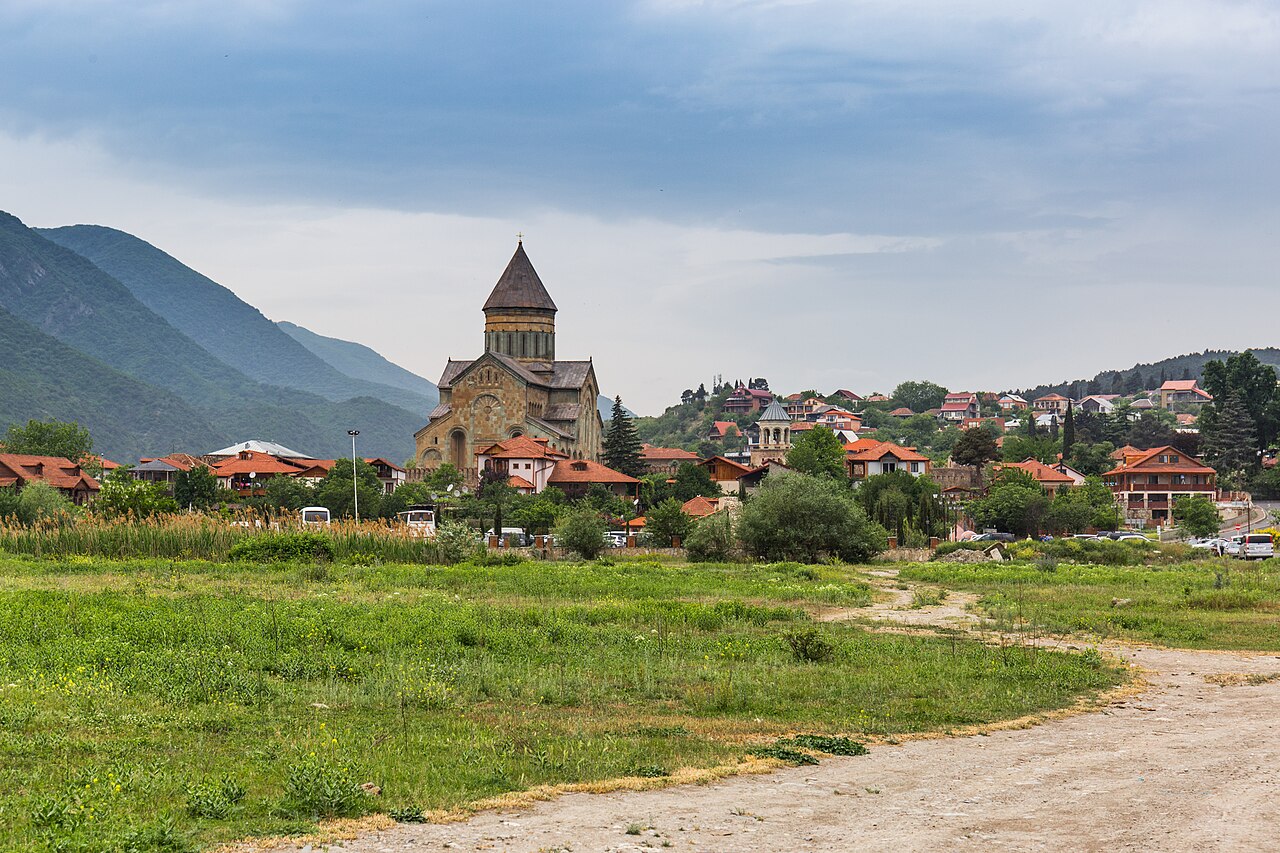
Mtskheta is 20 km from Tbilisi, and nearly everything travellers arrive believing about it is a little bit wrong. The drive takes longer than the guidebooks say, the famous hilltop church is not walkable, and by noon the old town belongs to coach groups.
None of that makes it a bad trip. Georgia’s old royal capital holds the cathedral where the country’s kings are buried, the seat of the Georgian Orthodox patriarch, and a UNESCO-listed cluster of churches you can cover in a morning. It just rewards people who plan around the five mistakes below.
The name defeats most visitors, so: MTSKH-eta, and the consonant pile-up is normal in Georgian. This was the royal seat of the Kingdom of Iberia for something close to a thousand years before Tbilisi took over, and the conversion of the country to Christianity happened here in the 4th century. The patriarch still lives in town. That is the short version of why a place of 8,000 people carries this much weight.
Myth 1: “It’s 30 minutes away”
Thirty minutes is the driving time between two motorway junctions, not the time it takes you to get from your guesthouse to the cathedral door. Budget 45 to 60 minutes each way and you will not be disappointed.
The marshrutka from Didube costs 2₾, leaves every 15 to 20 minutes from about 7am, and takes 45 to 60 minutes in traffic, checked August 2026 against Wander-Lush. Then add the metro ride out to Didube on the red line (1₾ with a Metromoney card), the ten minutes you will spend working out which of the identical white vans is yours, and the short walk in from wherever the driver stops.
A Bolt collapses all of that into one leg and costs somewhere between 30₾ from Freedom Square and 60₾ from the far side of town at rush hour. For two or more people it is the sane choice, and the driver puts you down at the cathedral wall instead of on the highway.
There is a train, twice a day, 26 minutes. Ignore it. The station sits outside the historic core and the timetable is built for commuters, not visitors. Tbilisi City Hall announced on 1 July 2026 an international tender for a feasibility study into an urban rail corridor linking the capital with Mtskheta, Rustavi and the airport, so this may change one day. Not this year.
Myth 2: “You can walk up to Jvari”
You cannot stroll up to Jvari Monastery after your coffee. The church sits on the far side of the valley, and by road it is a 7 km climb around the bridge and up the switchbacks, roughly twenty minutes each way in a car. No bus goes there. Not one.
A footpath does exist, the old pilgrim route, with metal steps and handrails bolted into the steeper sections. It takes most walkers around an hour and a half uphill, the waymarking gives out in places, and there is no shade worth the name on the last stretch. In July, at midday, that is a genuinely bad idea.
So you take a taxi. Drivers waiting near the cathedral gate quote 40 to 50₾ for the return run with waiting time built in; several 2026 guides including Wander-Lush report doing it for 20 to 25₾, so open with their number and see what happens. Whatever you pay, pay for the wait. There is no taxi rank at the top, only tour vans that already have passengers.
One thing nobody tells you: Jvari has the better view, Svetitskhoveli has the better building. If you only have the patience for one, and you care more about architecture than panoramas, stay down in the town and spend the taxi money on lunch.
Our advice: go, but only when the air is clear. The building itself is a small, severe 6th-century cross-dome church that you will have seen properly in ten minutes. What you are actually buying is the moment the Aragvi and the Mtkvari meet below you, brown water pushing into green, with the whole town laid out flat behind. In August haze that view turns into a grey smear and the 40₾ stings. Check the sky from town before you commit.
Myth 3: “It’s a half day, so go any time”
Time of arrival matters more here than in any other day trip near Tbilisi. Svetitskhoveli opens at 8am and the tour coaches from the capital start unloading late morning, which is also when the Kazbegi tours make their scheduled twenty-minute stop on the way north.
Get there between 8.30 and 10 and the nave is nearly empty, the light comes in sideways through the south windows, and you can stand in front of the royal tombs without someone’s selfie stick in your ear. Turn up at 12.30 and you are queueing for a scarf.
Two scheduling traps. Sunday liturgy runs from about 9am to 1pm and Saturday evening vespers from roughly 5pm, and while you are welcome to attend, wandering around with a camera during a service is not on. The other is the late option: the cathedral stays open until 8pm per travelguide.ge, and the last hour before sunset is the second-quietest slot of the day. Only the food gets worse that late.
Season matters less than hour, but it matters. April to June and September to October give you mild air and thinner crowds; July and August bake the stone courtyard and fill it, and January leaves you with a beautiful, freezing, half-shuttered town where two of the three restaurants you wanted are closed.
Myth 4: “It’s just one church”
Svetitskhoveli is the reason people come, and the legend is worth knowing before you walk in. A local man is said to have carried Christ’s robe back from Jerusalem; his sister died holding it and was buried with it, a cedar grew from the grave, and the column cut from that cedar refused to be raised until Saint Nino prayed it into place. The robe is believed to lie under the floor. Entry is free.
But the town has four more things worth your feet:
- Samtavro Monastery — eight minutes’ walk north, an active convent, and the burial place of King Mirian III and Queen Nana, the couple who made Christianity the state religion. Quieter than the cathedral and the nuns run a tighter dress code.
- Bebris Tsikhe — the ruined fortress at the northern edge of town, free, usually empty, and the best place to see how the valley funnels traffic north.
- Shio-Mgvime Monastery — 12 km up a side valley, cave cells cut into the cliff, about 12₾ each way by taxi. Adds an hour and turns the half day into most of a day.
- The stall row — churchkhela, homemade wine, chacha, felt hats. Prices are set for day-trippers, so the bottle you buy here costs more than the same wine in a Tbilisi shop. Our Tbilisi souvenirs guide covers what is genuinely worth carrying home.
Myth 5: “The dress code is a formality”
It is enforced, politely and without exception. Shoulders and knees covered, and women cover their hair inside both Svetitskhoveli and Samtavro. Wraps and scarves sit in a basket by the door for anyone who turns up in shorts, and plenty of people do.
Bringing your own scarf is faster and cleaner than digging through the communal basket at 11am in August. Men get handed a wrap-around skirt over shorts, which is exactly as awkward as it sounds. Carry coins too: candles are bought and lit with small change, and the stalls outside are cash-first even in 2026.
The practical block
A working morning looks like this. Leave central Tbilisi around 8.15, be at the cathedral gate by 9.30, give Svetitskhoveli an hour and Samtavro fifteen minutes, take the taxi up to Jvari at 11, eat at 12.30, and you are back in the city by 2pm with your afternoon intact.
- Getting there: marshrutka from Didube 2₾, 45 to 60 minutes; Bolt 30 to 60₾ one way.
- Jvari: taxi only, 20 to 50₾ return, agree the waiting time out loud before you get in.
- Entry: free at every church in town.
- Lunch: khinkali run 2 to 3₾ a piece and a filling meal for two with a jug of house wine lands around 40 to 60₾. Walk one street back from the cathedral gate and the same food costs less.
- Cash: small lari notes for the van, the stalls and the candles.
If you would rather know what you are ordering before the waiter arrives, our Georgian food guide sorts the menu out.
Frequently asked questions
How do you get from Tbilisi to Mtskheta?
Marshrutka or taxi. Vans leave Didube station every 15 to 20 minutes for 2₾ and take 45 to 60 minutes; a Bolt from the centre runs 30 to 60₾ and drops you at the cathedral rather than on the main road. The twice-daily train is faster on paper but leaves you outside the old town.
How much is a taxi from Mtskheta to Jvari?
Between 20 and 50₾ for the return trip, depending on how you bargain and how busy the gate is. Fix the price and the waiting time before you sit down, because there is nothing to flag down at the top of the hill.
How long do you need in Mtskheta?
Three to four hours on the ground covers Svetitskhoveli, Samtavro, the taxi run up to Jvari and lunch. Adding Shio-Mgvime pushes it towards six. Stretching it further mostly means walking past the same souvenir stalls twice.
Do you have to cover your head in Svetitskhoveli Cathedral?
Women do, and it is checked at the door. Shoulders and knees must be covered for everyone, shorts included. Scarves and wrap skirts are lent free at the entrance, though bringing your own scarf saves you a queue in high season.
One last thing worth deciding before you book anything: whether Mtskheta should be its own morning at all. It sits on the Georgian Military Highway, so almost every Kazbegi day trip already stops here, and if your days in Georgia are short you will see the cathedral either way. Wanting more than twenty rushed minutes in it is the only real reason to come separately. Our day trips from Tbilisi guide lays out how the rest of them compare.
Featured image: Dmitry A. Mottl (CC BY-SA 4.0) via Wikimedia Commons.

Leave a Reply