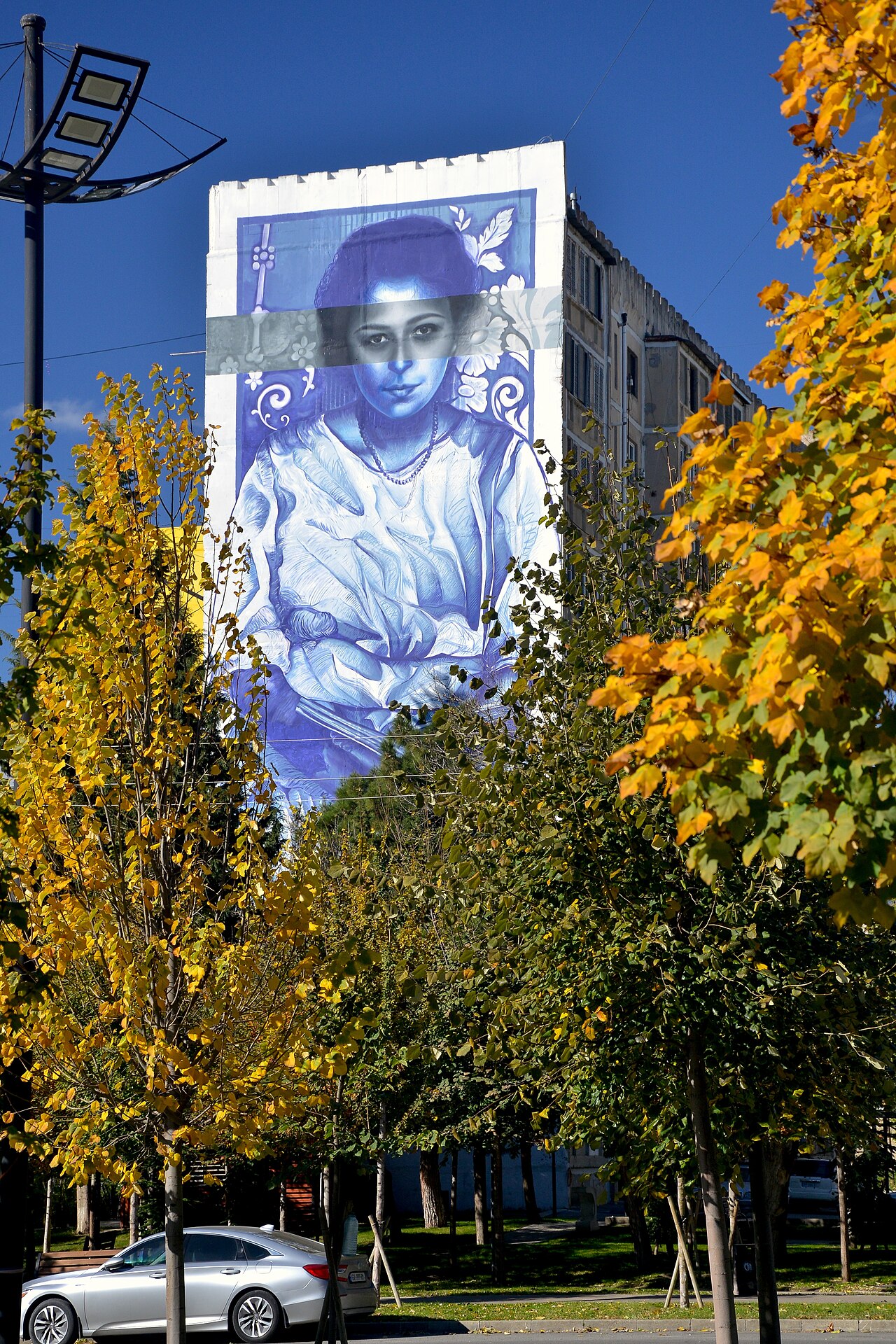
The densest, most reliable Tbilisi street art sits in two places: the courtyard and surrounding lanes of Fabrika in Chughureti, and the political stencils that keep reappearing along Rustaveli Avenue no matter how often the city paints them out. Start at either and you will not run short of walls.
One honest warning before you lace up. Almost none of this is permanent. Murals get painted over, defaced, weathered, or simply replaced at the next festival, so treat every specific piece named below as a snapshot from mid-2026 rather than a guarantee. If a wall is bare when you arrive, that is the art form working as intended.
Begin at Fabrika, because it always delivers
Fabrika is a converted Soviet sewing factory turned hostel, bar cluster and creative hub, and its inner courtyard has functioned as the neighbourhood’s open-air gallery since roughly the mid-2010s. Two murals here get photographed more than anything else in the district: MUSYA’s Cosmic Girl and Fabrika Kids, according to Red Fedora Diary’s mapped survey of the city’s walls. You will also spot Tamoonz’s recurring red-haired girl, a signature that turns up across Chughureti.
The reason to open here is simple. Fabrika is the one location where the art rarely disappears entirely, so even on a bad day you get something. For the food, bars and layout of the complex itself, our full Fabrika guide covers the ground floor properly.
Don’t stop at the courtyard, though. That’s the mistake most visitors make.
The Chughureti backstreets are the real gallery
Walk out of Fabrika and loop the blocks around Ninoshvili and Aghmashenebeli, and the density climbs fast. This is the stretch tied to the Niko Movement, a loose collective that has treated the district’s crumbling facades as practice ground and finished gallery at once. Names to look for on the ground: Tamoonz, Dante and Kuba.
Chughureti earns its own visit for the architecture alone, and the murals are stitched into it rather than pasted on. If you want the neighbourhood’s cafes, wine bars and history alongside the art, read our Chughureti and Marjanishvili walk and fold the two together.
Here’s the part nobody tells you: the good stuff is up a flight of stairs or inside a half-open gate as often as it’s on a main frontage. Which brings us to the courtyards, and to a rule you should hold onto before you go peering into them. More on that below.
The political murals, and why they keep vanishing
This is the strand that makes Tbilisi’s walls different from a tidy mural-festival town. Since the 2024 protests against the Georgian Dream government, and building on a decade of civic street work before that, the city’s walls have carried EU flags, Ukrainian flags beside the Georgian one, and slogans like Georgia is Europe. Many have then been crossed out or scrubbed. The Aleksanteri Institute’s study of protest art describes this back-and-forth as a running argument played out in paint.
The name to know is Gagosh, a stencil artist whose satirical political pieces cluster around Rustaveli Avenue and the underpasses off it. His best-known sequence started as a Mother of Georgia figure; the authorities erased the top half, leaving a headless torso, so he repainted a police officer aiming a gun where the head had been, turning the censorship itself into the subject. By his own account, reported in UP Magazine’s walk with the artist, close to 90% of his roughly 200 works have been removed for political or religious reasons.
A timing note that actually helps you here. Rustaveli is closed to vehicles for its full 2 km, from around Tamar Chovelidze Street to Freedom Square, from 23 July to the end of November 2026, and the pro-EU protests outside Parliament run nightly. That makes the avenue easier and safer to walk slowly with a camera than it usually is. It also means fresh political work, and fresh erasures, tend to appear here first.
Our advice: photograph the political pieces the day you see them and don’t plan a trip around a specific one you found online. The wall you saw in a 2025 post may already be grey.
Old Town stairs: Betlemi, Gudiashvili, the Gabriadze lanes
The Old Town holds a quieter, more decorative strand than Chughureti’s. Around the Betlemi steps climbing toward Narikala, the restored Gudiashvili Square, and the lanes near Rezo Gabriadze’s clock tower and puppet theatre, you get painted doorways, mosaic fragments and small commissioned murals rather than big political statements. It reads softer, and it photographs beautifully in the narrow light.
Note that Narikala Fortress itself is fenced off for restoration through at least August 2026, so plan the Betlemi climb as a street-level wander, not a route to the walls.
A rough self-guided route for one morning
Half a day covers the two strongest zones without a car.
- Start at Fabrika mid-morning, before the courtyard fills with brunch crowds. Cover the inner walls, then loop the surrounding Chughureti blocks toward Aghmashenebeli.
- Walk south across the river toward Rustaveli. With the avenue pedestrianised this season, work your way down it and dip into the underpasses for the political stencils.
- Finish in the Old Town on the Betlemi steps and around Gudiashvili and the Gabriadze lanes as the afternoon light drops.
If you would rather have someone point out the pieces and their backstory, a guided option removes the guesswork. Several of the walks on our free walking tours roundup pass through Chughureti and the political-mural stretch, and a good guide will know which walls are current this week.
Shooting courtyards where people actually live
Those famous Italian courtyards, the ones with the wooden balconies and shared staircases, are not attractions. They are homes, and the entrances you step into to reach a mural are someone’s front door. Local photographers are blunt about this: JAM News’s courtyard photo story notes that plenty of residents don’t want strangers shooting against the backdrop of where they live.
So a short code. Don’t push open a closed gate. Skip laundry lines, open windows and anyone’s face without a nod first. If someone waves you off, leave, and take the small tangent as a gift, because they’ll often point you to a better wall two doors down. A murmured gamarjoba as you enter does more than any zoom lens.
Best light, and when the walls read cleanest
Chughureti’s lanes are narrow and run past tall facades, so mid-morning to early afternoon is when direct sun actually reaches the lower walls; earlier than that and half the courtyard sits in shadow. The Old Town steps do the opposite, glowing best in the last hour before sunset when the stone warms up. Late June gives you well over 15 hours of daylight to work with, against barely 9 in late December, so summer buys you time on both ends of the day.
Frequently asked questions
Is street art legal in Tbilisi?
Festival and commissioned murals are sanctioned; unsanctioned political stencils are not, which is why they get fined and painted over. As a viewer you’re doing nothing wrong by looking or photographing. Just don’t add your own tag to a wall.
When is the Tbilisi Mural Fest?
The festival has run annually since 2019, with the 2025 edition adding new large-scale works across Tbilisi and several other Georgian cities. Dates shift year to year, so check the organiser’s channels close to your trip rather than pinning a fixed week.
Can I find the murals without a guide?
Yes. The Fabrika courtyard and the Chughureti blocks around it are walkable on your own with a phone map, and Rustaveli’s political pieces are self-evident once you slow down. A guide mainly saves you from chasing walls that have already been repainted.
Are the political murals safe to visit right now?
Viewing and photographing the walls is fine. The nightly demonstrations outside Parliament on Rustaveli are peaceful for onlookers, but crowds swell after dark, so daytime is calmer if you want to concentrate on the art.
Last thing, and the one worth acting on. Before you go, save your own photos of whatever moves you, because Gagosh’s near-total erasure rate is the rule here, not the exception. The wall is temporary; your frame of it is the only permanent version.
Featured image: Jelger Groeneveld (CC BY-SA 4.0) via Wikimedia Commons.




Leave a Reply