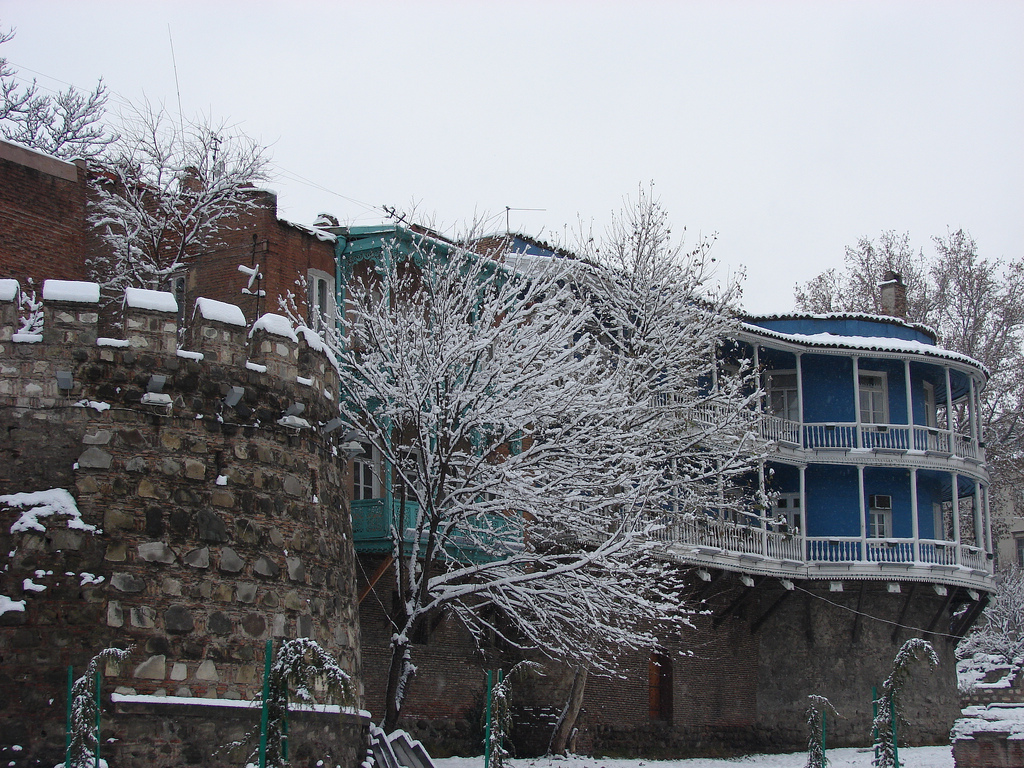
Almost everything you came to Tbilisi for is open in winter. The short list that quietly isn’t: the mountain road north on avalanche days, most rooftop and terrace seating, the botanical garden after mid-afternoon, and Narikala’s ruined walls — fenced for restoration, nothing to do with the season.
Nobody writes that list down, so people arrive in January with a July itinerary and lose two days to it. Closed list first, then the honest case for coming anyway. Still picking dates? Our best time to visit Tbilisi comparison weighs the seasons against each other, and Tbilisi weather by month has the figures.
What quietly closes or shortens between December and February
The road first, because it’s the only closure that wrecks a whole day. The Georgian Military Highway crosses the Jvari Pass at 2,379 m to reach Stepantsminda, and in winter that pass shuts several times a month for avalanche control — sometimes six hours, sometimes two days, and once or twice a season Kazbegi is cut off entirely. Wander-Lush’s Kazbegi guide, checked August 2026, points at the Geo Roads hotline for live status.
Gergeti Trinity Church itself doesn’t close, and it looks better in snow than at any other point in the year. But the summer walk up from Stepantsminda turns into an ice route, so the 4×4 drivers become the only sane way up (about 25₾ per person, 70–100₾ for the vehicle) — and none of it matters on a day the pass is shut. Our advice: in winter, never book Kazbegi as a day trip. Sleep in Stepantsminda and keep a spare morning. Practicalities in our Gergeti Trinity Church guide.
Back in the city the losses are smaller and more annoying. Old Town terraces and rooftop bars stack their chairs from November; a few keep going with heaters and blankets, but the picture in your head is a May picture. The National Botanical Garden opens at 09:00 all year on a 4₾ ticket and shuts around 17:30 in the cold months, not the 19:00 aggregator listings still print. Mtatsminda Park runs fewer rides, and the funicular is first to stop when weather turns.
Narikala catches people out: the fortress walls are fenced off for restoration. The cable car from Rike Park runs as normal at 2.5₾ each way (Metromoney card only, no cash) and Kartlis Deda and the ridge path are open, so the view survives even though the ruins don’t — see our Narikala Fortress guide.
What is genuinely better in winter, not just tolerable
The sulfur baths, and it isn’t close. Abanotubani’s water comes out of the ground hot all year, but the twenty seconds when you step from a 40°C private room into a 2°C alley is the entire experience, and you can only have it now. Plain private cabins run 15–40₾ an hour, the tiled Chreli-Abano rooms 60–70₾, spa-grade suites 150–300₾; public halls are still single-digit lari. Full breakdown in our Tbilisi sulfur bath prices guide.
Then the thing you can’t buy: empty lanes. In August the stairs below Betlemi Street have a queue for the same photograph; in January you get them, plus whoever is walking their dog. The Simon Janashia Museum, 30₾ for foreign visitors, is quiet enough to actually read the Soviet Occupation labels instead of shuffling past them.
And the ridge. Street snow rarely survives past lunch, but the high ground above Mtatsminda holds it for weeks — from the Rike Park side of the river you get a warm brown Old Town with a white line behind it. That’s the winter photograph worth having. The snowy-cobbles one mostly never happens.
The daylight problem, in actual clock times
You lose an afternoon, effectively. At the December solstice the sun is up at 08:25 and gone by 17:34 — nine hours nine minutes, per Gaisma’s Tbilisi tables, checked August 2026. Mid-January sunset is back to about 18:00, late February near 18:30.
Those numbers flatter the Old Town, which sits in the trough below the Sololaki ridge. The sun goes behind it well before official sunset, so the lanes turn blue and cold while Vake is still lit. Plan for real light from 10:00 to 15:30.
So flip the day: viewpoints and day trips in the morning block, baths and museums and long dinners after dark, when there’s nothing else on offer. Fighting that order is how people end up eating at 18:00 with five hours to fill.
Heating, or why your flat may be colder than the street
This is the complaint in winter reviews more than any other, and it has a cause: Tbilisi has no district heating. Every building runs its own gas. A post-2010 apartment means a boiler and radiators in every room; a converted nineteenth-century Old Town flat can mean one wall-mounted heater in the living room, single-pane windows and four-metre ceilings that swallow whatever it produces. Those bedrooms sit at 14–16°C overnight.
So ask in writing before booking: heating in the bedroom specifically, gas or electric, double glazing or not. Listings say heated when they mean there is a heater somewhere on the property. A split air-conditioner set to heat is common and fine, but loud, and it won’t reach a second room. The most charming Old Town guesthouses are the highest-risk category, which is the annoying part.
Winter is cheaper, but not the way you’ve been told
The half-price winter is a myth. Average nightly rates move from about $64 at the summer peak to about $55 in midwinter — a 14% dip, not a discount. What halves is occupancy, and that’s the real prize: the good room is free, and you can rebook on the morning of arrival if the heating turns out to be bad. The genuine saving is in airfares. Budget the same nightly figure you would in shoulder season and buy a better-heated room with it.
New Year, 7 January, and the days things actually shut
Georgia’s church calendar is Julian, so Christmas Day is 7 January. The big night, by a distance, is 31 December: family-centred, fireworks off half the balconies in the city, closer to a national dinner than a night out.
The Tbilisi Christmas Village ran 12 December to 14 January at First Republic Square in the 2025–26 season, moved there from Orbeliani Square. The coming winter follows the same window; Wander-Lush’s festive guide, checked August 2026, is the fastest place to confirm before you fly.
Now the closures. 1, 2 and 7 January are public holidays: banks, government offices, exchange booths and small family-run shops shut, some of them for the whole first week. Supermarkets run short hours. Restaurants, cafes, bars, pharmacies and ATMs carry on. Two things for your calendar: metro and buses run free until 03:00 on 1 and 7 January, and the Alilo procession — carol singers with icons and crosses — leaves First Republic Square about 14:00 on 7 January for Sameba Cathedral.
One local quirk worth knowing: 2 January is Bedoba, the day of luck, when what you do is said to set the pattern for your year, so Georgians spend it with people they like. Want the lights without the shut banks? Come between 15 and 30 December.
Packing for cold but not Nordic
Tbilisi in January is a London winter with better sun and worse pavements. No expedition parka. Traction, though, yes.
- Boots with actual tread. Old Town cobbles and the Betlemi steps go slick with damp and refreeze after dark. The one item people get wrong.
- A warm mid-layer plus a windproof shell beats one heavy coat — restaurant heating runs hot and you’ll want to shed something.
- Hat and gloves for evenings. Afternoons sit at 5–9°C, but it drops to freezing fast once the ridge takes the sun.
- Flip-flops if you’re bath-hopping — towels are provided almost everywhere, footwear rarely is.
- Lip balm and heavy moisturiser. Dry cold outside, gas heat inside; your skin notices by day three.
- No ski gear unless you’re committed. Gudauri is a 2–2.5 hour drive north, not the hour people assume, and it all rents on site.
Frequently asked questions
What is closed in Tbilisi in winter?
Less than people fear. Terrace and rooftop seating shuts from November, the botanical garden closes around 17:30 instead of 19:00, and Mtatsminda Park runs fewer rides. Narikala’s fortress walls are fenced for restoration, though the cable car and Kartlis Deda stay open. The real closure risk is the Jvari Pass to Kazbegi, shut several times a month for avalanche control.
Is Tbilisi worth visiting in winter?
Yes, if you want sulfur baths, wine bars and museums rather than long outdoor days. You get empty Old Town lanes, restaurant tables without booking and snow on the ridge behind the city. Skip it if your trip depends on mountain excursions, or if five hours of usable daylight isn’t enough.
How cold does Tbilisi get in December and January?
Afternoons sit around 5–9°C and nights just below freezing, with January the coldest month. Snow settles in the city only a few days a season and rarely lasts past lunchtime. The bigger discomfort is an under-heated old apartment, not the street.
What happens in Tbilisi over New Year and 7 January?
31 December is the main celebration, with citywide fireworks and family dinners. 7 January is Orthodox Christmas, marked by the Alilo procession from First Republic Square to Sameba Cathedral around 14:00. Public transport runs free until 03:00 on both dates. Banks and government offices close on 1, 2 and 7 January; restaurants and pharmacies stay open.
Featured image: daduNI – Nino Narozauli (CC BY-SA 2.0) via Wikimedia Commons.

Leave a Reply