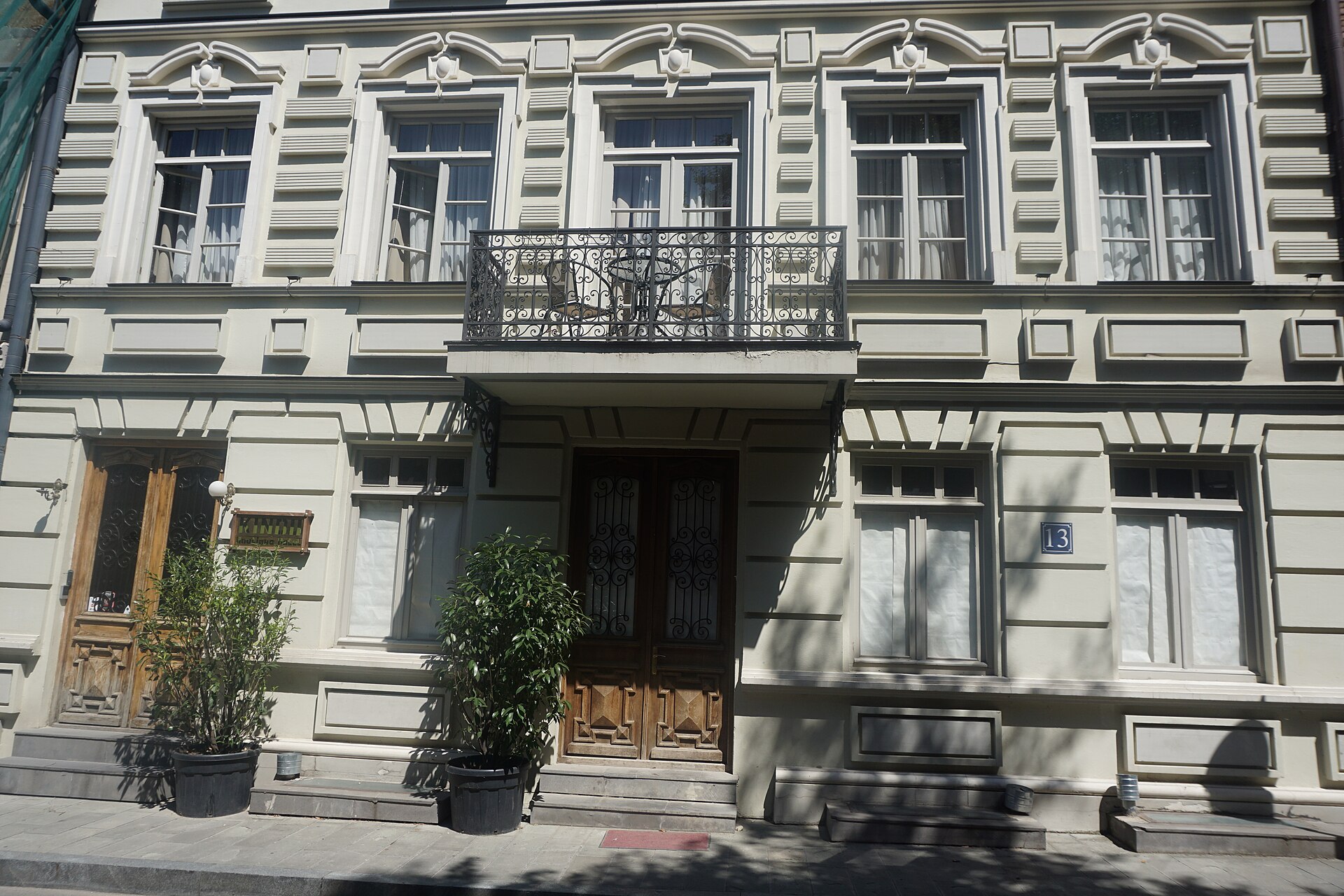
Book a Tbilisi apartment rental for a short stay and the price will look absurdly good: $49–57 a night is the citywide average on the two big short-let data trackers, checked September 2026 against AirDNA and AirROI (the two disagree on exact figures, so treat that as a band, not a decimal). The catch isn’t the price. It’s that Tbilisi listing photos are honest about the room and silent about the building.
A wide-angle shot of a restored Sololaki ceiling tells you nothing about the four flights of stairs below it, the absence of air conditioning, or the gas heater that runs the hot water. This guide is organised around those silences, in the order they ruin trips.
The photo shows the room, not the summer
Air conditioning is the first thing to check and the last thing listings volunteer. July afternoons in Tbilisi average around 31°C, and a lot of the city’s most photogenic flats, the high-ceilinged 19th-century ones in Sololaki and the Old Town, have no AC at all. Thick walls and three-metre ceilings take the edge off, but a west-facing room in an August heatwave is still a west-facing room. Our post on Tbilisi in summer goes deeper on what those months actually feel like.
Don’t trust the amenity checkbox. Zoom into the photos and look for the white split-unit box on a wall, or its compressor hanging outside a window. If you can’t find one in any picture, message the host and ask directly: is there air conditioning in the bedroom, and does it work? Hosts answer honestly when asked in writing. The checkbox sometimes means one unit in the living room cooling a flat with two closed bedroom doors.
Between June and September, no confirmed bedroom AC, no booking. That rule alone filters out most of the disappointments.
Fourth floor, no lift, and nobody mentioned it
Those beautiful old houses were built decades before anyone in Georgia installed an elevator. A “4th floor, historic building” listing in Sololaki, Mtatsminda or the Old Town almost always means a wooden staircase, sometimes a slightly alarming one, and no lift. With two suitcases in August, that’s a genuine consideration, not a quirk. Travellers with knee trouble or a pram should treat any historic-district listing above the second floor as suspect until the host confirms otherwise.
Soviet-era blocks further out do have lifts, and here’s the local wrinkle worth knowing: some older ones still take a coin or charge a few tetri per ride, paid into a little box in the cabin. It’s a small thing. It’s also exactly the kind of thing you’d rather learn from a guide than at 1am with luggage.
“City centre” can mean a cliff
Tbilisi is a gorge city. A flat that sits 400 metres from Freedom Square on the map can sit 60 vertical metres above it in reality, up a steep, cobbled, poorly lit street on the flank of Mtatsminda or upper Sololaki. The listing will say “5 minutes to the centre”, and downhill, it is. The walk home after dinner is a different trip.
Check the actual pin, then check it in satellite or street view. If the streets between the flat and the main drag look like switchbacks, they are. Nothing wrong with staying up there, the views are the reward, but you should choose it, not discover it. Our Tbilisi neighborhoods guide maps which districts are flat, which climb, and which only pretend to be central.
Hot water is a machine, and the machine has moods
Most Tbilisi flats heat water on demand with a wall-mounted gas unit called a karma, not a storage tank. When it works, it’s excellent: endless hot water, no waiting. When it’s an old unit, the shower runs hot-cold-hot as the flame cycles, and in a few flats it needs relighting after the gas flickers.
Two questions for the host before booking in winter: what heats the flat, and what heats the water? “Central heating” in the Western sense barely exists here; you’re looking for gas heating plus a modern combi boiler, or at minimum decent electric heaters in every room you’ll use. A January listing photographed in June won’t show you the cold. Reviews will, so read the December–February ones specifically.
The noise trade, and the wifi number nobody tested
Street-facing or courtyard-facing? In central Tbilisi that’s the real quiet-or-not question. Street side gets traffic, bar spill and, on Rustaveli, the nightly protest soundscape that’s been part of the avenue since late 2024. Courtyard side gets the famous Tbilisi ezo instead: neighbours, dogs, a rooster in a surprising number of Old Town yards, and conversations that carry beautifully off the balconies. Courtyards win, but they’re not silent, and light sleepers should pack earplugs either way.
Wifi claims deserve the same scepticism. “Fast wifi, great for remote work” is decoration until someone posts a speed test. Georgian fibre is genuinely quick where it’s installed, 100 Mbps plans are ordinary, but old buildings sometimes run on a shared or ancient connection. If you need to work, ask the host for a screenshot of a speed test taken in the flat. A host who can’t produce one in a day is telling you something.
How booking actually works here
Airbnb and Booking.com carry the bulk of the short-stay market; AirROI counts roughly 6,000 active Airbnb rentals in the city, over 90% of them entire flats. For stays under two weeks, staying on-platform is the sane default: payment protection, reviews, and a refund path if the flat isn’t what the photos promised.
For two weeks to three months, local listing portals such as ss.ge and myhome.ge open up a cheaper layer of the market, and agents there work fast, often showing flats the same day. The trade-offs: agency fees (commonly half a month’s rent on longer lets), cash deposits of one month handed over with minimal paperwork, and no platform to appeal to. Deposits do come back, but get the terms in writing, even as a text message, and photograph the flat’s condition on day one.
Never pay a deposit to hold a flat you haven’t seen or booked through a platform. That’s the one genuine scam pattern here.
What a fair price looks like
Against that $49–57 nightly average, here’s how the districts break out for a decent one-bedroom in high season:
- Old Town and Sololaki: $45–80 a night for something renovated; the $30 listings are the ones with the stairs, the missing AC, or both.
- Vera and Vake: $50–90. Vake is the city’s premium district, and monthly figures back that up: furnished one-beds in Vera, Vake or Sololaki run about $500–900 a month long-term, so short-let rates 30–50% above that pro-rata are normal, not a rip-off.
- Marjanishvili and the left bank: $35–60, the best value zone with a metro stop and flat streets.
- Saburtalo and further out: $30–50, fine for a work base, dull for a first visit.
Weekly stays should earn a discount of 10–15% off the nightly rate; monthly, 30% or more, and it’s worth messaging hosts to ask even when no discount is shown. Winter isn’t the bargain people assume: nightly rates only slip from about $64 to $55, it’s occupancy that collapses, which means winter’s real advantage is choice, not price. For how these numbers sit against everything else you’ll spend, see our cost of living in Tbilisi breakdown.
When a hotel beats a flat
For one or two nights, a hotel wins, full stop. Check-in at a Tbilisi flat often involves a WhatsApp exchange, a lockbox hunt, or waiting for someone’s cousin with a key, and that overhead isn’t worth it for a short hop. Hotels also solve every problem above at once: guaranteed AC, a lift, a front desk, and hot water that doesn’t have moods.
Our advice: three nights is the crossover. Under that, book a hotel; over that, a well-vetted flat gives you more space, a washing machine and a balcony for less money, and a better feel for how the city actually lives. Plenty of frequent visitors will tell you to always take the flat. For a first, short visit, they’re wrong. Where to base yourself either way is covered in where to stay in Tbilisi.
Frequently asked questions
Is it safe to rent an apartment in Tbilisi through Airbnb?
Yes. Fraud on the major platforms is rare, and Georgia is a low-crime country by European standards. The risks are comfort risks, a flat that doesn’t match its photos, not safety ones. Keep all payment on-platform and the worst case is an awkward refund process.
How much does a short-term apartment in Tbilisi cost per week?
Budget $250–450 for a week in a good central one-bedroom once a weekly discount is applied, and $200 or under further from the centre. August and September sit at the top of those bands; February at the bottom.
Do apartments in Tbilisi Old Town have air conditioning?
Renovated ones increasingly do; unrenovated ones mostly don’t, and the amenity list isn’t always accurate either way. Confirm in writing that there’s a working unit in the bedroom before booking any stay between June and September.
Do I need to pay a deposit for a short-term rental in Tbilisi?
Not on Airbnb or Booking.com, where any damage claim goes through the platform. Deposits appear once you rent through local portals or agents, standardly one month’s rent in cash on longer stays, so document the flat’s condition with photos the day you move in.
One last check
Before you press book, read the three most recent reviews and search the rest for four words: stairs, hot, noise, wifi. Reviewers bury the truth in the middle of polite paragraphs, and those four words are where every Tbilisi listing’s silences get broken.
Featured image: Yuri Samoylov (CC BY-SA 4.0) via Wikimedia Commons.




Leave a Reply