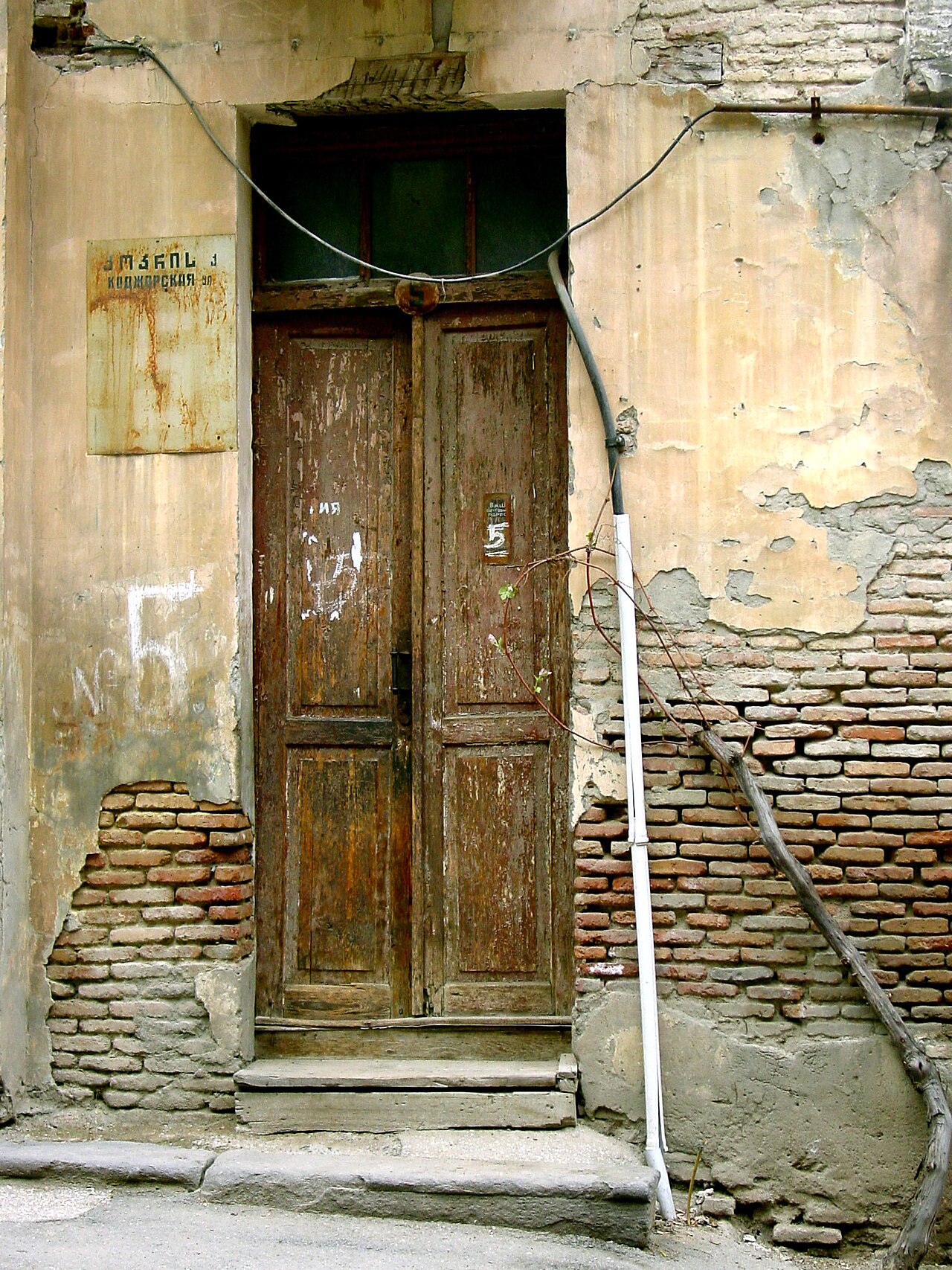
The best architecture in Sololaki is not on the street. It is three metres inside the street, behind a heavy wooden door that is probably unlocked: painted walls, mosaic floors, cast-iron banisters and a coloured glass ceiling over a staircase that eleven families still climb every day.
So the district rewards one specific way of walking: head up, eyes on first-floor balconies and window surrounds, and a willingness to push a door and stand quietly in a stranger’s hallway for ninety seconds. Get that habit right and this is the most interesting hour in Tbilisi. Get it wrong and you are a tourist in somebody’s corridor.
How to behave once the door opens
Start here, because this is the part people get wrong before they get anything else wrong.
These are not museums. People still live in these houses and use the hallways as part of everyday life. A Sololaki stairwell is somewhere a nurse comes home at seven in the morning, where a pram is chained to the railing, where somebody’s washing is drying one flight up. Treat it as you would the shared landing of a building in your own city.
- If the door is locked or keypad-coded, that is an answer. Do not wait to tailgate a resident in.
- Stay in the entrance hall and on the first half-flight. Nobody’s painted ceiling is worth walking to the fourth floor for.
- Voices down, phone on silent, flash off. Flash is also the fastest way to ruin a photograph of a dim painted wall.
- Never photograph an apartment door, a nameplate, or an open doorway with a person in it.
- Two or three people at a time. A group of eight in a stairwell reads as an invasion, not curiosity.
- Daylight hours only, and if anyone says anything to you at all, say gmadlobt, smile, and leave.
Is it actually allowed? There is no rule against stepping into an unlocked shared entrance, and residents in the well-known buildings have watched strangers do it for twenty years. That tolerance is a favour, not a right. Some hallways now have a handwritten sign or a dish for coins. Leave two or five lari if you see one.
Why the district looks like this
Sololaki is a Russian-imperial suburb, not a medieval quarter. After the 1820s annexation Tbilisi burst out of its walls, and this slope below Mtatsminda became the address for the city’s new money. From the 1860s up to the First World War, Armenian, Georgian and Russian merchant families built European-style houses here, hiring architects who mixed Art Nouveau, neo-classicism and neo-Moorish detail with local balcony traditions.
The competition between those families happened indoors. A facade could only say so much. The vestibule was where you proved yourself, so owners commissioned painted allegories, glazed tiled stoves imported from Italy and France, mosaic floors spelling the Latin greeting SALVE, and stained glass set into the stairwell ceiling. At 18 Galaktion Tabidze Street the tobacco-dealing Seilanov brothers had their own surname laid into the floor mosaic in Russian, under painted allegories of the continents and a glass ceiling on the third floor.
Then 1921. Soviet Georgia nationalised housing, and homes built for one family were handed to anywhere from five to fifteen. One bourgeois floorplan became a warren of communal rooms with a shared kitchen and one tap. Nobody owned the hallway any more, so nobody repaired it, and nobody painted over it either. The decoration survived precisely because it stopped belonging to anyone.
What to look for once you are inside
Give your eyes ten seconds to adjust. Sololaki halls are dark, and the first impression is always disappointing.
Then look down first. The floor is often the most intact thing in the building, because feet wear tiles slowly and damp destroys plaster fast: medallion patterns, geometric flower borders, the SALVE inscription at the threshold. Then the walls, painted straight onto plaster in oil or tempera, most often landscapes, and surviving only as a metre-high band under later Soviet paint. Then the ceiling, for rosettes, painted friezes and coloured glass over the stairwell. Then the banister ironwork, which in the better houses is the finest object in the building.
Look for the stove scar. Many halls were heated by a large glazed-tile stove, and where one has gone its outline still reads on the wall like a shadow.
The streets that repay a slow walk
Georgia’s national tourism board publishes an address-by-address list, the most reliable English-language starting point there is. Checked September 2026 against the board’s own Sololaki page, the buildings worth crossing the road for:
- Ivane Machabeli 17 — built 1910 by the engineer Ghazar Sarkisian for the tobacco and oil man Michael Kalantarov. Moorish interior: turquoise and orange walls, lancet arches, a stalactite stucco ceiling, marble stairs, a stained glass circle overhead. The most photographed hall in the city and still the best.
- Ivane Machabeli 13 — the Sarajishvili house, 1905, on the modernist end of the district’s taste.
- Geronti Kikodze 9 and 11 — number 9 for its openwork staircase, number 11 for a 1914 mixture of European styles by Gabriel Ter-Michelov.
- Daniel Chonkadze 4 and 11 — 1902 by Mikhail Oganjanov, and an 1892 reconstruction with Islamic detailing.
- Galaktion Tabidze 18 — the Seilanov house, 1911.
- Sololaki 8 and Amaghleba 23 — for surviving wooden balconies rather than interiors.
Between them, wander Lado Asatiani and Nino Chkheidze without a target. The boundary streets are Giorgi Leonidze, Daniel Chonkadze, Amaghleba, Gizo Nishnianidze, Lado Asatiani and Shalva Dadiani, a small enough box to cover on foot in a morning. For how it sits against Vera, Chugureti and Avlabari, our Tbilisi neighbourhoods guide maps the lot.
Call it the door lottery: on any given street perhaps one door in four opens, and which four changes month to month as locks get fitted and codes get shared. Walk a street twice on different days and you will see different buildings.
The stairs problem
Sololaki is built on a slope, and the north-south streets climb hard toward Mtatsminda. Lado Asatiani and Amaghleba run more or less level; anything crossing them does not. Add the halls themselves, where the good detail sits half a flight up a marble staircase missing a handrail, and this is a hard district for anyone with knees that complain.
Two fixes. Walk the flat streets east to west and climb deliberately, once, at the end. And do not bolt Sololaki onto the walk up to Narikala fortress. The ridge is close enough to tempt you and steep enough to end the day early.
Sololaki is not Old Town, and the difference matters
They touch, so people conflate them. They are opposites in almost every way that affects your day.
Old Town proper, the tangle around Sioni and Shardeni, is medieval in plan, heavily rebuilt and organised around visitors: English menus, sulphur baths, souvenir stalls, noise until late. Our Tbilisi Old Town guide covers that side. Sololaki is a nineteenth-century grid of residential blocks with peeling plaster, courtyards full of parked cars, and nothing staged for you. The attraction is interior and accidental. It is also far quieter after nine in the evening, which is worth weighing in our where to stay in Tbilisi comparison.
The decay, and the argument about fixing it
Be honest about what you are looking at. Many of these halls are water-damaged, propped, wired with a spaghetti of retrofitted cable, and losing plaster by the winter. City Hall has restored individual buildings, the Machabeli 17 and Galaktion Tabidze 18 interiors among them, plus stretches of Galaktioni and Machabeli streets. The district is far too large for that to count as a plan.
The bigger fight is over method. Sololaki’s own Gudiashvili Square reopened in 2021 after a rehabilitation that heritage campaigners spent a decade contesting, largely because the model on offer was facadism: keep or replicate the outer shell, gut everything behind it. The nineteenth-century Lermontov house was partly torn apart in the process, and much of the rebuilt square has since sat empty because the finished property is priced beyond the people who lived there. openDemocracy’s account of Tbilisi restoration and the local NGO Tiflis Hamqari, founded in 2005, both frame it as redevelopment wearing a conservation label.
Our advice, and plenty of people will disagree: if you have one morning, spend it on Machabeli and Kikodze and skip Gudiashvili Square. The square is the prettiest thing in Sololaki and the least truthful. The cracked hallway three streets away tells you more about the district than the restored one does.
Frequently asked questions
Do you need a guide to see the entrance halls?
No, and most visitors go alone with a list of addresses. A guide buys you access to buildings whose keypads they know, and the backstory of the family whose initials are worked into the ironwork. If that second thing matters to you, book one. Otherwise a phone torch and four hours will do.
How much time should I set aside for Sololaki?
Three to four hours covers it at the pace the place wants. Under two and you are ticking off addresses rather than standing in them, which defeats the point.
Is Sololaki safe at night?
Yes, by the standards of any European capital. Tbilisi has little street crime and this is a lived-in residential area with people on balconies. The real hazards after dark are unlit steps, missing paving and open basement hatches. The buildings are a daytime activity anyway, since none of the interiors are lit.
What is the closest metro station to Sololaki?
Freedom Square, on the red line, sits at the district’s northeastern corner, two minutes from Galaktion Tabidze Street. Liberty Square and Tavisuplebis Moedani are the same station under different names, which trips people up on maps.
One last thing, and it changes the whole day: go between about ten and noon. That is when the sun is high enough to come through the stairwell glass and down the well onto the painted walls, and it is also the quietest window in a residential building, after the commute and before the lunch traffic. Bring a small torch for the floors. Do not bring a tripod.
Featured image: Vladimer Shioshvili (CC BY-SA 2.0) via Wikimedia Commons.




Leave a Reply