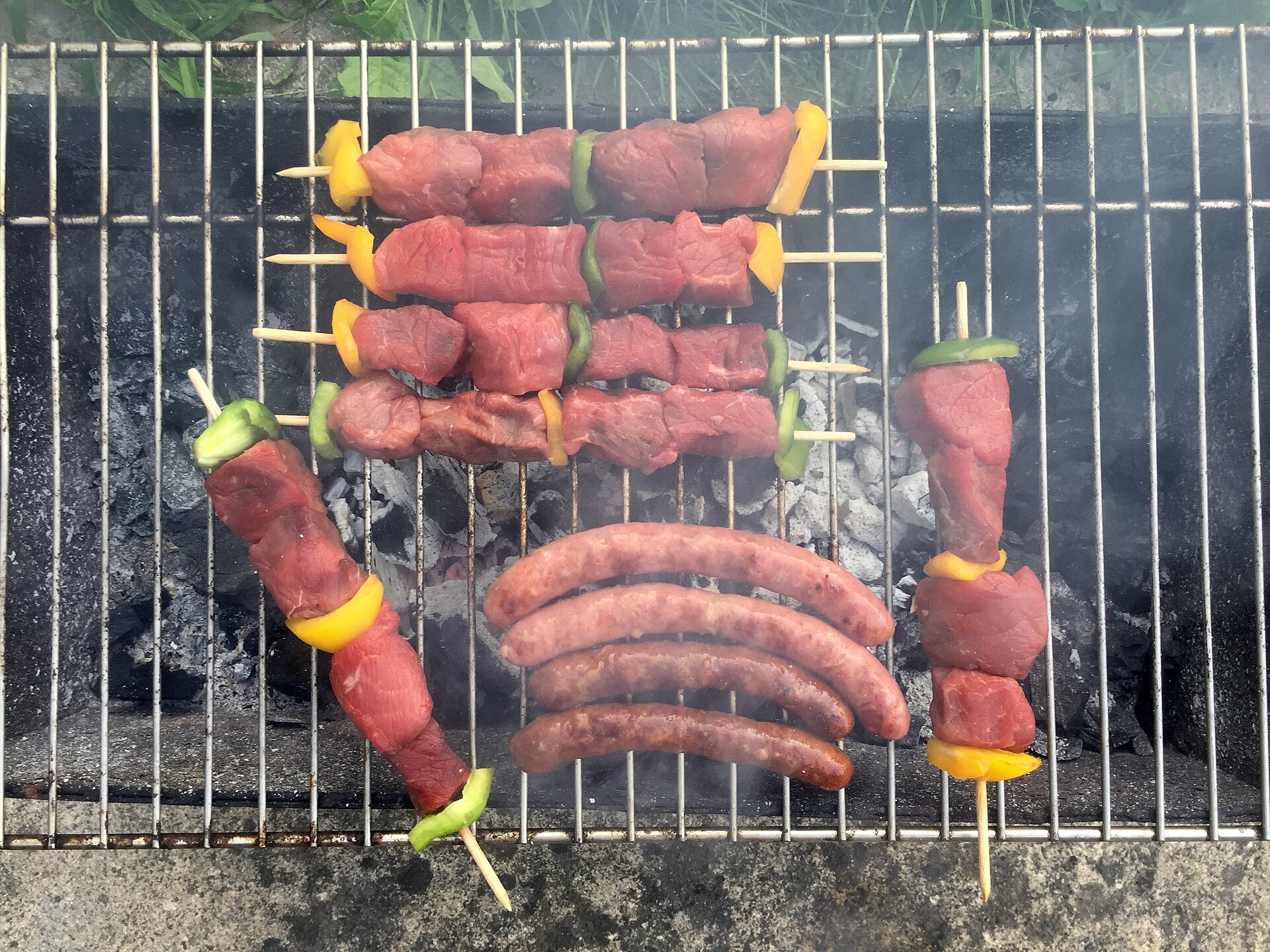
Mtsvadi is Georgian barbecue: chunks of meat threaded onto a long skewer and cooked over embers, most often pork, sometimes veal or lamb. What sets the good version apart is the fuel. The best is grilled over dried grapevine cuttings rather than charcoal, and the meat itself carries almost no marinade beyond salt. It arrives with raw onion, a bowl of sour plum sauce, and warm bread, and in most Georgian households it is less a dish than a reason for everyone to stand around the fire until it’s ready.
If you’ve eaten shashlik in Russia or Central Asia, you already half-know this food. But the Georgian take is different in ways that matter, and the differences are the first thing worth clearing up.
How is it different from shashlik?
Same idea, different philosophy. Shashlik across the former Soviet space usually leans on a marinade: vinegar, onion juice, sometimes wine or kefir, left to work on the meat overnight. Mtsvadi at its most traditional skips almost all of that. Fresh pork gets cut into pieces roughly the size of a matchbox, salted, and put straight over the coals. No cumin, no paprika crust, no soy. The flavour is supposed to come from the meat and the smoke, not from a spice cabinet.
The other tell is what lands next to it. A plate of mtsvadi almost always comes with sliced raw onion, tkemali (that sharp green or red plum sauce), and often a scatter of pomegranate seeds squeezed over the top. That combination — smoky fat, raw onion bite, sour plum — is the Georgian signature. Order the same skewers in Yerevan or Baku and the sauces and sides shift entirely.
Why the grapevine matters
Here’s the part most visitors miss. In Kakheti, Georgia’s main wine region, the classic fuel isn’t charcoal at all. After the vines are pruned each winter, the cut-off canes — tsalami in Georgian — are dried and saved specifically to grill over. According to Georgia’s national tourism board, the Kakhetian method burns these vine clippings (or, in some villages, deka, a kind of azalea wood) down to embers, then cooks the meat over that.
Does the fuel actually change the taste? Yes, and not in a subtle marketing way. Dried vine wood burns hot and fairly clean, throwing off a faintly sweet smoke that settles into the fat as it renders. A Georgian food resource that walks through the traditional method notes the vine gives off a fragrant oil and produces even, long-lasting coals rather than the fierce spikes you get from lump charcoal (details checked September 2026 against madloba.info). Even heat is half the battle — pork over an uneven fire either dries out or stays raw in the middle.
One more Kakhetian habit: the grill master lays the skewers over white embers, never open flame, and turns them steadily for about 20 to 25 minutes, sometimes sprinkling on a little qvevri wine or pomegranate juice as they cook. If you ever see a cook fanning the coals down to a dull glow before the meat goes on, that’s not laziness. That’s the whole technique.
What comes on the plate
The meat does most of the talking, but the sides earn their place. Tkemali is the one to understand: a runny sauce made from wild sour plums, garlic and herbs, tart enough to cut clean through pork fat. Green tkemali (unripe plums, plus coriander and blue fenugreek) leans herbal; red tkemali is a touch sweeter. Either way it does for mtsvadi what a squeeze of lemon does for fried fish.
Then the raw onion, cut into rings and sometimes tossed with a little salt or those pomegranate seeds. And bread — most often shoti, the canoe-shaped white loaf pulled from a clay tone oven, or a soft flatbread to wrap a piece of meat and an onion ring together. You eat with your hands more than you’d expect. If you want to know where mtsvadi fits among the other big Georgian plates, our Georgian food guide lays out the full spread, and the how to order Georgian food walk-through covers the ordering rhythm at a proper sit-down meal.
The outing around the meat
Georgians don’t really grill on a random Tuesday because they fancy barbecue. Mtsvadi is the anchor of the gathering — a birthday, a name day, the first warm weekend of spring, a drive into the countryside that somehow requires a mangal (the metal grill) in the boot of the car. Someone appoints themselves head of the fire, often the most opinionated man present, and everyone else is expected to have views about his technique.
It runs into the calendar hard, too. Turkey satsivi is the centrepiece of the Georgian New Year table, but grilled meat shows up among the hot dishes at that same feast, and mtsvadi is common through the whole New Year and Christmas run of eating (Georgia.travel’s New Year supra guide, checked September 2026). In Kakheti there’s an even more specific occasion: Zaotoba, a late-autumn day when families distil chacha and grill together, half-jokingly called the pigs’ funeral. If you’re in Tbilisi over the holidays, our New Year in Tbilisi guide covers what actually happens in the city those nights.
Worth knowing before you idealise it: this is warm-weather food at heart. Roadside grill shacks and countryside picnics thin out in the cold, so much of the winter mtsvadi you’ll meet in Tbilisi comes off an indoor grill or an enclosed courtyard rather than a hillside.
Restaurant or roadside?
Both have their place. Roadside stands — the ones with a smoking mangal out front on the highways toward Kakheti or Gori — are where mtsvadi feels most honest, and where the vine-wood smell hits you before you’ve parked. The catch is that quality swings wildly and there’s no menu to check; you’re trusting the cook and the crowd. A stand with a queue of local drivers at lunchtime is telling you something a signboard can’t.
City restaurants trade some of that romance for consistency. The good ones still cook over real embers rather than gas, which is the single thing to ask about if you can’t see the grill. A gas flat-top produces something perfectly edible and completely different — it’s grilled pork, not mtsvadi in any way a Kakhetian would recognise.
Where to try it in Tbilisi, and what it costs
A few Tbilisi spots do the grilling properly. Kaklebi, up in Vake, is regularly singled out for cooking mtsvadi over actual grapevine embers rather than gas, with the char to prove it — the Wander-Lush 2026 Tbilisi restaurant guide (checked September 2026) calls out its real-ember barbecue specifically. Honoré is another that focuses on simple grilled meat, where you can take plain pork mtsvadi or pay a few lari more for tenderloin. Chains like Machakhela are the reliable, everywhere option if you just want a solid skewer without hunting.
On price, a portion of mtsvadi in Tbilisi runs somewhere around ₾15–35 depending on the meat and the place, and a full sit-down meal with sides lands at ₾45–80 per person, more once wine is flowing at ₾6–8 a glass. That said, prices have crept up with inflation, so treat any figure as a starting point rather than a promise, and check the menu before you commit to the fancier cuts.
Our advice: skip the mtsvadi in the postcard-view restaurants of the old town and eat it where locals do — Vake, Saburtalo, or better still on a day trip toward Kakheti where the vine wood is a few kilometres from the fire. The setting is worth less than the smoke.
Last practical thing, and the one that most changes your meal: order it and eat it immediately. Mtsvadi is at its best in the first five minutes off the skewer, while the fat is still soft and the onion still sharp against it. Let it sit and go lukewarm on the plate and you’ve missed the point of the whole fire.
Common questions
Is mtsvadi always made with pork?
No, though pork is the default and by far the most common. You’ll also find veal and lamb versions, and occasionally beef. Kakhetian pork mtsvadi is the one Georgians tend to argue is the real thing, but if you don’t eat pork, most grills will happily skewer lamb or veal instead — just say so when you order.
What is tkemali sauce made of?
It’s a sauce built from wild sour plums, cooked down with garlic, salt and herbs. The green kind uses unripe plums with coriander and blue fenugreek and tastes herbal and very tart; the red kind uses riper fruit and comes out a little sweeter. Both are meant to be sharp — that acidity is what balances the fatty grilled pork.
Can you eat mtsvadi in Tbilisi in winter?
Yes. Many roadside grills quieten down when it’s cold, but Tbilisi restaurants keep it on the menu year-round, and it’s a fixture of the New Year and Christmas feasting in December and January. Look for a place that grills over embers indoors or in a covered courtyard if you want the traditional version rather than a gas-cooked one.
Is Georgian mtsvadi spicy?
Not really. The meat itself is barely seasoned — often just salt — so the skewer arrives mild and smoky. Any kick comes from the extras you add yourself: the raw onion, and above all the tkemali, which brings sourness more than heat. If you want fire, ask for adjika, the chilli-garlic paste, on the side.
Featured image: Photo: Benoît Prieur / Wikimedia Commons (CC0)




Leave a Reply