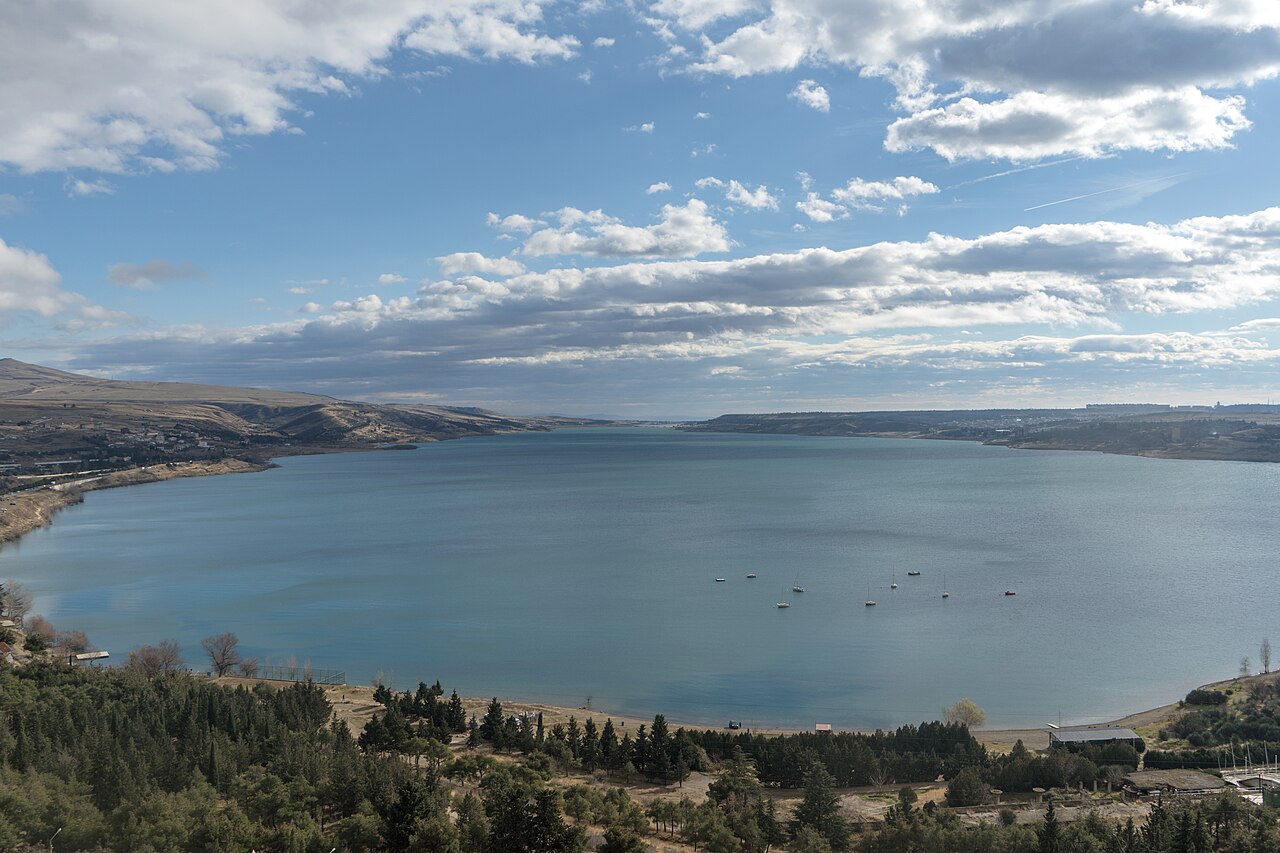
Yes, you can swim in the Tbilisi Sea, and plenty of locals do all summer. It isn’t a sea at all, though: it’s a large man-made reservoir on the north-east edge of the city, built in the 1950s to supply Tbilisi with water, so don’t come expecting sand and surf. What you get is a wide sheet of open water with a monument on the hill above it, a free public beach on one side, and a paid club on the other.
The quick version: the free beach is fine for a cheap dip and costs you nothing but the bus fare; the paid club buys you a sunbed, pools and a cleaner strip of shore for around 35₾. The catch is safety, and it’s a real one, so read the next part before you dive in.
Is the water actually safe to swim in?
Clean enough, deep enough to respect. This is a drinking-water reservoir, not a lake with a gentle shelf. It runs to about 26 metres deep in the middle, and the shallows drop away faster than they look (Doli Doki). Surface water sits at roughly 21–25°C through July and August, which is warm enough to float around in for an hour without your teeth chattering.
Here’s the part the glossy guides skip. The free beaches have no lifeguards, and people drown in the Tbilisi Sea most summers. Georgian rights monitors have flagged the informal swimming zones here as some of the most dangerous water in the country, singling out the area near the tower where the Iori River feeds in through an engineered channel — the current there is not something to test (Humanrights.ge).
So swim parallel to the shore, not out toward the middle. Keep children within arm’s reach. And if the wind picks up in the afternoon and the surface starts chopping, get out. It’s a big body of water with nobody paid to come and get you.
Free public beach or the paid club?
This is the decision most people are really asking about, so let’s settle it.
The main free option is Temka Beach, on the Grmagele (Ghrmaghele) side. It’s a proper local scene in season: beach bars, grill zones you can rent, sometimes a banya set up in the sand, and a lot of families on a hot weekend. Nobody charges you to walk in and swim. The trade-off is what you’d guess — busier, rougher underfoot, and only as clean as the crowd that day leaves it.
The paid alternative is Tbilisi Sea Club, a gated complex with two large swimming pools, a small kids’ pool with a slide, sunbeds, a café and its own maintained stretch of shore. Entry has run around 35₾ on weekdays and about 40₾ at weekends in recent seasons, with parking and a sunbed usually included (a price the club itself has posted on its own social feed; treat it as a guide, since it’s reset each summer). The club opens in late May and closes in late September.
Our advice: if you have kids or you just want a clean sunbed and a pool to rinse off in, pay for the club — 35₾ is less than two cocktails and it removes every hassle. If you’re a confident swimmer who wants the local flavour and doesn’t mind sharing the water, Temka is genuinely fine and free. What we would not do is drive all the way out here, look at the crowded free beach, and then swim somewhere sketchy to save 35₾.
Getting there without overpaying
The cheap way is the metro-plus-bus combo. Take the red line (First Line) north toward Akhmeteli Theatre and get off at Ghrmaghele, about 15 minutes from Freedom Square. Outside the station, on the same side of the road, catch bus 360 (it used to be the 60). It runs about every 15 minutes from around 6:30am and follows the northern shore of the reservoir (Wander-Lush).
Because the bus counts as a transfer, the whole trip is 1₾ on a Metromoney card, so long as you tap on within the 90-minute transfer window (pay the driver in cash and you lose that, and pay the full fare twice). For the Chronicle of Georgia, get off at the Cadet Corps stop and walk up. For the beach itself, stay on toward the Temka side.
Prefer the door-to-door route? A Bolt from the city centre runs roughly 20–25₾, and only about 10₾ if you hop out at Ghrmaghele metro and order from there. On a 34°C afternoon with a cooler bag, the Bolt is worth it. Skip the taxis idling by the beach entrance; order in the app instead.
The Chronicle of Georgia on the hill above
You can’t miss it. Above the water stand the giant black pillars of the Chronicle of Georgia, Zurab Tsereteli’s monument that people keep calling Tbilisi’s Stonehenge. Most visitors pair the two: monument first while the light is good, then down to the water to cool off, or the reverse.
They sit close on the map but they are not a two-minute stroll apart, and the walk between them is uphill on an exposed slope. Do the climb before the midday heat, not after a swim when you’re already flat. We’ve covered the monument, its carvings and the best hour to photograph it in a separate guide, so head there for the detail.
Windsurfing, jet skis and the afternoon wind
The same wind that ends your swim is why boards come here at all. The Tbilisi Sea is the closest reliable wind-sport water to the city, with an afternoon breeze that builds most summer days — enough that forecasters track it as its own spot (Windguru). It’s not a world-class venue, but for a quick session it beats driving to the coast.
Jet skis and paddleboards launch from the Tbilisi Sea Club side, and separate yacht and watersports outfits along the shore run boat trips, waterskiing and the occasional parasail. Prices for these aren’t fixed or published anywhere reliable, so agree the number before you climb on, not after. If windsurfing is the whole reason you’re coming, message a club ahead — gear rental isn’t something you can count on turning up and finding.
When to go, and when it’s a mistake
The water is swimmable from about June through mid-September, warmest in July and August. That’s also exactly when everyone else shows up. On a hot weekend the free beach near the monument gets packed, the grill smoke drifts over the sand, and parking near the club fills early.
A weekday morning is a different place: cooler, quieter, the water calmer before the wind arrives. If your schedule allows it, go then. For a fuller picture of what the city feels like in the heat and how to plan around it, see our guide to Tbilisi in summer. Come in May and you’ll find the club may not have opened and the water still cold; the reservoir isn’t a spring destination.
Frequently asked questions
Is the Tbilisi Sea clean enough to swim in?
It’s a functioning drinking-water reservoir, and locals swim in it all season, so the water quality itself is acceptable. The real issue isn’t bacteria, it’s depth and the absence of lifeguards on the free beaches. Treat it like open water: stay near shore and don’t swim alone.
How much does Tbilisi Sea Club cost to get in?
Entry has sat around 35₾ midweek and near 40₾ at weekends, with a sunbed and parking thrown in. The club sets fresh prices each summer, so check its social channels for the current season rather than trusting an old blog figure. The public beach at Temka charges nothing.
Which bus goes to the Tbilisi Sea?
Bus 360 from Ghrmaghele metro runs along the northern shore and drops you near both the Chronicle of Georgia and the beach. With a Metromoney card the metro-and-bus hop together costs 1₾, provided you tap the second leg inside the 90-minute window.
Can you visit the Chronicle of Georgia and swim on the same trip?
That’s the standard half-day out here. The monument sits on the hill directly above the reservoir, so people do both in one visit. Just remember the connecting path is an uphill walk on open ground, not a quick hop, so tackle the climb before you’re tired and sun-baked.
One last thing worth carrying: water shoes. The lakebed near the free beaches has sharp rock and scattered debris in places, and a cut foot two buses from the nearest pharmacy is the fastest way to end a good afternoon here.
Featured image: Alexkom000 (CC BY 4.0) via Wikimedia Commons.




Leave a Reply