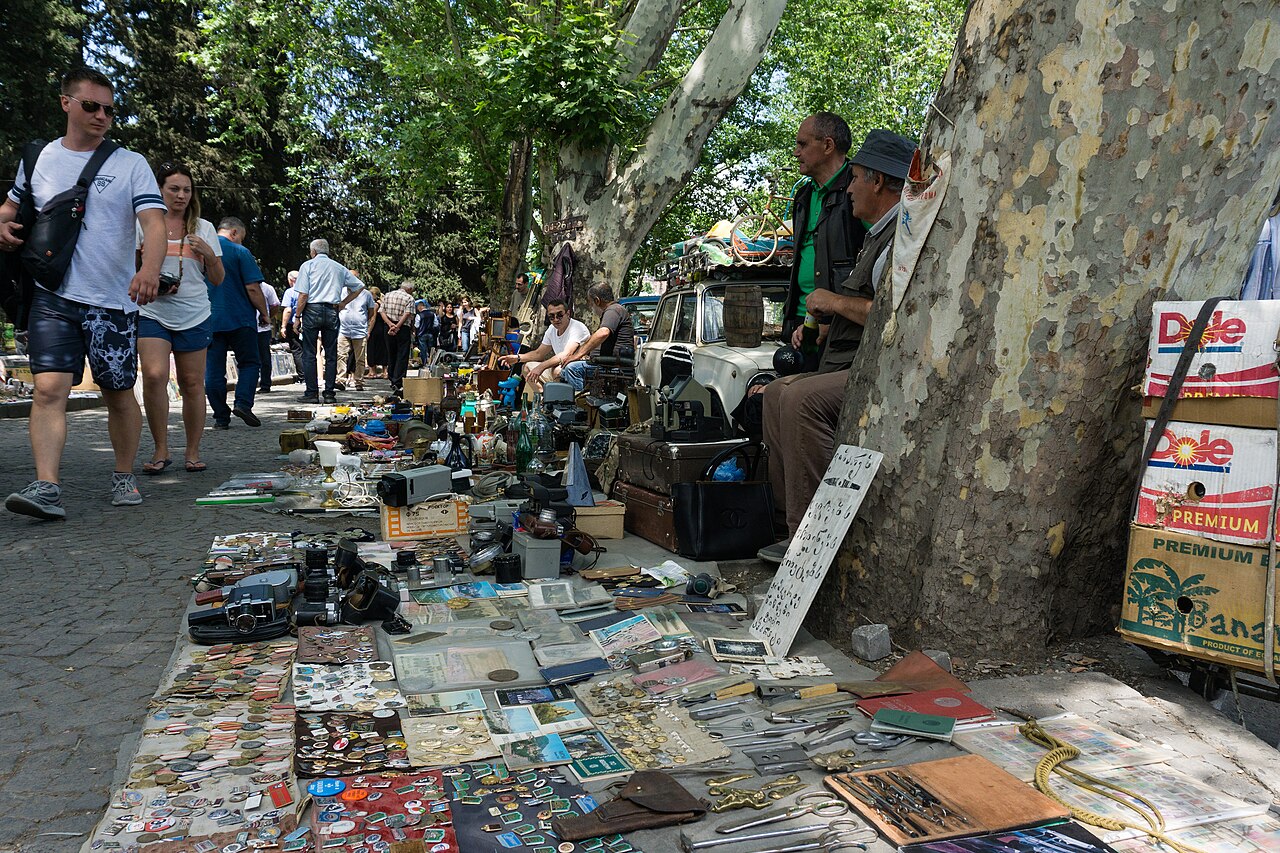
Spread out along a leafy stretch of pavement beside the Mtkvari River, the dry bridge market is Tbilisi’s most atmospheric open-air flea market, and one of the few places in the city where you can hold a piece of Soviet history in your hands before deciding whether to haggle for it. Vendors lay their wares straight onto blankets, folding tables and the low stone parapets near Dedaena Park: war medals, brass door handles, hand-tinted photographs, chipped porcelain and paintings still smelling faintly of oil. It is part antiques fair, part social club, part living museum. This guide covers what you will find, when to go, how to bargain without offending anyone, and how to tell a genuine bargain from tourist-priced filler.
Dry Bridge Market at a glance
- What it is: an open-air flea and antiques market that sprang up in the 1990s after the collapse of the Soviet Union.
- Where: along the pavement near the Dry Bridge over the Mtkvari (Kura) River, beside Dedaena Park, a 10 to 15 minute walk from Liberty Square metro.
- Hours: daily, roughly 10:00 to 17:00; late morning is best and weekends are busiest.
- Payment: mostly cash in small Georgian lari notes; very few sellers take cards.
- Best for: Soviet memorabilia, old cameras, coins, medals, silverware, jewellery, records, porcelain and original art.
What is the Dry Bridge Market?
The market takes its name from the bridge it clusters around. An arm of the Mtkvari River once cut a small island out of the riverbank here; that channel long ago dried up, but the “dry bridge” name stuck. Commerce of this kind would have been illegal under Soviet rule, so the market only appeared in the early 1990s, when Georgians began selling their own belongings on the street to make ends meet after the USSR fell apart. Soviet memorabilia was among the first things offered to foreigners, and it remains the market’s signature to this day. What began as necessity has settled into a permanent daily fixture, now maintained as public space by the city, according to Wander-Lush.
What you will find at Dry Bridge Market
The joy of the market is its sheer disorder. One blanket holds Lenin badges and Red Army medals; the next has vintage Zenit and FED cameras, brass samovars and tangled costume jewellery. Wander a little and you will turn up whole categories of curiosity.
- Soviet memorabilia: medals, pins, propaganda posters, old rubles, flags and caviar tins.
- Vintage cameras, wristwatches, typewriters, telephones and film reels.
- Coins, banknotes, stamps, matchboxes and other small collectibles.
- Silverware, cutlery, brass fittings, chandeliers and antique clocks.
- Jewellery, from Soviet-era pieces to filigree and amber.
- Porcelain, glassware, ceramics and the occasional nineteenth-century find.
- Vinyl records and stacks of old Georgian and Russian books.
- Genuine oddities: second-hand tools, sunglasses, medals of unclear origin and things you did not know you wanted.
Towards Dedaena Park and the surrounding green space you will also find local artists selling original paintings, Pirosmani-style reproductions, felted shawls, knitted socks and carved wooden crafts. For a wider look at what makes a good keepsake here, see our guide to the best souvenirs in Tbilisi.
When is the Dry Bridge Market open?
The market runs daily, generally from about 10:00 until 17:00, though hours are informal and depend on the weather. Heavy rain or snow keeps most vendors at home, so a clear day is essential. Aim to arrive from around 11:00 onwards, when the largest number of stalls are set up. Weekends, especially Saturday and Sunday mornings, are by far the liveliest, with the most vendors and the most seasoned collectors; a weekday visit will feel quieter and only half-full. If you want both the fullest selection and a calmer browse, a weekend late morning is the sweet spot.
How to haggle at Dry Bridge Market
Bargaining is expected here and part of the fun, but it is a friendly ritual rather than a battle. Vendors are famously relaxed and rarely pushy, so a smile and a little patience go a long way. As Atlas Obscura and local guides both note, this is primarily a tourist-facing market, so a “tourist tax” is baked into opening prices. A few practical habits help.
- Bring plenty of small-denomination lari; splitting a large note is often impossible and few sellers accept cards.
- Ask the price, then counter politely at roughly 50 to 70 percent and settle somewhere in the middle.
- A few words of Georgian, or Russian, often earns a warmer price than English alone.
- Never mock the item or the seller; walking away calmly is a fair negotiating move, but rudeness is not.
- Decide your top price before you start, and be ready to pay it in cash on the spot.
Good buys versus overpriced tourist stuff
The best value tends to sit in the genuinely old and slightly imperfect: tarnished silverware, mismatched porcelain, worn leather-bound books, brass instruments and dented cameras that clearly came out of somebody’s flat rather than a wholesaler’s box. Small Soviet pins, coins and postcards are cheap, packable and hard to fake convincingly. Handmade felt, knitted socks and original paintings from the artists near the park are also honest buys that support local makers.
Be more cautious with anything glossy, identical and stacked in quantity: mass-produced “Soviet” medals, shiny reproduction badges, generic magnets and souvenir trinkets are often marked up well beyond their worth. Very high-value claims, such as antique jewellery or “rare” military decorations, are hard to verify on the street, so buy those for the story and the look rather than as investments. When in doubt, judge the object on whether you would still love it at the price you actually pay.
Nearby: Saarbrucken Square, Dedaena Park and the art sellers
The market sits within easy walking distance of several worthwhile stops, so it slots neatly into a wider day out. Saarbrucken Square, just across the river, is ringed with cafes and bakeries, ideal for a coffee and a khachapuri before or after browsing. Dedaena Park, right beside the stalls, shelters a separate book market with vintage postcards, maps and a relaxed riverside cafe, plus the cluster of artists selling unframed canvases. From here it is a short stroll into the historic centre; pair your visit with our Tbilisi Old Town guide or slot it into a fuller itinerary of the best things to do in Tbilisi.
Practical tips for visiting
- Go on a dry day; the market thins out badly in rain or snow.
- Carry cash in small notes and keep it in a front pocket, as the crowds can be tight.
- Wear comfortable shoes; you will do a lot of slow, stop-start walking.
- Always ask before photographing a vendor or their table; a smile and a gesture is usually enough, and most are happy to oblige.
- Allow at least an hour, longer if you enjoy rummaging, and check any purchase you plan to fly home with for export or customs rules.
Frequently asked questions
Is the Dry Bridge Market open every day?
It trades seven days a week on an informal schedule, opening mid-morning and winding down around 17:00. Turnout collapses in bad weather, so pick a clear day; a weekend visit after 11:00 gives you the biggest spread of sellers.
Can I pay by card at Dry Bridge Market?
Almost never. This is a cash economy, so bring Georgian lari in small denominations. Few, if any, vendors accept cards, and change for large notes can be hard to come by, so plan your budget in cash before you arrive.
Is haggling expected at the market?
Yes, negotiating is a normal part of any purchase here. Sellers quote visitors a padded first figure, so counter at around half to two-thirds of it and meet in the middle, keeping the whole exchange light and friendly.
Can I take photos at Dry Bridge Market?
Generally yes, and the stalls make superb subjects. The etiquette is simple: get a seller’s nod before pointing a camera at them or their table. Nearly all will agree, particularly once you have bought something.
Last checked: July 2026. Opening hours and vendor turnout are informal and weather-dependent, so treat times as a guide rather than a guarantee.
Featured image: Alexey Komarov (CC BY-SA 4.0) via Wikimedia Commons.

Leave a Reply