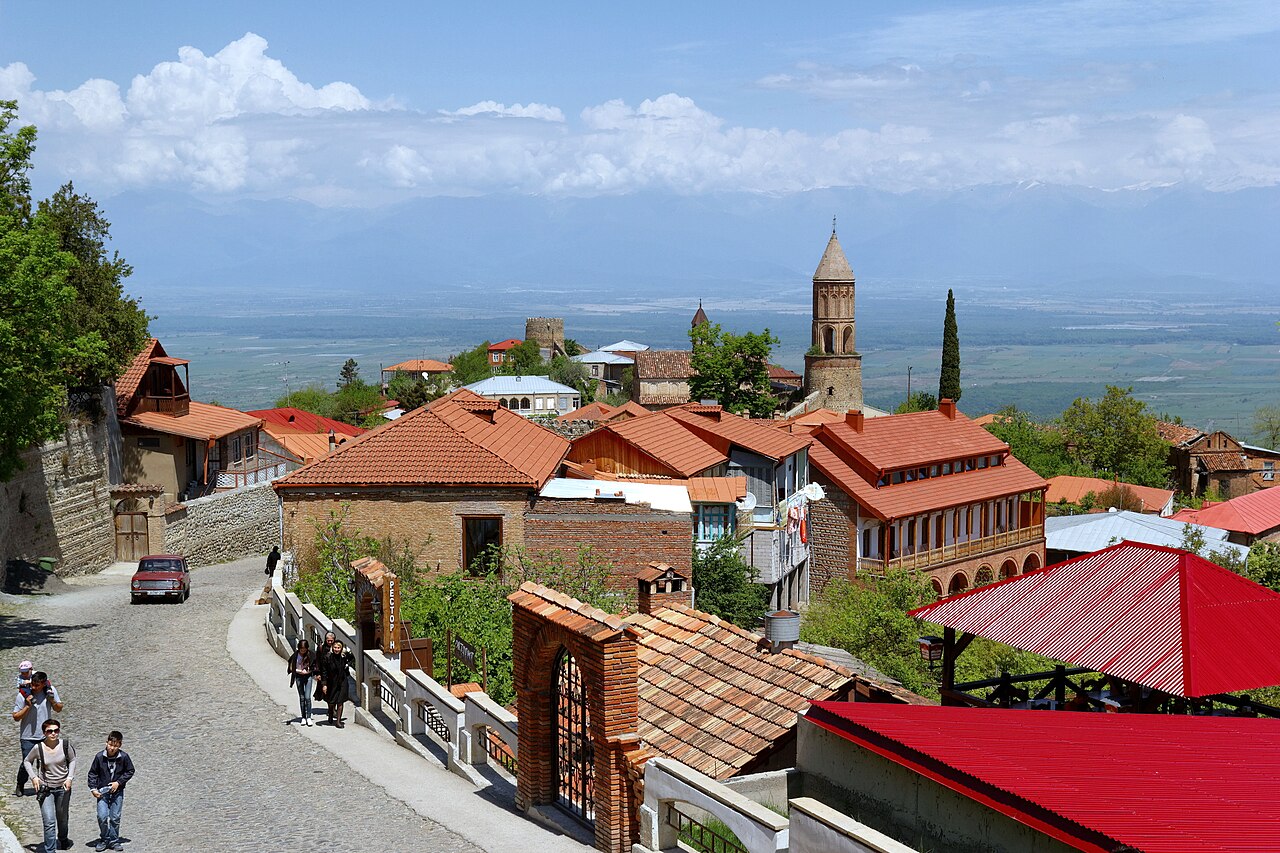
Sighnaghi is a small, heavily rebuilt hilltop town you can walk end to end in two hours. It is still worth the day, but for the Alazani valley behind it, the monastery below it and the cellars around it, not for the streets themselves.
The gap between the pitch and the place is unusually wide here. Georgia’s “City of Love”, the “Tuscany of the Caucasus”, the walled fortress town: that copy runs through every tour listing, and none of it prepares you for a town of about 1,420 people (the 2024 estimate on Wikipedia’s Signagi entry) with two commercial streets, one square, and a wall you can climb maybe two hundred metres of. Knowing that before you board the van turns the day from a mild letdown into a good one.
What the 2007 rebuild actually did
Almost every facade you will photograph in Sighnaghi is younger than the first iPhone. The town was the flagship of a state reconstruction programme launched in 2007 under Mikheil Saakashvili and co-funded by international lenders. Crews resurfaced the streets, re-roofed the centre in matching terracotta tile and replastered the house fronts along the main lanes.
What they mostly did not do was go inside. Georgian reporting at the time was blunt that facades and roofs were the scope, that houses were left half-finished behind the new paint, and that balconies were shedding their coats within eighteen months. Officials could not even agree on the cost: the district governor put it at 22 million GEL, Saakashvili at closer to 15 million.
You see the result the moment you step off the van: tidy, coherent and slightly flat, in the way of a place where every building was painted the same fortnight. Walk one street uphill from the square and the unrenovated version is right there, crooked wooden balconies and rusted tin.
Our advice: read Sighnaghi as excellent stage design rather than a preserved historic centre, and you stop waiting for a depth that is not coming. Nobody is being deceived. The town just gets described in language built for Dubrovnik.
What earns the trip
Four things, and only one of them is the town itself.
The view is the real attraction and it is not oversold. Sighnaghi sits on a ridge with the Alazani floor below it and the Greater Caucasus along the far side, snow on the tops into June. Mornings are hazy and you see little; by five the range comes out and the light goes gold. That alone argues for the later van out and the last one back.
Bodbe is the second, wine the third, with the caveat below. The fourth is the one nobody plans for: the Sighnaghi Museum holds around forty Niko Pirosmani canvases, the largest collection outside the national gallery in Tbilisi. Foreign tickets were reported at 15–20 GEL in August 2026, it shuts on Mondays, and it is the one indoor half-hour in town that pays off.
What does not
The “City of Love” branding is the weakest part of the package. It leans on the Pirosmani legend of a square filled with flowers for an actress, plus a marriage house that opened in 2007 and got famous for round-the-clock weddings. That 24/7 line is marketing memory now: the hall keeps daytime hours, and there is nothing to see unless a ceremony is running.
Skip the souvenir stretch too: the felt hats, drinking horns and churchkhela on Solomon Dodashvili Street come from the same suppliers as the stalls in Tbilisi Old Town, at higher prices.
And be careful with the phrase “wine town”. Sighnaghi sits inside Kakheti but makes almost nothing itself. The pours in the central cafes are tourist-priced glasses of bottled wine; the qvevri cellars worth an afternoon are down in the valley, which is a driver-and-a-plan problem, not a wander-and-see one.
The wall walk, honestly
Here is the number that reframes it. The fortification Erekle II ordered in the 1770s runs about 4.5 km and encloses some 40 hectares, with 23 towers and 6 gates, each tower built and named by a different Kiziki village. About four of those kilometres are closed. What visitors walk is a restored stretch at the top of the centre with two climbable towers, and it takes thirty to forty minutes with photographs.
Go anyway, and go up a tower: the rampart is the one spot where valley, wall and roofs line up in a single frame. Just do not budget an afternoon for it. The stairs are uneven, some stretches have no railing, and the stone is slick after rain.
Bodbe, the part people underrate
Two kilometres outside town, down a cypress alley, sits the convent over the grave of St Nino, the woman credited with converting Georgia in the fourth century. It is a working nunnery, free to enter, open daily 09:00–19:00 April to October and closing an hour earlier in winter.
It is quieter, older and more intact than anything inside the walls, and group tours give it a rushed twenty minutes. Give it an hour. Shoulders and knees covered, headscarf for women, wraps lent at the gate.
Below the church a stepped path drops around 800 metres to a chapel over St Nino’s spring, where pilgrims immerse themselves in a plain white shirt you can borrow on site. The descent is easy, the climb back in August heat is not. Add an hour, or skip it when the day is tight.
A taxi from the square is about 10 GEL each way and most drivers will wait. Walking takes half an hour, along a road with no pavement for part of it.
How long you actually need
Add it up. Two hours for the streets and the square, forty minutes for the wall, an hour at Bodbe, half an hour with the Pirosmanis and an unhurried lunch: about five hours on the ground. That is the honest figure.
The standard ten-hour group tour is four of those hours in a vehicle plus a fixed winery stop. Independently, there is no reason to leave Tbilisi at seven: take a mid-morning van, be in Sighnaghi by lunch, and use the afternoon light on the ramparts before you head back. What will not fit alongside the wall, Bodbe and a proper meal is two cellars.
Getting there without overpaying
The commonest mistake is going to the wrong bus station. Sighnaghi marshrutkas do not leave from Didube. They go from the Navtlughi terminal beside Samgori metro on the eastern edge of the city, in the second, smaller car park after the metro exit, with some vans and taxis also gathering outside Isani. Ticketing and etiquette are the same everywhere in Georgia, so our Didube marshrutka guide carries over unchanged.
- Marshrutka — around 15 GEL, 2 to 2.5 hours. From Samgori at 09:00, 11:00, 13:00, 15:00, 17:00 and 18:00, plus an extra 07:00 van in summer; back from Sighnaghi at 07:00, 09:00, 11:00, 13:00, 16:00 and 18:00. Vans go when full, so arrive 30 minutes early on summer weekends.
- Shared taxi from Isani — 25 to 30 GEL a head, departs once four passengers are aboard, 1.5 to 2 hours.
- Private driver — from about 170 GEL round trip, which beats a group tour on price for three or four people and lets you add cellars.
A fare caveat: Wander-Lush’s route guide, checked August 2026 still lists 10–12 GEL one way, but intercity minibus prices rose across Georgia after the May 2026 fuel increases and 15 GEL is the figure travellers report. Carry small notes; drivers rarely have change for a 50. For how this compares with the rest of the shortlist, see our day trips from Tbilisi roundup, and note that Mtskheta is 45 minutes out, not two and a half hours.
Overnight, or pair it with cellars?
Our advice: do not overnight unless you are carrying on deeper into Kakheti the next morning. Every travel site recommends the night, on the theory that the town transforms once the buses leave. It half does. The square empties and dusk on a guesthouse terrace is the best hour of the day, but five or six restaurants stay open and that is the entertainment. Stay if the plan is Telavi or Tsinandali tomorrow.
The better pairing is wine. Sighnaghi plus two cellars is a full day, and the town stops having to carry it alone; our Kakheti wine tour guide covers how to build that day and what a tasting should cost. Either way, set an alarm for 17:30. The last van back is the 18:00, and missing it costs 100 to 120 GEL in a private car.
Frequently asked questions
Is Sighnaghi worth visiting?
Yes, but for the setting more than the town. The Alazani panorama, Bodbe convent and the cellars nearby justify the ride; the restored centre is charming and takes two hours.
How many hours do you need in Sighnaghi?
About five hours on the ground covers everything without rushing: two for the streets, forty minutes on the wall, an hour at Bodbe and a long lunch. Group tours run ten hours door to door because four of those are driving.
How do you get to Sighnaghi from Tbilisi by public transport?
Take a marshrutka from the Navtlughi terminal next to Samgori metro, not from Didube. It costs around 15 GEL and takes two to two and a half hours, with departures every couple of hours from 09:00. Shared taxis at Isani cost 25 to 30 GEL a head.
Is Sighnaghi old or was it rebuilt?
Both. The fortress wall dates from the 1770s, but the house fronts, roofs and cobbles in the centre were rebuilt in a state programme that began in 2007, and that work covered facades and roofs rather than whole buildings.
Featured image: Alexxx1979 (CC BY-SA 4.0) via Wikimedia Commons.

Leave a Reply