Those round, looping letters on the shopfront are Mkhedruli: the everyday Georgian alphabet, 33 letters, no capitals, and no relation to Latin, Cyrillic or Greek. It is one of three Georgian scripts still alive, and it is the only one you will meet on a bank door, a menu or a metro sign.
You don’t need all 33 to stop feeling illiterate. Around a dozen letters carry the words a traveller actually has to read, and those words are shorter than the tangle of curves makes them look. Ten minutes here and you’ll pick out bank, pharmacy, bakery and exit from across the street.
Three scripts, and you only need the third one
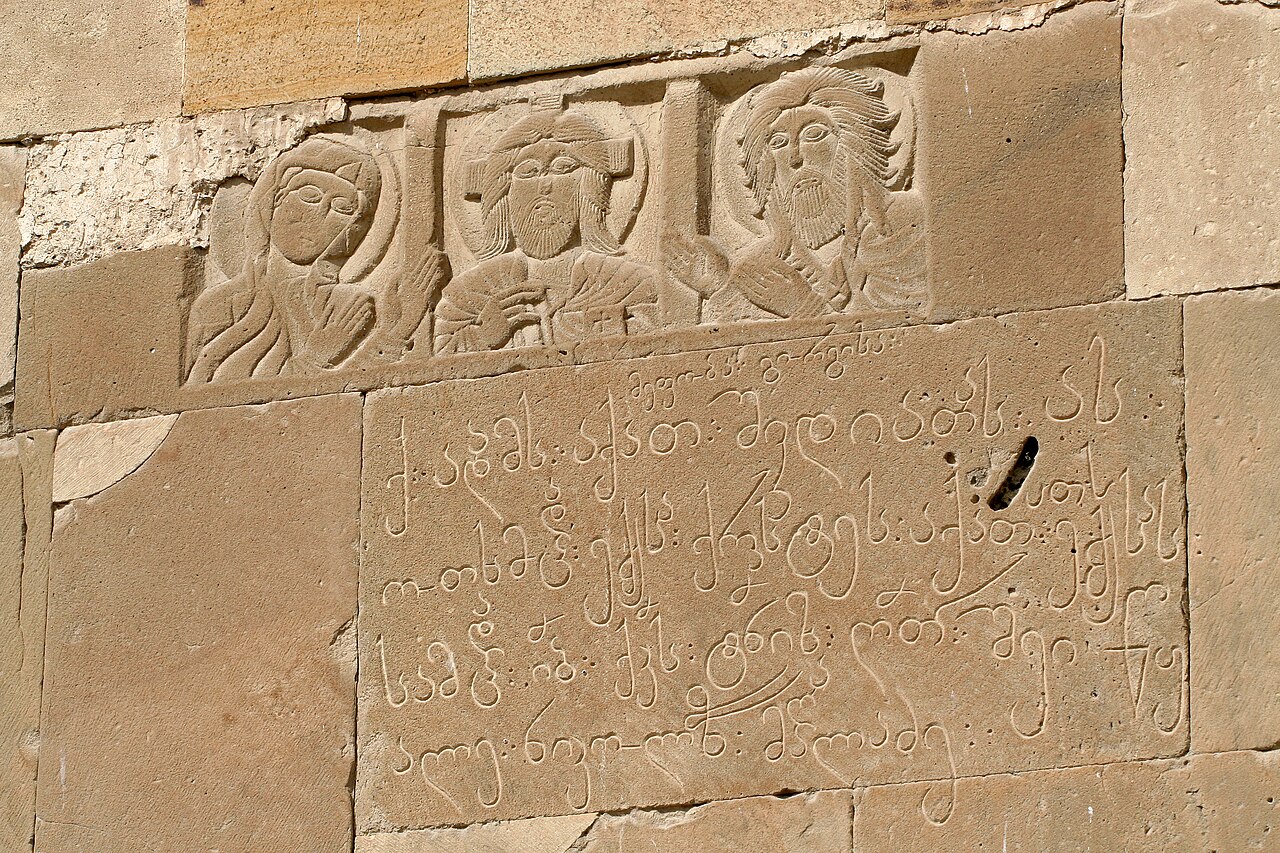
Georgian has been written three different ways, and all three are still in use. Asomtavruli (also called Mrgvlovani, the rounded one) dates from the 5th century and survives in the oldest inscriptions anywhere in the language, at Bir el Qutt near Bethlehem around 430 AD and at Bolnisi Sioni around 494. Nuskhuri appeared in the 9th century as a cramped, slanted book hand for monastic copying. Mkhedruli arrived in the 10th century for royal charters and secular business, and printing pushed it into total dominance during the 19th century, according to the reference summary of the three scripts.
So the two older scripts didn’t die. They moved into church.
Asomtavruli is what’s carved above monastery doorways and painted onto icons, and it’s what a wine label or a restaurant fascia borrows when it wants to look ancient. Nuskhuri lives in psalters and hymn books. That coexistence is precisely what UNESCO recognised when it inscribed the living culture of the three writing systems on the Representative List in 2016, noting that the church community keeps the two older alphabets in daily practice while the school system runs entirely on Mkhedruli (UNESCO inscription file, checked September 2026).
Our advice: ignore the two older scripts completely. Language schools in Tbilisi love to show all three in the first lesson and it’s a lovely bit of history, but it doubles the visual noise in your head for zero practical return. Learn Mkhedruli. Admire the rest.
One number worth carrying: the alphabet had 38 letters until 1879, when the Society for the Spreading of Literacy among Georgians dropped five that had stopped doing any work.
There are no capital letters
Mkhedruli is unicameral. Proper nouns, sentence openings and ordinary words look identical, so one of your strongest reading habits is useless here: you can’t scan a page and find the place names by their capitals.
There is a wrinkle. A set of squared-off forms called Mtavruli is used the way English uses ALL CAPS, on shop fascias, headlines and street signs, and Unicode only encoded them properly in 2018. They are the same 33 letters with the loops flattened and the ascenders and descenders trimmed to a single band. The practical effect is that a café’s sign outside and its menu inside can look like two different alphabets to a beginner. They aren’t.
Eight words that do most of the work
Signs, not letters, are what you’re actually decoding. Start with whole shapes and let the letters arrive on their own:
- ბანკი — banki — bank. The cash machine on its wall is ბანკომატი, bankomati.
- აფთიაქი — aptiaki — pharmacy. Long, spiky, and lit green in most Tbilisi streets. The one word here worth learning to recognise instantly.
- საცხობი — satskhobi — bakery. Also look for პური, puri, bread.
- მეტრო — metro. Short, and the closest thing to a freebie in the language; the second letter ე is an e and ო is an o.
- გასასვლელი — gasasvleli — exit. Its opposite is შესასვლელი, shesasvleli, entrance. They differ only at the front, which is a genuinely annoying design.
- ღია — ghia — open. დაკეტილია or დახურულია — daketilia, dakhurulia — closed. Both are common on door cards.
- ხინკალი — khinkali — the dumplings.
- ხაჭაპური — khachapuri — the cheese bread. Notice both start with the same letter, ხ.
If you want the spoken versions to go with these, our Georgian phrases for travellers page has the ones that get answered, and the menu vocabulary sits in how to order Georgian food.
The letters hiding inside those words
Here’s the single most useful pattern in the whole script: almost every Georgian noun in its plain dictionary form ends in ი, a bare vertical stroke, the letter i. Banki, bankomati, aptiaki, satskhobi, khinkali, gasasvleli. Once you can see that stroke you can see where words end, and a wall of script turns into a list of things.
The vowels are the other quick win, because there are only five and they turn up constantly: ა (a), ე (e), ი (i), ო (o), უ (u).
Then the workhorse consonants that appear in nearly every sign you’ll read: ბ (b), გ (g), დ (d), ლ (l), მ (m), ნ (n), რ (r), ს (s), ტ (t), კ (k). Add ხ (kh) and ღ (gh) and you have the dozen that matter.
Two pairs will catch you out, both times because the difference is one small tail. უ (u) and ყ (q) sit on nearly the same frame. So do ო (o) and ღ (gh). Look at the bottom of the letter, not the top.
The sounds English speakers get wrong
Georgian has six ejective consonants, and English has none, which is why your khinkali order sometimes lands as a blank stare. An ejective is made by closing the throat and popping the air out of your mouth rather than pushing it from your lungs. It sounds clipped, almost like a click glued onto the consonant.
The six are კ, პ, ტ, წ, ჭ and ყ. Each has a breathy twin that English speakers produce by default: ქ, ფ, თ, ც and ჩ. To a Georgian ear these are as far apart as b and p are to you, so the substitution isn’t a small accent thing, it changes words.
Three specific sounds, in rising order of difficulty. ხ is the ch in Scottish loch, which most people manage on the second try. ღ is a Parisian r, made at the back of the throat and voiced. ყ is the hard one, an ejective made far back where you’d gag, and it has no English neighbour at all.
Then the consonant clusters, which are the reason written Georgian looks longer than it sounds. მცხეთა, the old capital half an hour north of Tbilisi, opens with m-ts-kh before it reaches a vowel. Say the consonants fast and flat rather than trying to squeeze vowels between them; the vowels aren’t there and Georgians don’t hear them.
Why one street has three different Latin spellings
Because there are three competing systems for writing Georgian in Latin letters, and no sign painter is obliged to pick one.
ISO 9984 came first, in 1996, and uses accented letters for scholarly precision: ღ becomes ḡ. Georgia’s own national system followed in February 2002, from the State Department of Geodesy and Cartography together with the Institute of Linguistics, and it marks the ejectives with an apostrophe instead: კ is k’, ტ is t’, პ is p’, while their breathy twins ქ, თ and ფ get plain k, t and p. BGN and PCGN adopted that same national scheme in 2009, so international maps and Georgian street signs should agree (the working-group romanization table).
They don’t, and the reason is mundane: nobody bothers with the apostrophes. Drop them and two distinct Georgian letters collapse into one Latin letter, so a name can be transcribed correctly by two different people and come out differently. Add older Russian-era spellings still baked into some map data and you get a street that is Vaja on one sign, Vazha on another, and Važa in a guidebook.
What to do about it: search maps on the first three or four letters plus the district, never the full spelling, and when you’re given an address by a Georgian, ask them to send it as a pin. Station names have the same problem, which is worth knowing before you use the Tbilisi metro and try to match a Latin name on your phone to Mtavruli letters on a platform wall.
Frequently asked questions
Is the Georgian alphabet like Russian?
No. Cyrillic and Georgian share no letters and the languages aren’t related; Georgian belongs to the Kartvelian family, which has no relatives outside the Caucasus. Knowing Cyrillic gives you nothing here. Russian still works with many older Georgians, but it lands badly with some, and English is the safer opener under about 40.
How long does it take to learn to read Georgian?
Sounding out the full 33 takes most learners a few focused hours spread across a week, because the script is a clean one-letter-one-sound system with no silent letters and no spelling exceptions. Reading at any speed is a different job and takes months. For a two-week trip, the dozen letters above are the honest target.
Are signs in Tbilisi in English?
In the centre, mostly yes: metro stations, main streets and anywhere serving visitors carry Latin script alongside Georgian. It thins out fast. Neighbourhood bakeries, pharmacies outside the tourist grid, marshrutka destination boards and handwritten door notices are Georgian-only, and door notices are exactly where the words for open and closed matter.
Can my phone camera translate Georgian script?
Google Lens handles printed Mkhedruli well and gives you the sense of a menu in seconds. It struggles with two things you’ll hit constantly: decorative Mtavruli on fascias, and handwriting. A chalkboard listing the day’s dishes will defeat it, which is the case for knowing a few words yourself. If you’re scanning menus for what you can eat, our vegetarian and vegan guide to Tbilisi lists the dish names in both scripts.
One last word for your list, and it’s the one that pays best: თონე, tone, the clay oven bread is baked in. The good bakeries in Tbilisi don’t bother with a shopfront at all. You get a doorway below street level, three steps down, a stack of hot flat loaves on a wooden counter, and that single word painted on the wall. Learn to spot it and you’ll eat better than the signs suggest.
Featured image: Alix Kroeger from Brussels, Belgium (CC BY-SA 2.0) via Wikimedia Commons.




Leave a Reply